
SEO Tricks You Need to Make More Money With Your Writing
SEO writing made simple with these tips and tricks for your article writing

If you want to make money with your writing, SEO isn’t just an option, it’s a pertinent tool to learn and use to leverage your skills to potential clients. If they want SEO-optimized work for their sites, it is up to you, the writing professional, to deliver. Also, if you are writing for a blog or content site, SEO gives your work a leg up in a very competitive field.
Today I’ll cover keywords, metadata, and a bit about article organization so you can get your SEO on!
So let’s get into this SEO mystery, shall we?
Table of Contents· What Is SEO?
· First, Let’s Talk About Those Keywords
∘ SEO Is More Than Plugging Keywords
∘ Keyword Stuffing
∘ Finding Keywords
∘ Keywords vs Long-Tail Keywords
∘ Stop Words
· Metadata
∘ What Is Optimal for Metadata?
∘ How Do You Set the Metadata for Medium Articles?
· Article Organization
∘ Length of Your Articles
∘ Structure of Your Articles
· Sample Structure for an SEO Article:
∘ SEO Optimization Helps Your Work to Be SeenWhat Is SEO?
SEO refers to search engine optimization. It is a way of optimizing your articles so they can compete with other articles on similar topics and appear more aggressively at the top of search engine pages. For example, if you are writing about dog sitting, and a potential reader searches on Google for topics about dog sitting, the phrases they use to search are what brings them to your article. These are called keywords and long-tail keyword phrases. Knowing how to use these within your article, how often, and where to place them is key to creating content that more people will see on Google and other search engines.
Over 94% of people who use Google only look at the first page of search results, and most people only click on the first three results. 83% of people worldwide use Google, but this concept applies to every search engine. So what do you do if your small business website appears on the 12th page of results instead of the first page? Search engine optimization, or SEO, is the process of increasing your site position and page rank organically through quality backlinks and effective keywords. SEO is the most effective way to increase traffic to your website. — Bluehost
First, Let’s Talk About Those Keywords
Keywords are everything when it comes to SEO. Many people use keywords but don’t necessarily know how to use them efficiently and with a more targeted approach.
SEO Is More Than Plugging Keywords
Putting keywords into your article will help, yes, but there’s more to it than that. Here are some tips for putting keywords into your articles:
- Make sure the main keyword is in your title, and near the front of your title.
- Put the main keyword into a few of your H1, H2, and H3 tags (these are the headers in your article.)
- Put a few supportive keywords into your H1, H2, and H3 tags
- Use both your main keyword and supportive keywords sprinkled organically throughout your article.
- Use the main keyword in the first 100 words of your article.
- Use the main keyword in the last 100 words of your article.
- Decorate one of your keywords toward the beginning of the article. This means to bold or italicize. Like this: dog sitting, dog sitting
Keyword Stuffing
Using far too many keywords so that your article does not read fluidly is called keyword stuffing. This will hurt the performance of your article. The trick is to use keywords in such a way that the reader does not feel you are repeating yourself or throwing certain phrases in just for rankings.
Finding Keywords
Before you begin your article, consider which keywords you will use. There are several ways you can do this and I’ll focus on the free methods.
First, you can go directly to a Google search page and type in different words that have to do with your topic. Make note of which words and phrases auto-populate as suggestions. These are various combinations of keywords. For example for dog sitting I may find:
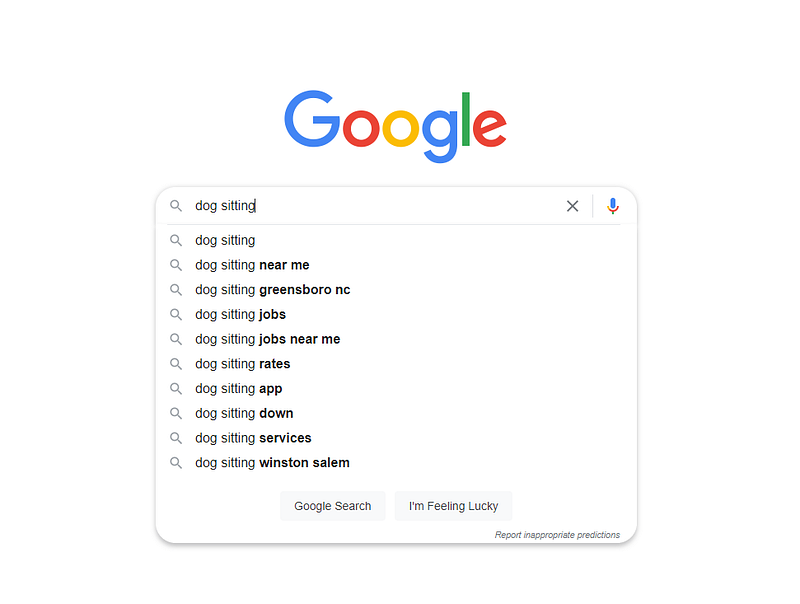
On this list I may choose:
- dog sitting
- dog sitting app
- dog sitting services
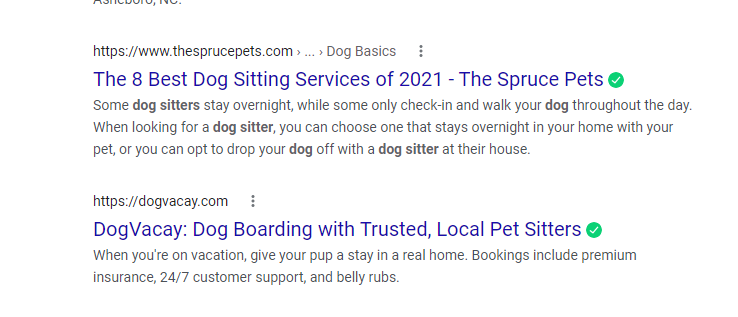
When you select “dog sitting” and the search results appear, you will see ads at the top, followed by maybe some local stories but the top-ranking articles will appear near the top.
Another way to find keywords is to use a free tool such as Wordtracker. The same search there provides me with this:
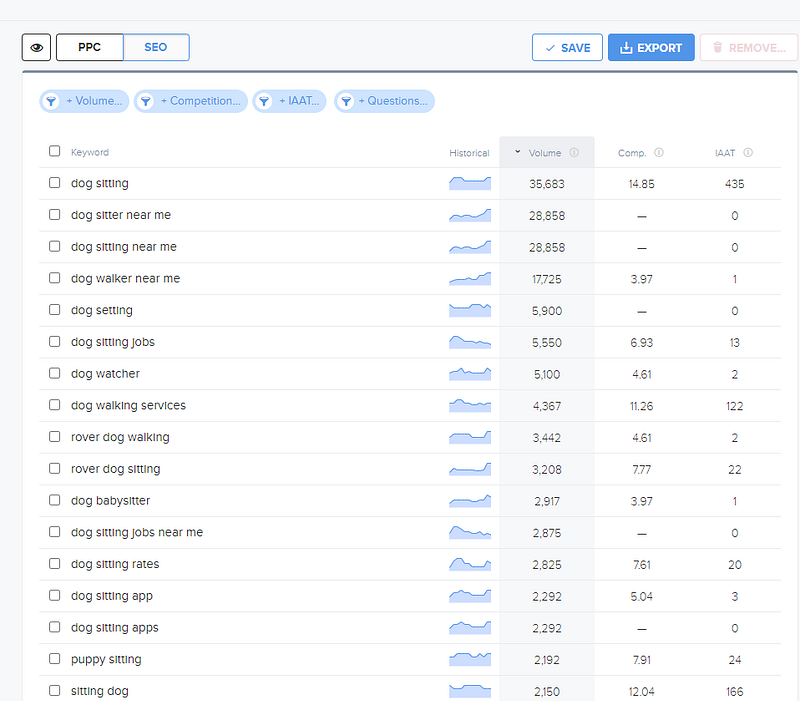
Here I may choose a few more to focus on and add them to my keywords list for my article. I usually choose 1 as the main focus, then 2–10 as supportive keywords or long-tail keyword phrases.
The numbers next to the keywords are important. A higher search volume means the keyword is popular — and you will have loads of competition trying to rank for those keywords. The lesser searched ones, inversely, will have less competition. I try to use some of both in my articles.
Keywords vs Long-Tail Keywords
Keywords are typically one, two, or three-word phrases that feel like “topics.” Long-tail keywords are longer, more detailed, more specific, and sometimes quite awkward.
Long-tail keywords are phrases that pop up due to the searching habits of people. Most people will not simply type in “dog sitting.” They will type in what they are looking for:
“dog sitting nightmares”
“dog sitting jobs for teenagers”
“how much money can you make dog sitting?”
“is dog sitting ok?”
Take a look again at some of the suggestions on Wordtracker:
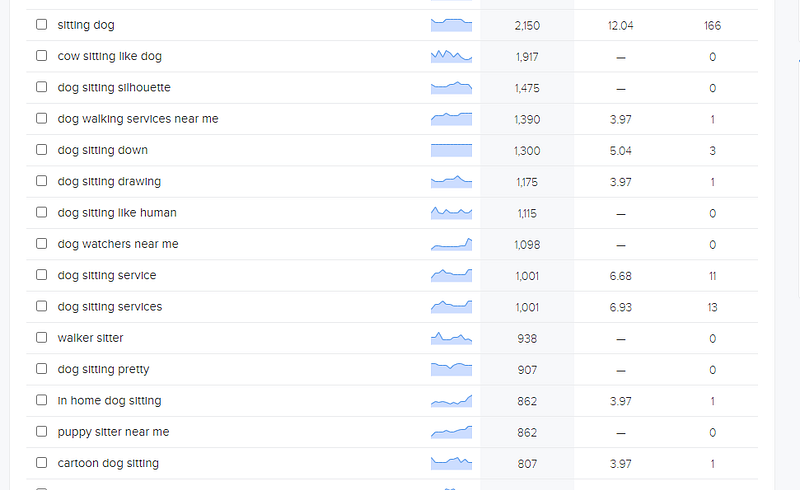
Note that phrases such as “dog sitting pretty” and “dog sitting down” show up, with less search volume, and even though this may not be the actual direction of your article, there may be times you’ll need to work in supportive keywords like this to lower the competition your article will face.
This brings us to stop words and one other SEO keyword trick you’ll want to know.
Stop Words
There are two tricks to making these awkward keyword phrases work. One, include stop punctuation, and two, include a stop word.
Some punctuation, like a period, and some words like “and, the, your, this” are ignored by the Google analyzer. Therefore you could try something like (bold is there to show the keyword phrase):
“ ….when you are dog sitting. Pretty doggie smiles make your day!”
“…because when I am dog sitting their pretty faces make it all worthwhile.”
Metadata
Let’s take a look again at the screenshot from search results before.
Metadata are those words that appear underneath the title of the article. If you do not set the metadata for your article, these words will be a conglomerate jumble of your subtitle and your first words of the article.
What Is Optimal for Metadata?
Metadata should:
- Tell readers EXACTLY what your article is about.
- Include your main keyword and optimally a supportive keyword or long-tail keyword phrase.
- Be (optimally) 155–160 characters.
How Do You Set the Metadata for Medium Articles?
Go into your Medium editor and use the three dots drop-down menu to find more settings. Select this option.

Choose from the menu on the left: SEO settings.
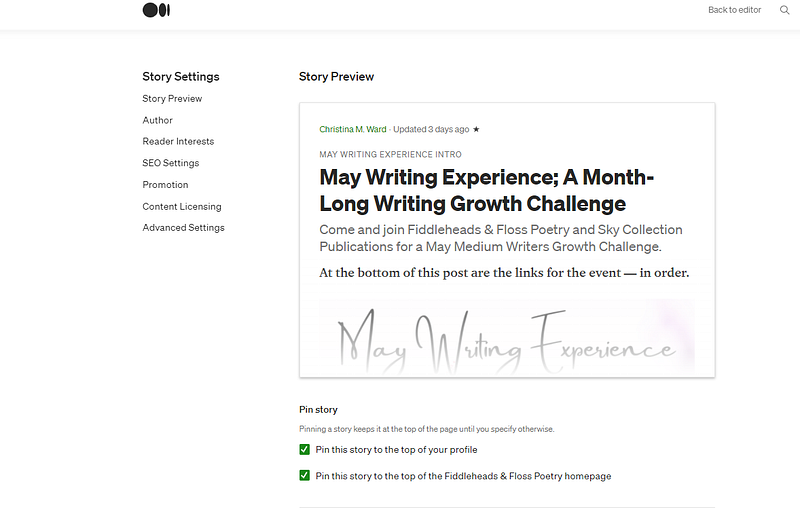
As you can see, I edited the SEO description (this is the metadata) to show what my article is about, but the red number indicator shows me it is a little long at 185 characters. For better performance, I could go in there and tighten up the metadata and add more focus on my keyword usage.
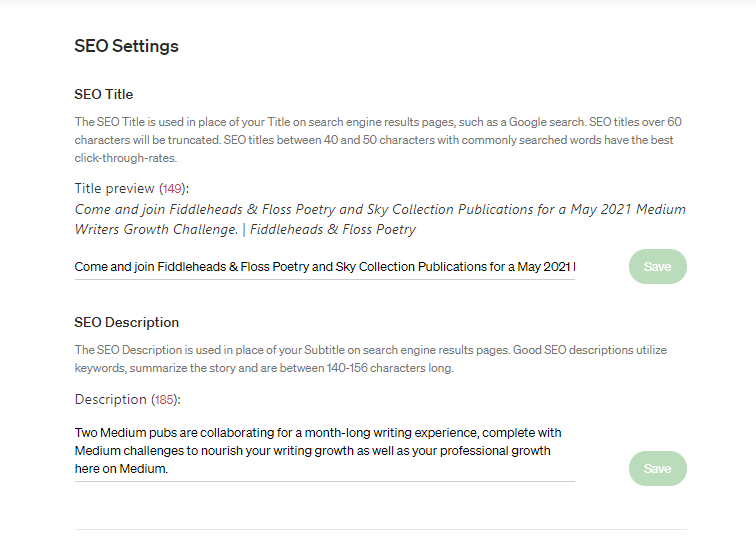
You should edit the metadata for every single article, even if you have not opted to use SEO in your article.
Article Organization
Another factor in SEO is to optimize the length and organization of your articles. In general, longer and more well-organized articles — that deliver what they promise in the intro — perform the best. Let’s take a look at the length and organization of your SEO articles.
Length of Your Articles
If you are writing articles 500–800 words, even 1000 words, you are likely struggling to get them to rank on Google. This is because Google ranks longer articles first. The optimal word count for a good SEO article will be around 1800 words to 3000.
Neil Patel has some great data on the specifics of word counts in his article How Long Should Your Blog Articles Be? (With Word Counts for Every Industry)
Structure of Your Articles
Longer articles perform well but the structure of your article also matters. More recently, preference for structure has shifted toward longer articles with more than one H1 section with H2 subheadings, almost like mini-essays within a larger context. Recently I presented 3 outline templates and these were designed with SEO preference in mind.
Generally speaking, your articles should:
- Have subsections that “stack” as demonstrated in the 3 outline templates referenced above.
- Have adequate white space.
- Have a clear introduction that adequately defines the article.
- Have media (pictures, etc.) in pertinent portions of the article.
Sample Structure for an SEO Article:
- Your article title with pertinent SEO keyword at the beginning of the title.
- Introduction: Be clear about what the article will include. Be concise and include your keyword in the first 100 words.
- H1 heading with keyword Small intro to the section
- H2 heading with keyword or supportive keyword Paragraphs with sprinkled-in keywords and supportive keywords
- H2 heading with keyword or supportive keyword Paragraphs with sprinkled-in keywords and supportive keywords
(Repeat #3,4,5 for each of your sections.)
- Conclusion: Summarize the H1’s. Be concise and include your keyword in the last 100 words.
SEO Optimization Helps Your Work to Be Seen
SEO optimization for your articles will give you a greater chance to get your work seen by the most interested viewers. Rather than leaving the hopes of finding readers to the algorithms, learn a little about how you can enhance your writing with these targeted tools. Thank you for reading this article today and the author wishes you all the best with your writing.