
14 Nonprofit Sustainability Hacks For (Un)common Times
Stop competing for resources and start attracting them instead.

To be sustainable means growing resources- not depleting or permanently damaging them. So how does a nonprofit assure it’s around for the long haul?
❶ Bring people together.
Think of your greatest resource-your people-as water. Water can sustain us but is toxic when stagnant.
Bringing people together to move toward a shared purpose is a powerful process. It is more important to sustainability than raising funds. Money is part of the harvest-not the tilling of soil or planting of seeds. Attracting, appreciating and growing human capital is the true foundation of sustainability.
❷ Map momentum for all to see.
Your nonprofit is moving closer to or further away from its vision. Be careful separating temporary setbacks from fundamental sea changes though.
🌠 Areas that Decorate enrich and elevate your organization toward its vision.
🌠 Durable areas are long-lasting and offer a dependable foundation.
💣 Areas of Decay are rusting out and showing signs of decline.
💣 Death is indicated in areas where activity has ceased.
When the trend in momentum moves down this spectrum towards death, a death spiral is forming.
“Death is not the greatest loss in life. The greatest loss is what dies inside us while we live.” ~Norman Cousins
❸ Diagnose cash flow issues.
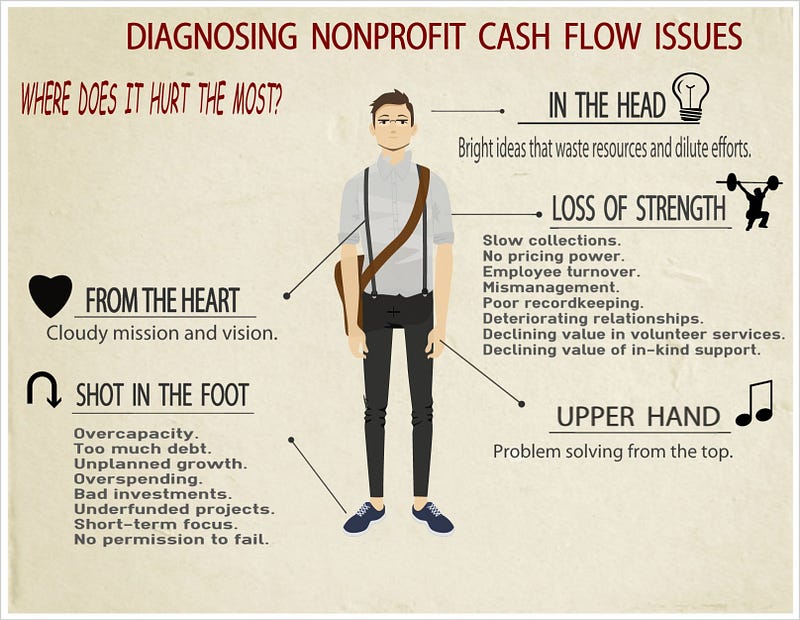
❹ Be contagious and go viral.
A nonprofit whose people genuinely crackle with electricity demonstrates faith. Going viral can quickly attract resources. Do what it takes to make your charity’s mission and vision infectious.
❺ Put faith into action.
I had the opportunity of brainstorming with Luis Antonio Pichardo to get his insights on faith. Luis is a Poet/Artist, and the dynamic Founder/Executive Director of DSTL Arts, a nonprofit arts mentorship organization that inspires, teaches and hires emerging artists from underserved communities, primarily serving the communities of South and East Los Angeles. Here is what Luis shared with me.
Where do you draw your own faith from Luis and how do you let that shine through to donors?
Generally, I draw faith from my spiritual beliefs, in that, I know in my heart that what I hope to achieve through DSTL Arts is an act of goodness and an act of empowerment for the community I come from. Having grown up within the poverty cycle, and being told that my dreams were capable of becoming reality in spite of my circumstances, I clearly understand the challenges and cultural barriers that our students must confront in their own lives in order to succeed, and this unique insight helps me relate the importance and power of our Arts Mentorship Program to supporters. In my experience, when we speak from an informed space, our message can become more clear and inspiring for those who have potential of becoming allies in our community.
What made you think DSTL Arts could inspire at-risk students to be more than just “starving artists”?
The idea of the “starving artist” comes from a lack of understanding how artists function in society. Los Angeles is the creative capital of the world. With 1 out of every 7 jobs in Los Angeles County being tied to the Creative Economy, it is very clear to us that DSTL Arts can help guide the next generation of the creative workforce. Our program was developed from the idea that arts programs are capable of doing more than just giving students a medium for expression. Our program was developed to train and teach students in a social entrepreneurial form. We give our students the tools for expressing their voices artistically as well as economically. We empower them to accept their artist identity and to parlay that into a possible career within the creative workforce of Los Angeles and the world.
Why do donors have faith in DSTL Arts?
Our donors recognize the power of social and economic empowerment, it seems. The people who donate materials and other in-kind donations value the work of our students. They recognize the quality of their artistic work. The supporters who give monetary donations tend to share with us that they believe in our vision of empowering our youth and our community. Their support seems to come from an ideological source that is inspired by the actual work we do with our students. It’s the testimonials of our students that inspire faith in our cause.
What do contributors need to see, feel, hear or believe before you can ask them for help?
In many ways, the people who support DSTL Arts do so through direct or indirect interaction with our students. When a potential contributor sees the fruits of our students’ labor (i.e. a poetry chapbook, a photographic series, a work of fine art, etc.) they recognize the value of the artwork and the voice of our students. However, when that is compounded with our students’ articulation of their career and educational goals, and how DSTL Arts has inspired them to pursue those goals through the entrepreneurial training we are providing them, it brings home the idea in contributors’ minds that our program is truly changing lives. Whether it be a video posted to our YouTube page or the photos we post regularly to our Twitter and Facebook pages, our supporters get to experience the impact DSTL Arts is making in the lives of our youth.
Please walk me through the step-by-step process of how you built that faith in your mission.
The refining of our mission statement came thanks to the branding and marketing expertise of one of our board members, L.J. Fogel. With her vast knowledge of marketing and branding strategies, we were able to develop a concise and clear mission statement that we feel represents our goals. In addition to a mission statement, we also created a vision statement that is more ideology-driven. This vision statement helps us answer the question of why we believe in what we’re doing as an organization. This provides motivation for us which we then articulate through our social media posts and presentations.
And how will you continue to strengthen that faith going forward?
The faith we have in ourselves and our mission will continue to grow through our actions. The measurable outcomes that we set for ourselves as an organization will prove that our endeavor is worth funding, supporting, and growing. We see the results of our Arts Mentorship Program everyday in the students we work with, and it is our responsibility to present this growth in our students to the larger community. We recognize that our shareholders are much more than our students and their families: our shareholders are the entire community of Los Angeles, which will benefit from the personal and professional development our students experience through our Arts Mentorship Program.
❻ Bring your budgeting process back to life.
Facing the difficulty of balancing a budget year after year can result in a process driven by fear. This blinding of vision is accentuated when the nonprofit remains focused on earlier years financial struggles. Abandon a view of budgets as control and compliance monsters.
Preparing an Opportunity Budget can release financial fear and shift the focus from just surviving to thriving.
An Opportunity Budget seeks to discover and capitalize upon timely, favorable circumstances. That means always keeping your feet on the ground and your nose in the air.
“Opportunity dances with those already on the dance floor.” ~H. Jackson Brown, Jr.
❼ Stop obsessing with industry norms.
That’s the road to mediocrity followed by lightweights.
Instead, blaze new paths and redefine industry benchmarks.
Which leads to our next hack.
❽ Embrace a spirit of Internal Outreach.
If there’s one thing I find disappointing, it’s a nonprofit that settles for mediocrity. Focusing on the headache of the day means fewer opportunities to reach for the stars. When the most trivial matters keep getting raised to the top of the heap, the big fish don’t get fried.
It’s time for your nonprofit to quit stomping on ants. Disengage and become an ELEPHANT HUNTER.
Now here’s the one thing your best employee may not tell you.
“I want to help advance the mission but you won’t let me.”
Shift your focus away from less important matters to bagging the big game. And, if your results are really good, your nonprofit will captivate the attention of 5 star employees, volunteers and donors too.
Embrace a spirit of Internal Outreach.
Internal Outreach is concerned with elevating your nonprofit to the next plateau. It’s a continuous journey with milestones but no destination. There is a laser focus placed upon activities within the organization.
Internal Outreach concentrates primarily upon people, processes, ideas and opportunities. Getting better means surpassing conventional limits to raise the bar of performance.
Signs of building resiliency are very attractive to funders seeking nonprofit staying power. A formal Internal Outreach initiative helps donors to make that distinction. Remember also that supporters prefer to be viewed as investor partners and not enablers.
Here’s what an Internal Outreach Coordinator could do.
🔭 Breathe new life into your nonprofit.
🔭 Identify new opportunities.
🔭 Serve as the orchestrator for projects that build resiliency.
🔭 Assure the clear highlighting of outcomes for stakeholders.
🔭 Listen to learn.
Internal Outreach opens the following doors.
- Establishes a culture providing employees with the ability to innovate.
- Allows employees to discover by exploring alternatives without any fears of reprisal or failure.
- Empowers carefully selected employees to break (really enhance) the established rules of doing business.
❾ Regularly check the pulse of your nonprofit.
Here are three employee burnout themes. These fires need to be extinguished in order to be sustainable.
Over-dedicated Theme: Campfire Burnout
Many nonprofit employees are passionate about the cause they represent. Yet, some employees may not be passionate at all about the mission. The pure thought of a salary supplemented with adequate benefits, irrespective of cause, are reason enough to attract potential employees in a tough economic climate.
Once the wheat is separated from the chaff, it’s easy to see there is usually a small core group of over-dedicated employees. It’s this group that consistently goes the extra mile. Unfortunately, it is also this group that is most susceptible to burn out. When that happens, we have what I call “campfire burnout”. In this stage, up to several of your best people are at risk.
Cost of Quality Theme: House on Fire Burnout
To carry out your mission, you need to offer high quality services. Attaining that quality requires many steps and plenty of fine tuning right? But what about work that has to be redone and rechecked? How about systems that don’t work? Or work that doesn’t even really need done period?! Excessive absenteeism or duplicating effort doesn’t help either. When these type of issues persist, we have a “house on fire burnout”. A large chunk of the organization is likely being affected- directly or indirectly- by the wasted time and effort.
Misdirection Theme: Wildfire Burnout
When the vision painted by leadership is not crystal clear, confusion results. Burnout of the entire organization will ultimately occur. I call this “wildfire burnout”. Persistent misdirection can be a threat to the very existence of a nonprofit. Ultimately it will tarnish the mission and have a serious negative impact upon everyone.
Here are two key questions you can ask your staff to detect burnout.
1. How have you been feeling lately about coming to work?
When you have a small group of employees losing sleep and feeling fatigued over work, you may have identified Campfire burnout. If you have widespread absenteeism due to employees wanting to avoid work, it could be the sign of House on Fire burnout.
It’s been often said that employees leave their manager- not their job. Do some soul searching about your nonprofit’s management style and make positive changes where necessary before it becomes a threat to sustainability.
2. Are you having difficulty giving honest feedback about how you feel?
When employees feel disregarded, they stop initiating. Some may even shut down completely. They report to work but simply go through the motions. They are clearly checked-out.
When lost hope becomes the focal point of the nonprofit culture, Wildfire burnout has taken hold. Without genuine inclusion, sustainability becomes difficult to achieve.
Nonprofits have limited resources. The most important of these is its people. When this valuable resource is squandered away, the mission is placed in jeopardy.
Recovering from burnout requires a foundation of trust, hope and sometimes even forgiveness. Without this basis, your organization will never be free to move forward.
Typically the burnout problem is “fixed” by adding more staff or giving a raise to placate one or more employees. Unfortunately, these are weak long-term solutions that don’t address the real issues, have little staying power, result in greater costs and can turn off potential funders. Being aware of the true underlying causes of employee burnout can help you to respond more effectively to this problem and make your organization more resilient in the process.
❿ Understand when to save and when to invest.
Being penny-wise and pound-foolish does not lead to sustainability. Invest in your people, your vision and the activities that can truly make a difference.
⓫ Start a listening workout program.
Everyone knows Lincoln’s Gettysburg address as one of the greatest messages in our nation’s history. But do you remember Edward Everett? Like many others, you may be drawing a blank. Everett got top billing and gave a lengthy speech at Gettysburg. It was two hours long. Mr. Lincoln and about 15,000 others patiently listened. 13,607 words later, what was planned to be “the” Gettysburg address ended. But few remember it today.
Lincoln followed. He was a storyteller with a keen ability to capture attention. Yet it was his careful, energized listening over the preceding months that truly prepared him. He delivered 272 powerfully crafted words in less than 3 minutes. The noise of the battle had ended but his impactful message still rings loud and clear today.
There are three key things listening enables us to do better.
- Learn. We explore the needs of others rather than seeking instant gratification.
- Adapt. We adjust our expectations accordingly.
- Empathize. We find common areas of understanding.
It takes a lot of time and energy to make noise. But that doesn’t guarantee more attention. Focus first on hearing more stories. Yes, this is engagement of a different kind. Rather than competing for resources, try attracting them instead.
■ Ask questions.
■ Speak to communicate- not to impress.
■ Create anticipation.
■ Take notes.
■ Discover problems.
■ Transform from peddler to active listener.
HERE’S YOUR DAILY 15 MINUTE LISTENING WORKOUT.
Lincoln was known to have said that if he had six hours to chop down a tree, he would spend the first four sharpening his axe. On Monday, compile a list of three individuals who you would like to know more about. Your goal for today? Simply get their contact information.
- An employee of another nonprofit
- A small business owner
- A corporate community relations specialist
Tip: Use your staff, board members, volunteers, clients or friends to help provide the contacts.
Tuesday is about anticipating interests. What common threads do you share with these individuals? A hobby? Financial struggle? A friend? A pressing problem? A dream? Your faith? Consider questions you could ask to break the ice.
Tip: Think in terms of what you want to learn about the other person and their organization: not about asking for something you need.
It’s time to make some new friends on Wednesday. Go old school and reach out to the three individuals on your list with an introductory phone call. Express your interest in finding out more about what they do and how you could help their organization in some small way.
Tip: Don’t let suspicion ruffle your feathers. After all, it’s not everyday that you run across someone who doesn’t prescribe to “me-first” thinking. Abandon any agendas and any expectations.
On Thursday, do some thinking and summarize your conversations. Take note of common threads, what you learned from others about their organizations and what they seemed to be interested in regarding your own nonprofit. Document your findings. Then make plans to cultivate the relationships.
Tip: Consider a virtual Open House.
Now rinse and repeat starting with three new contacts next week. Rotate the responsibility too if you can.
But where’s the payoff, you ask?
Listening opens the door to the possibility of deeper, long-term relationships. Asking strangers to hit your “donate now” button is a shallow approach that does not inspire sustainability.
It’s been said that the only way to have a friend is to be one. Investing time with someone only when you have a need is not a sign of friendship. Not listening to what they have to say doesn’t help either.
To get the biggest payoffs, you need to put your fears aside. Being transparent can create anxiety because it makes an organization vulnerable. Are you carrying out your mission as promised? If the answer is yes, there is nothing to fear. If the answer is no, you need to start bringing your A game.
Misunderstandings, distractions and even chaos can result without properly listening. Aim to improve your communications with potential stakeholders.
It’s much easier to initiate contact without expectation. Cling tightly to hope and faith instead. Simply trying to squeeze the most juice from the orange is not a sound strategy.
“A wise old owl sat on an oak; the more he saw the less he spoke; the less he spoke the more he heard; why aren’t we like that wise old bird?~CHARLES SCHULTZ
When your organization seeks to search for itself, listens, learns and adapts, the probability of sustainable success will increase. The simple discipline of listening can indeed take your cause to new heights. And the preparation needed is the same as that Lincoln exercised.
⓬ Put zest into your meetings.
Nonprofits don’t need showy, compliance driven gatherings masquerading as true meetings. These just result in wasted expense. What a nonprofit does need is a culture that keenly supports meaningful interactions.
🍎 Fruitfulness starts with Faithfulness. Incorporate prayer into all of your meetings. Also make prayer requests for the tough fork-in-the-road decisions that may lie ahead. Galatians 5:22–23 reminds us, “But when the Holy Spirit controls our lives he will produce this kind of fruit in us: love, joy, peace, patience, kindness, goodness, faithfulness, gentleness and self-control…”
⤱ Broaden Perspective. Arrange for one day to one week job switches. But don’t make the mistake of restricting those switches to the inside of your own nonprofit walls. Open windows and include other nonprofits and for-profit businesses too.
Ask participants to come back together in a casual atmosphere. There they can share experiences and summarize what they learned about their host organization, it’s culture and processes.
Then convene a virtual meeting to report the findings. Open a dialogue to explore problems, solutions and new modes of operation. Make it fun and be sure to foot the bills too. You’ll be glad you did.
✍ Develop Common Agendas. Leaders who consistently press forward with only their own agendas produce division rather than harmony. Sustainability is encouraged when others are given reasons to care. Common Agendas identify the points of tangency between everyone.
🕐 Budget time for knowledge seeking and reflection, remembering it is a limited resource. Stop focusing on nuts and bolts. That’s not inspirational. Instead consider a Virtual Vision Retreat. Narrow your focus to exploration and ignite creativity.
🔮 Setup a Visual Idea Board. Openly share this with staff and volunteers. Ask them to share contributions and connect the dots as they are moved to do so. Each week start with new white space and a question. For example, you may ask: How can we multiply the good we already do? or How can we attract the resources we need? At the end of the week, you can take the completed Idea Board and try 3D.
◪ Go 3D. First Disclose. Share ideas and important connections in building a bridge between key decision makers and those in the trenches. Next Discuss. Issues that have emerged as the most critical in Disclose can be prioritized and openly dissected. The loops should then get closed in Decide.
Dynamic, think on your feet meetings are more stimulating to participants and productive for the organizations they serve.
⓭ End scarcity mindsets.
Scarcity mindsets are a common affliction of nonprofits that threaten sustainability. In the future, sustainability will fittingly belong to no strings attached nonprofits that stop competing for resources and start attracting them instead.
Tapping your nonprofit’s potential requires a firm resolve. Unfortunately, limiting beliefs can work in reverse to dangerously shape the organizational culture. Sometimes in a very unsuspecting way.
Energy can quickly dissipate. Mediocrity results and unnecessary boundaries become established. The sky is no longer the limit.
A tone of impoverishment attracts only scarcity and constrains your efforts. You stop attempting. Choices become limited and there is a narrowing of possibilities.
Not the type of impact a good steward would seek.
Remember, the vision is always one step ahead of you. Chasing it means making a few mistakes along the way. Our troubled world has many problems for charities to tackle. Making it a better place requires calculated risk-taking.
Perfection is not expected but patience is.
Here are 10 limiting beliefs to be on the lookout for.
1. OUR CHARITY IS FRAGILE.
Your charity can be robust. Building a dynamic think on your feet culture promotes resilience.
2. DONORS HATE OVERHEAD.
No donor wants to see their funds wasted. Likely neither do you. Build a meaningful infrastructure that produces a good return on investment.
3. FAILURE IS UNACCEPTABLE.
John Wooden said failure is not fatal but failure to change might be. Continuously transform your organization and multiply impact. That’s what stakeholders want to see.
4. BOARD MEMBER=FUNDRAISER
The equation is wrong. Many Board members bring unique skill sets that nonprofits fail to tap. Let them guide you through their pipeline when they are ready. Board members are really your triple threat.
Board Member=Conduit+Consultant +Volunteer
5. SMALL NONPROFITS CAN’T COMPETE WITH BIG ONES.
When your small nonprofit stops competing for resources and starts attracting them it will no longer have larger competitors top of mind. Avoid the red tape of endless channels: simplify.
6. THERE’S NOT ENOUGH TIME.
Time can be what we want the most. But do we make good use of it? Time is a finite resource. Don’t wish for more of it-just extract more from it.
7. MONEY IS WHAT WE NEED THE MOST.
No, the power of people moving together toward a shared purpose is what you really need. The goodness-outcomes and money-will follow.
8. OUR BOARD DOESN’T GET IT.
Your Board members bring their own life experiences to the table. They may be trying to plugin to your mission using an outlet other than the one you have ready for them. Embrace the diversity in that.
9. MEETINGS ARE A WASTE OF TIME.
It’s essential to take time away from busyness to dissect problems and opportunities. Waste typically comes from a poorly orchestrated gathering. Call it a meeting, committee, working group or retreat. It matters not. Stay focused with a desired outcome. Always leave with action steps and clearly agreed upon responsibilities to keep the positive momentum.
10. WE’RE AWESOME!
Glad to hear that but I have news for you. Your charity will never arrive. Always strive to get better and leave more. Stop tooting your horn- your awesomeness is best evaluated by stakeholders. Knock their socks off and they will have their own parade on your behalf.
During the Middle Ages, a disorder called the glass delusion developed. Even the King of France became “afflicted”. People actually believed they were made of glass and could shatter into pieces. Consequently, they went to great lengths to protect themselves. The resulting fear led to the establishment of unrealistic boundaries.
GET INTO THEIR HEADS.
Find out what’s on your stakeholder’s minds. Pick a sample of board members, management, staff and volunteers. Here’s five questions you can ask to get started. Compare the results searching for common threads.
- What one word would you use to describe our organization?
- Are your gifts being fully utilized here?
- What does success mean to you?
- What is our greatest asset?
- Why do you believe in our mission?
Common limiting beliefs create boundaries for nonprofits that can prove to be a greater danger to sustainability than any virus.
⓮ Take steps to increase your relevance.
Last year I offered up 25 Warning Signs Your Company is Becoming Irrelevant. Insidious losses are lurking. Spreading like deadly diseases that aren’t recognized until it’s too late. Then the plummet begins.
Stay relevant.
Nonprofits are struggling in the new normal.
A large percentage are projected to fall by the wayside. The face of charity will undoubtedly change. The time is now to take your best shots to immunize your nonprofit- from viruses and maybe even itself.