
What we do with our Pain
Joscha Bach writes eloquently on pain. Here’s one:
Pain can be addictive, because it can be used as a way to balance your books with yourself, and the cheating is far more obvious to yourself and others when you use pleasure.
In other words, we compensate for suffering with pleasure, be it drugs, sex, denial, sublimation…that there are dozens of ways to contrive pleasure to avoid pain shows the behavior is near-universal.
And another:
Our experience of pain, pleasure, suffering, morality and justice does not correspond to physical reality. Instead, it is constructed at the interface between two mental models: the universe and self. Valence is the mind’s way of inflicting its model of the universe on the self.
Meaning, what we believe of the world, we believe of ourselves. Borderlines who live in a world riddled with unsafe love — a world they made in their own image, a world that made them in their own childhood— carry a self-fulfilling prophecy: love fails.
In Bach’s interview by Lex Fridman, he points out that pain exists to disincentivize dysfunctional behavior. This makes sense when we pull our hand from the fire, but puzzles us when we sob at a funeral, for we can’t be disincentivized out of loving mortals. And, we would not want to be unable to grieve for our dead. Somehow, being able to walk from my father’s funeral to a coffee shop sounds numbing. If death is banal, so, too, must be life.
But Bach’s point remains: pain’s function is to tell us what not to do. No one likes feeling shame, but interacting with someone shameless is worse, and even worse is being that shameless narcissist. No one likes fear, but pushing a bear is worse. So pain draws boundaries for us: which is what our partners do in relationship when they are in pain.
In therapy, I have noted people misuse pain in two main ways:
People use pain to form beliefs. Somehow, instead of paying attention to their pain, some people pay attention through their pain. From perceptions come beliefs; from beliefs come behaviors.

Hence the Buddhist adage:
You see the world not as it is, but as you are.
Similarly, we do not see objects, but the light bouncing off of them. This became clear to me during a nearby forest fire, when the sky turned a reddish orange, and I very much believed I lived on Mars. Which makes me realize that living on ‘Earth’ is another set of light conditions.
Mythologically, we see this when Narcissus looks for love strangely: by seeing a ‘person’ in a river’s reflection. It helps to know his father, Cephissus, was the god of rivers. And Cephissus raped the nymphad Liriope, which was how Narcissus was conceived. So when Narcissus mistakes self-love for real love, it’s when he’s looking into a river, the symbol of his father. This is what forms Narcissus’s perception of the world when he looks for love through trauma: his father’s abandonment, his mother’s betrayal, his narcissism. Narcissus is unable to love others because he doesn’t understand the difference between loving others and loving himself, because he looks for love through his wound.
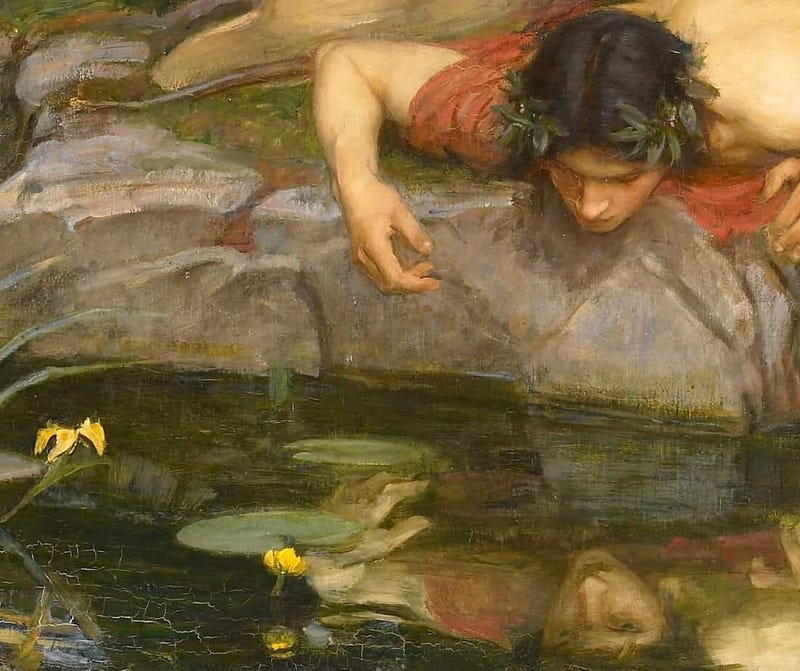
In addition to using pain as a lens, people use pain to attack or defend.
Pain used to attack is called anger. Chronic anger is usually a secondary emotion, meaning it covers a more essential one. We get angry at being betrayed or abandoned because we are less vulnerable to future betrayals and abandonments. While there is a short-term cathartic scream or rage patients need to go through, once they do, it usually gives way to tears. I have witnessed screams lead to tears, but never tears to screams, suggesting that anger is the sharp outer layer to pain, covering the more vulnerable softness within that has been bruised.
Anger is the only emotion primarily governed by the left hemisphere, the more masculine half of our brains. While the right hemisphere integrates holistically, including with input from the left hemisphere, the left hemisphere solipsistically does not integrate the right hemisphere. So that when you are angry, you are not feeling your other emotions, or considering their existence. Weaponized pain becomes a way to transfer pain so that the victim can switch to being the persecutor in the Drama Triangle. Anger then becomes a way to escape pain by giving pain.
Bishop of the X-Men has this form of power. He can attack others, but only by having absorbed their attack first and returning it to them. Watch at 12:00 and notice how he willingly suffers others’ violence, then turns red-eyed with rage when returning the favor.
Pain used to defend involves closing the doors to one’s heart. When we feel there is too much pain in the world, we may choose to close these doors. Only later do we realize that love enters through the same doors as pain, so that we cannot receive love when we use pain to seal the heart.
Further, the love and pain lying within our hearts have a harder time leaving. Hence when we protect ourselves with pain, we insulate existing pain, making it hard to heal. We also make it harder to give love. Vulnerability is the capacity to allow our softness to interface with the world. Pain incentivizes the loss of vulnerability, which is one of the best ways to keep our pain over a lifetime. Pain begets pain.
Instead of using pain for perceiving the world or undoing vulnerability, we might just listen to it. Just, listen. Like a therapist.
To follow me: https://medium.com/@myartman
To subscribe: https://medium.com/@myartman/membership


