
Fiction
130,815,769 Footsteps
Submission is permissible after a panel review
The clock on the wall showed three minutes after twelve.
John Ryan was impatient. He squeaked his freshly unboxed sneakers on the salt and pepper linoleum floor of the waiting room. How in the hell did I develop gallstones? His wife told him: he lost too much weight too fast, but what did she know? He didn’t like doctors, especially egotistical surgeons, and was there anything more egotistical than slicing up guts for a living?
This Dr. Kline was recommended by his awful GP, the doc in the 70s leisure suit, who kept ordering Nexium for his acid reflux when it was never acid reflux really. It was the damn gallstones that doubled him over out of the blue, for about an hour, but what an hour.
The pain was horrible. Was it like the pain of childbirth? His wife didn’t know because they were childless. But there was still time, right? They were only in their middle thirties.
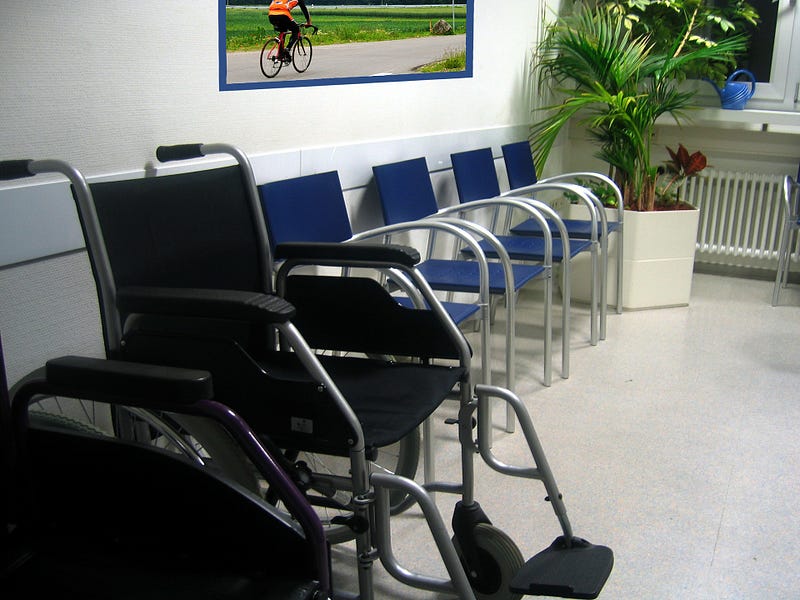
He counted the lowered crowns ahead of him. Was the waiting room getting a make-over? Nothing adorned the walls except a silly photograph of a guy riding a bike in a blue frame. Was that on the discount rack at IKEA? The clock with a white face with black hands and black trim. And the walls were white. It looked like primer white. The chairs were silver with a blue seat. The side table next to the new steel chairs was black, again, like the modern-chic-cheap from that place called Sweden. The name must be something like “Mycket dyr stol.” An empty black wheelchair stood guardian next to the entrance of the doctor’s chambers. A fake fern blossomed in the corner. The fake leaves were free of dust. Why was there a blue watering can? Who waters a fake plant?
What was really odd, amongst a whole list of oddities, was that there weren’t any magazines. No Car and Driver. No Newsweek. No Smithsonian, or People. Instead, the side table contained black, plastic three-ring folders with white-lined paper. It must be some kind of joke or a creative writing class.
He turned to one of the downtrodden masses next to him and asked, “How long you been waiting, huh?” The guy just shrugged his shoulders.
John Ryan picked up the folder. “What are we supposed to do with this?”
Again, the guy didn’t answer. Ryan searched his jacket for a pen and started writing: “Dear Dr. Kline, if you insist on scheduling so many patients for a day, at least provide entertainment. Would a magazine or a TV set be too much to ask?”
His pen was the only sound, and he liked the sound. He also liked the sound of squeaking sneakers, but his wife hated that sound. That’s why she always refused to go to basketball games. So he tapped the pen against the paper and squeaked his sneakers to get a rise, but he didn’t even get a raised eyebrow.
He turned to the old man again and said: “You want me to write anything for you?” The guy just shook his head.
There was another guy, who had to have been eighty, and he was slouched over in his chair. John Ryan thought he was dead. The guy’s brown trousers were torn and frayed. His hair was frayed too and gray. “It’s a little too late for the doc to help that stiff,” John Ryan told his mute friend.
The gallstones weren’t hurting him now. He felt fine. In fact, there were ten other things he could be doing right now than hanging out with the doomed and the dying. But a week ago at his sister-in-law, he cringed in agony at the dinner table and went outside to walk it off, and his wife came with him and demanded that he see an internal medicine guy. This pain had been with him for over half a year. How many attacks had he had? Ten? One was enough. So he finally kept the appointment and got the work done, and now he would have the surgery: in and out, same day, they’d just laparoscopically slurp that gall bladder right out, and he’d be righter than Rush Limbaugh.
He examined the clock, but the clock's hands hadn’t moved. He searched his pocket for his cell phone to check the time, but the damn cell phone ran out of juice. Why do I never bring a backup battery charger? Was that dead, too? For Chrissakes, he had two, both from Amazon, a white one and a black one. He walked over to the clock and pressed his ear against the wall and only heard his breathing. The clock was busted.
“The only thing the doc has in the room, and it doesn’t work,” Ryan said to the gang. “I hope his medical equipment has better batteries, huh?”
He pulled a chair against the wall to take the clock down, and no one even looked at him, not even when he lost his equilibrium and had to reach out to grab hold of this old geezer’s shoulder. The clock wouldn’t budge. The idiots painted the clock to the wall, Ryan thought, and then realized the clock must be hard-wired to the wall, like a fire alarm.
As he was tapping on the clock with his pen, thinking that maybe some force would get it to tick again, he remembered that he forgot about his buddy Dave. He was supposed to drive him to get his car at the mechanics, and he forgot to call him. “At least I have a good excuse,” he told the clock. “Jim’s a great guy. He’ll understand. I’m sure he got someone else.”
The door that seemed part of the white wall opened. A kind, pillow-like voice chimed for “John Ryan.”
Ryan turned around and grinned awkwardly like a kid discovered with his dad’s Playboy. “Up here,” he said. “Your clock’s not working.”
“Well, does anyone really know what time it is?” She sang the words to the old Chicago song and she smiled. She actually sang. She stood erect with a brown clipboard snug into her waist. Her plain white dress fell straight like boards, stopping above the knee.
“What’s the sense of hard-wiring a clock if the clock doesn’t work?”
“I wouldn’t know anything about electricity,” the woman sang sweetly to musical comedy bit. He never met a cabaret-singer-nurse. “I guess I can always inform the doctor… the doctor… the doctor…”
“Do you sing like this all the time?”
“Life’s short, why not sing? All the world’s a stage. Don’t I have a great voice?”
“It’s all right, but what do I know?”
“You must think I have a great ass, too.”
“What?”
“A woman always feels the heat from a man’s eye, you know,” she said.
John Ryan’s face should have flushed, but it was pasty white, almost pallid. A mumbled apology was not offered. He just picked up his jacket, fumbled through his wallet for his insurance card, and the five-dollar co-pay, and the nurse sang that they’d take care of all the paperwork later — it was part of their new patient-friendly relations.
Ryan walked behind her through a slender, colorless corridor, commenting to himself that her butt reminded him of a girl from his past. He touched both thumbs and stretched out his fingers to frame her ass and said it was just about right. Without missing a beat or turning around, the nurse crooned, “Thank you for objectifying me, and I just love that blue sweater you’re wearing. Your wife knows how to match your eyes. But your vitamin D levels may be off, or your liver.”
“It’s gallstones,” he said. “That’s all that’s wrong with me, babe. It’s my wife, yes, of course, my wife does my shopping. She got this for three dollars at Kohls on the summer discount racks! You know, I should tell the doctor about his waiting room. The reading material…”
“There’s nothing more exciting than a blank page,” she sang. “Think of the possibilities!”
“I have a good mind to tell Dr. Kline…”
“Oh, my, I’m sorry.” Her tune changed to a dirge. “Dr. Kline died some time ago. Didn’t you hear?”
How was that possible? He made the appointment only a month ago. It was gallstones all right, and this was his first consultation. Why didn’t anyone notify him? It was quite strange. He didn’t know the guy, so he couldn’t feel too bad, right? But who was the new guy?
“His name is Shastri,” the nurse said in a happier registrar.
“Is that first or last name?”
“That’s right,” the nurse said — extending the “I” sound for two measures.
“Shastri Shastri?”
“Yes, yes, right in here, Mr. John John.”
As she was about to close the door, she sang, “Very tragic. The way Kline died.”
It was a better room than the waiting area, larger with high ceilings and a white floral wooden border around the top of the walls like a European mansion. The walls were a light blue. It had an airy, open feel. There was a huge mahogany desk in the middle of the room with a high-back leather chair turned away from Ryan. There were also two flat-screen monitors on either side of the desk, and absolutely no paper or filing cabinet or patient table. There was a folding chair in front of the desk. Uncertain, feeling awkward, he walked toward the desk, and then a low voice was heard counting, 130,815,769… 770… 771… 772….773….774…”
While he appreciated the end of the One Woman Musical revue, the review of his footsteps through mechanical counting was even more bizarre. He couldn’t locate the source of the voice. He took a step back. The step was counted. He hopped to the left; the hop was counted. He hopped to the right; the voice counted. He walked quickly to the chair behind the desk and said, “Dr. Shastri! Dr. Shastri! What is going on?”
Someone tapped him on the shoulder. Ryan jumped. Behind him was a frail man in his seventies, very tan, if you can call folks from India tan, and smiling with bright blue eyes. “We’re counting footsteps,” he said with a heavy Indian accent. “But if it’s upsetting, and you don’t know where you’re going, I’ll turn the counter off.” And with a click of the remote, the counting stopped. Ryan did a quick two-step, and there was no counting.
“You’re Dr. Shastri?”
The old man bowed and smiled and said, “Shastri would be fine, my fine fellow. In this office, see, there is no pretense. What are degrees, anyway? Lawyers used to be able to study for the bar exam without the expense of law schools, but did law schools like this?” He pulled out the folding chair, and before Ryan could sit down, Shastri sat and told him to sit in the comfy chair. “Our patients come first,” he said with a nod. “Thank you for your patience.”
For a while, Shastri didn’t say anything. Shastri waited. He grinned. He pursed his lips and hummed the nurse’s catchy melody to “Shastri, Shastri.” He examined Ryan. He was dressed in a long white robe with a gold sash. He was practically bald with white puffs around the ears.
“So you were counting my footsteps,” Ryan said. Shastri shook his head and pointed to the monitor on the left. Ryan saw his name: Patient: John Ryan. Footsteps: Lifetime Steps: 130,815,769.” He stepped out of his chair and the machine added another step.
“It’s like a pedometer,” Ryan said.
“Yes, like a pedometer,” repeated Shastri.
“And it counts my footsteps.”
“Yes, it counts your footsteps.”
“This is all a joke right?” Ryan said. “Are you some funny man?”
“No, but for laughs, tell me how many times you said the word ‘the’.”
“What, today?”
“No, since April 17th, 1982.”
“My birthdate?”
“Obviously, Mr. John.”
Ryan got up from the desk and examined the room. He was now conscious of every footstep. There was no TV camera. No windows. Maybe there was a camera in the wall. Then on his remote Shastri keyed in “The.”
“Take a guess,” Shastri said. “It’s fascinating. You know, twenty of the most common words in the English language account for 20% of our conversation. And the average male speaks about 3,000 words per day, much less than the average woman, about 10,000 words a day. So a common word like the must be a lot, don’t you think, Mr. John. But not as much as the word ‘I’ or ‘you’ right?”
“Listen, doc, I’m sure you got my x-rays,” Ryan said, “and you got to believe I have gallstones. When do you think you can do the surgery?”
“The surgery is over, Mr. John.”
Ryan just stared at him with a cold, questioning stare. He reminded the good doctor that his last name was Ryan. John Ryan. With two first names, he was used to the confusion. Nobody seemed to know who he was. Then Shastri said: “You will no longer be pestered by those horrible gallstones anymore. I once passed a kidney stone, and I know the pain, what? My wife once told me it’s nothing like childbirth, but she is a woman, yes, and they can take more pain. Am I right, Mr. Ryan?”
“What?”
“Women can take more pain,” Shastri said.
“Why would I know something about that?” Ryan said.
“Then you have no idea about your wife, Virginia, then, right?”
Shastri pointed to the monitor. “It’s in your file.”
“But my gallstones, doc.”
“Gallstones are no longer an issue.”
“What is a real issue? What’s my problem?”
“Well, from a certain perspective, perhaps death, if life wasn’t wasted.”
“Death? Yeah, I’ll give you that, doc, sure, but I’m only thirty-eight.”
Shastri then instructed Ryan to make himself comfortable. On the remote, he keyed in the date: February 22, 2020. A narrative in “Google Docs” popped up:
John Ryan woke up with a headache and a crimp in his neck on the pull-out bed in the family room, and the sunlight from the sky windows made him realize he had overslept. He didn’t want to wake up, because he knew he had the appointment, and he wondered why he had an erection since he was dreaming that he was at the Philadelphia Auto Show, but he smelled coffee, and he realized that Virginia had already left for work, and there was a note on the table: “Good luck with your appt.”
John Ryan stopped reading. Shastri asked, “Does this sound familiar?”
“This already happened, but how do you…?”
“Your entire life’s story has been composed as a biography.”
John Ryan dragged the cursor to the bottom, but it ended after only five more pages. He read:
“There were complications during the routine procedure. Dr. Kline had to operate, but he had a coughing fit while John Ryan was sedated, and the scalpel lacerated John Ryan’s heart and liver and John Ryan died on the surgeon’s table.”
“This can’t be?” Ryan said. He felt dizzy and grabbed the desk.
The biography in front of him was indeed true — a work of non-fiction from an objective writer. There was no authorial comment, Shastri explained. “Your youth was quite interesting,” Shastri said. “Lots of interesting ideas… especially when you played with those wooden blocks. Quite an imagination. But that died on October 28, 1987. What killed it? Who killed it? Who did you blame?”
“I don’t care about that,” Ryan said. “You mean I’m dead?”
“In the literal sense, yes, but still alive in this document. Not that your narrative would win any awards. It’s actually rather sad in a pathetic way. Typical really. I can’t technically say tragic because you weren’t noble and you didn’t disturb the moral universe and you didn’t have a fall from grace, but hubris was a problem of yours. Quite.”
John Ryan never meant anyone so critical — with the exception of his wife, passing judgment when he has no idea of what — well, the whole thing must be some trick or a dream. John rocked on the leather swivel chair and checked the veracity of the document. As he read, Shastri said:
“It’s sad that Kline committed suicide soon after he accidentally killed you. Of course, he has his own sordid narrative to read. He’s down the corridor. But at least your dear wife Virginia won a huge settlement, remarried, and had that child she always wanted.”
“But I just saw her this morning.”
“This morning is now so far in the past. Her son is now in graduate school.”
“What?”
“Don’t you recall Emily Dickinson in high school? ’Tis centuries since I surmised the Horses’ Head was toward Eternity.’ What a woman. She was in heaven even during life, and so there was no need for her to rewrite. That’s the way to live!”
“But I just saw her!”
“Emily Dickinson?”
“No, my wife!”
“Time, as you have noticed, moves differently here.”
“So is this heaven?”
“Does it look like heaven?”
John Ryan shook his head. “Why am I not in heaven?”
“Does your story look like a best-seller?”
“But whose life is?” Ryan asked.
“Most lives are littered with banality. There are so many patient rooms in this wing, just like this one — for as you know, the mansion has many rooms. I’ve had the benefit of reading excerpts of your narrative, a SparkNote version, if you will, as I’m the guidance counselor for many arrivals today, as you could tell from the waiting room, and day after day of watching television or surfing online doesn’t make for riveting reading… no climbing every mountain! No tales of the open road! No road less taken! No dreaming the impossible dream!”
“But…”
Then Shastri said that the interesting thing about the narrative program was that it could not only locate words but deeds and themes. For instance, Shastri keyed in “lies” and it listed all of John Ryan’s lies, with the date and the direct quote for the specific lie. Shastri then typed in “generous acts.” Then a relatively shortlist was generated. “Even something simple like holding the door open for someone behind you was beyond you. Then there was the $100 you lent a friend, right here, August 2, 2002, and you pestered him for it back…”
“But…”
Shastri grinned. “Do you want to know anything about yourself? Are you curious? This is quite an amazing program.”
“No, I don’t care to know anything.”
Shastri nodded and typed in “didn’t want to know” and a list that went on for pages and pages. Shastri moved the flat screen monitor so Ryan could see, and Ryan turned away. Shastri highlighted an important date. “The most selfish thing you did: what you didn’t want to know: you knew your wife wanted to get pregnant, and even though you were having trouble, you never got your own sperm tested. And it was your problem. It was your boys who needed help from medical science. But it was all on her. It was her problem. Do you want to see how you misused your precious few footsteps? Footsteps taken in all the wrong directions, I’m afraid. We can look back on page Google Doc page 12,856. But you never wanted children. You just dragged her along, when it really wasn’t her that you loved…”
John Ryan stared blankly away from the old man. Ryan felt the physical pain return — as if some unseen hand was shoving calcified stones the size of boulders through his tender bile ducts. He grabbed his stomach. “The nurse, the singing nurse, of course; she reminds you of the one who you tossed away. Now, what was the reason? Are breasts too small? Wouldn’t make a good attorney’s wife?” Shastri scrolled all the way back to when John Ryan was twenty and still in college — before he flunked out. “And no one encouraged to sing… and for some stupid reason she listened to stupid people.”
“I was only twenty!” Ryan screamed. “What did I know?”
“And for those reasons, and many more, like causing deliberate pain through passive-aggressive behavior, you’re here to reread your narrative and…”
“I have to reread everything?”
“Not just reread — but to re-see and rewrite. Why do you think those magazines of mine have blank pages.”
Shastri explained that The Almighty wanted his people to become self-actualized, to borrow a term from Mr. Maslow — even if it took an eternity to discover the Truth and to fix the broken places in mind, body, and soul. We’re patient, here, he said. “And according to your file, you have a SA Factor of 12 — that barely got you out of the physiological bottom and into the safety zone of the hierarchy of needs,” Shastri said to Ryan who finally sat down. “For as Maslow once said, ‘what a man can be, he must be.’ You can look at the triangle here. As you can see, you have a ways to go for sexual intimacy, creativity, self-esteem, friendships, acceptance of facts…”
John Ryan seemed to think that he would get to live his life over again, but Shastri said what had been written can’t be unwritten, but he could “move on” with a more convincing storyline and character development. He just needed to be creative. Ryan complained that this was nothing like he heard in church. Shastri laughed and said that he was a Hindu himself on Earth. He typed in “times went to church” and it came up fifteen.
“You see, the holy books were written a long time ago. Technology, after all, has come a long way. Don’t you think that God would relish evolution? God is not static. Unfortunately, the literal-minded have largely misinterpreted the symbolism. 40 days, really? A pillar of salt? An actual boat with all the animals of the world on it? After all, “Moby Dick” isn’t really about a whale, is it? You see, the world moves on, the sun rises and the sunsets, and communities change. Why would we condemn billions simply because of a mailing address? One’s birthplace, and one’s family, largely dictate one’s religion, so it was grossly unfair to save the Irish and to condemn the Taiwanese. That way of thinking may have been in vogue two thousand years ago, but haven’t we all moved on? That’s the problem with the written word. Once it’s written, it dies — and so people cling to dead things while the universe unfolds.”
“But I always hated writing in school,” Ryan said.
“In the beginning, there was the Word, and the Word was good.”
“But where do I start?”
“Well, as the King of Hearts tells Alice, ‘Begin at the beginning, go until you come to the end, and then stop’.”
John Ryan had what could only be explained as a tantrum that exhibited the usual fist-pounding, shouting, har-huffing, sighing, stamping of sneakers, demands of seeing someone in charge, and exclamations and variations of the ‘it’s not fair’ variety.
“Most of what you lived could have been lived by a monkey,” Shastri said serenely. “And it’s the impression around here that man has evolved to achieve something more with God’s gift than scratching your crotch and fist-pounding with buddies after a touchdown.”
“Aren’t we judgmental?” Ryan said.
“It’s our business to be judgmental. To show judgment. Not such a nasty word, right? It’s a shame, actually, that two important words in the English vocabulary, judgment and discriminating, have a negative connotation now — or at least they did when you roamed the earth on your sofa.”
Shastri stood up and collapsed the black folding chair. “I will leave you now, to peruse your manuscript. Feel free to take notes and to line edit the times when you were a jerk, or when you should have acted. So when you rewrite your life, you can spice it up with livelier action verbs, concrete nouns, and more engaging dialogue. I’ll be back to discuss.”
“When is this due?
“You have all the time in the world to finish,” he said. “I’ll be back to help proofread.”
John Ryan’s head fell to the keyboard, prompting the message:
“Sorry! Google After Death Program is programmed not to shut down. A submission form is permissible after panel review. Please start writing. Here is a prompt: In the beginning . . . ”
Thank you for reading. This story was first composed in 1991 when I was a junior in college. It won an award for fiction but was never published. It has been updated to “keep with the times.” Follow me on Medium at Walter Bowne and on Spotify
Other works of fiction, include:


