
13 Writing Tips from William Faulkner
Writing for money, writing for yourself, and the search for perfection
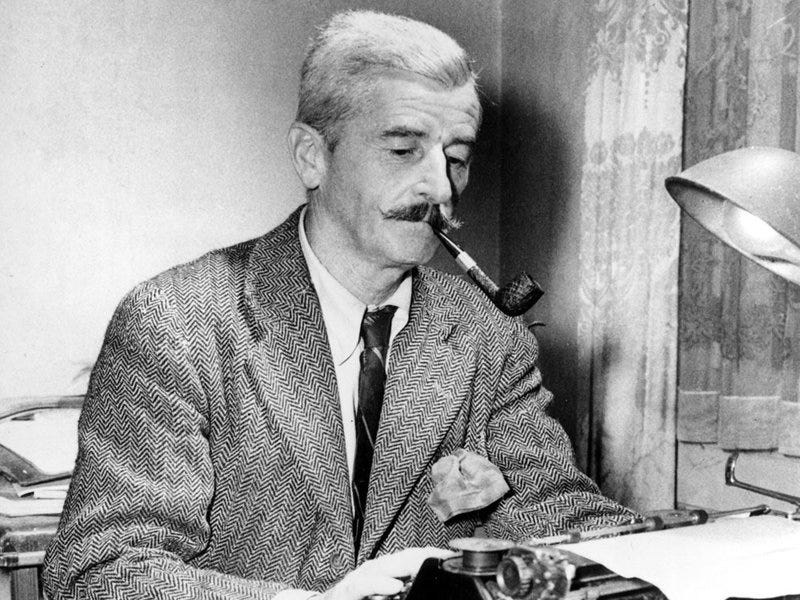
“Don’t be a ‘writer’ but instead be writing” — William Faulkner
When I first read William Faulkner’s work, it seemed perfect. His writing was dense, alliterative, moving, beautiful. But as I read more about Faulkner — about his life, about how he approached his work — I saw, not perfection, but a man who spent his whole life striving for it.
When an interviewer asked Faulkner about his life’s work, he said that he is convinced he could do a better job. Every time he sat down to write, he was trying to improve what he had previously done.
I can think of no better mindset for the writer — perfection as a goal but not a destination. We are always striving towards it, getting close with everything we write, but never quite reaching it. Which is the beautiful thing — if we were perfect, we wouldn’t need to write anything at all.
As I looked more into William Faulkner’s thoughts on his work, I discovered a treasure trove of writing advice. Here are some of my favorite tips and what they have meant to me on my writing journey.
#1: Write for pleasure, not for money
“Keep it amateur. You’re not writing for money but for pleasure. It should be fun. And it should be exciting. Maybe not as you write, but after it’s done you should feel an excitement, a passion. That doesn’t mean feeling proud, sitting there gloating over what you’ve done. It means you’ve done your best. Next time it’s going to be better.” — William Faulkner
It takes a long time to achieve success with your writing. You will be writing for years, possibly decades, before anyone decides your work is worth a look. In some cases, success takes so long that the writer has already passed away— Herman Melvill died penniless, believing Moby Dick to be a failure; F. Scott Fitzgerald was long gone before The Great Gatsby became a staple in every high school in the country; Emily Dickinson saw only 10 of her nearly 2,000 poems published in her lifetime.
If you write for external approval — money, fame, accolades — you’ll never keep writing. You must the act of writing itself. It must be satisfying to you alone. Even if no one in the world would read your writing, write anyway. That’s not to say you shouldn’t be paid for your work. Nor should you expect never to have readers. You should know your worth as a writer — and know that it comes from within. No external validation, like money or prizes, should be necessary.
When you write in this manner, you gain freedom. You can write what is genuine and honest. When you write for the love of it, you write without any boundaries. You write only to please yourself. Only when you focus on that can you write your best possible work.
#2: Avoid following a theory
“There is no mechanical way to get the writing done, no shortcut. The young writer would be a fool to follow a theory. Teach yourself by your own mistakes; people learn only by error.” — William Faulkner
We’re all looking for shortcuts. Strategies for better writing. A system that we can plug our work into for easy results — the three-act approach, the hero’s journey, etc. The truth is you can’t apply theory to your writing. You can only write first and see where it takes you.
The structure comes from the work, not the other way around. You are not building a house when you write. There is no need to figure out the foundation first. You have the freedom to start anywhere and see where the writing takes you. Let inspiration, not theory, lead the way.
A lot of writers are drawn to frameworks because it helps them get started. It’s nice to have a blueprint when you don’t know what you’re doing. But, over time, this framework can turn into a prison. It can easily hamper your writing, slow your growth. Don’t be afraid to throw it out and try something new.
Don’t be afraid to listen to your voice. It will tell you what your writing needs to do better than any theory or framework. Write, publish, fail, learn from your failure, and do better the next time.
#3: Start with your characters
“I would say get the character in your mind. Once he is in your mind, and he is right, and he’s true, then he does the work himself. All you need to do then is to trot along behind him and put down what he does and what he says.” — William Faulkner
If you build your character first, everything will fall in place. Again — you don’t need structure if you have character. They will build it for you. I’m sure you’ve heard writers say something to the effect, “I didn’t know what my character was going to do until they did it.”
It’s a weird feeling to be surprised by your creation. So much of writing comes from the subconscious, so much of it is hidden from you. Good writing comes from trusting those intuitions. Listen to your characters. Focus on bringing them to life, and they will lead the way for you.
Where do characters come from? There are only three sources:
- People you know in real life
- Characters from other stories
- Aspects of your personality
That’s it. The best characters are a combination of all three — they have quirks you’ve seen in other people, they resemble archetypal characters from literature, they possess your thoughts and dreams.
Once you’ve built your characters, put them in situations that test their values. See what happens out of that conflict. Follow the threads of cause and effect. Then, you’ll have your plot. It will fall out of character conflict, out of the choices they make.
#4: Put your writing above all else
“The writer’s only responsibility is to his art. He will be completely ruthless if he is a good one. He has a dream. It anguishes him so much he must get rid of it. He has no peace until then.” — William Faulkner
If you are not clear on your goals, you will not achieve them. If your goal is to be a great writer, then it should be your number one goal. It should be clear. You cannot try to be many things at once, or you will always be unclear on your priorities.
If you want to write, get up and write first thing in the morning before you do anything else. Signal to yourself that writing is a priority. You will always have a million responsibilities in your day. If you’re not careful, they will swallow your writing. If you are serious about it, protect your writing time.
#5: Stop writing when you’re in the flow
“The only rule I have is to quit while it’s hot. Never write yourself out. Always quit when it’s going good. Then it’s easier to take it up again. If you exhaust yourself, then you’ll get into a dead spell, and you have trouble with it.” — William Faulkner
Ernest Hemingway recommended the same thing — stop writing when you know what’s going to happen next. That way, you can get started quickly the next day.
There’s another benefit to stopping in a flow state. Your brain will continue to mull over your writing. When we have unfinished tasks, our brains will work to extend those tasks in our memory. Even when you’re not writing, your subconscious will continue working — looking for solutions, looking for alternative angles.
When you have an active writing project, your brain will be tuned to your surroundings. Eudora Welty said she always heard the best snippets of dialogue when she was working on her novels. You cannot hope to get these inspirations before you start. You must start writing and let your brain attune to the world for inspiration. It does not go the over way around.
Always keep an active writing project on hand. Anthony Trollope kept himself to a strict writing regiment all his life. If he finished a novel before his writing time was done for the day, he would immediately start on the next novel. No breaks. Using this approach, Trollope published over 40 books in his life.
#6: Write from the heart
“The real truths come from human hearts. Don’t try to present your ideas to the reader. Instead, try to describe your characters as you see them. Take something from one person you know, something from another, and you yourself to create a third person that people can look at and see something they understand.” — William Faulkner
When you write, it is not your job to present an idea to your reader. You are not trying to convince them of anything. Good writing asks more questions than it answers.
Flannery O’Connor said that she didn’t know what she thought until she read back what she wrote. In the first draft, you figure out what you are trying to say.
Readers connect more with people than ideas. Ideas should always come second to your characters. You must build a world in which the reader can imagine inhabiting. Only then can you populate that world with your ideas.
Too many writers approach this backward. They have an idea they wish to express, so they write. But their writing lacks weight because it is devoid of any reality. Write about people and objects and describe them accurately and with concrete details. Your writing will be much better for it.
#7: Don’t worry about style
“I think style is one of the tools of the craft, and I think anyone that spends too much of his time about his style, developing a style, or following a style, probably hasn’t got much to say and knows it and is afraid of it, and so he writes a style, a marvelous trove.” — William Faulkner
Style is important, but it’s overrated. Excellent writing has a style all its own. Fledgling writers see this and think that they must develop a style as well. But style is always a side effect. It’s the side effect of a writer’s voice (which takes time to develop), and it’s a side effect of the story the writer is trying to express.
If you get your characters down, if you get your story, the style will come naturally. Choose a style to fit what you are trying to say and not the other way around. If you don’t, your writing might be pretty — impressive even — but it will be empty.
#8: Write towards truth
“The young man or woman writing today has forgotten the problems of the human heart in conflict with itself which alone can make good writing because only that is worth writing about, worth the agony and the sweat. He must learn them again. He must teach himself that the basest of all things is to be afraid; and, teaching himself that, forget it forever, leaving no room in his workshop for anything but the old verities and truths of the heart, the old universal truths lacking which any story is ephemeral and doomed — love and honor and pity and pride and compassion and sacrifice.” — William Faulkner
Fear is the greatest struggle for any writer. We think that our biggest vices are distraction, laziness, procrastination. We worry that we do not have the talent or time. But it is fear that keeps us from writing.
To write about the human heart — to write that truth — requires courage. It is not easy to go deep into your heart and inquire as to what you truly feel. It is far too easy to shut that off and ignore the beating and pleading of your bone marrow.
And so your writing — as Faulkner says — is ephemeral and doomed. It is too easily forgotten. It does not linger in your readers’ minds long after your pages are done. Only those “universal” truths — the things which stir all humans — are worth writing. Are you writing about those truths? Why not?
#9: Fail
“All of us failed to match our dream of perfection. So I rate us on the basis of our splendid failure to do the impossible. In my opinion, if I could write all my work again, I am convinced that I would do it better, which is the healthiest condition for an artist.” — William Faulkner
Writers are too afraid to fail. Writing is hard enough on the best days; to face constant failure is often too much. Most writers secretly fear that they do not have what it takes to write. Any failure feels like proof of that concern. If we fail, we were never meant to succeed, we tell ourselves, and quit.
But the dedicated writer moves forward anyway. He or she fails again and again. The writer must embrace failure from the outset because it will dog at their heels for their entire life. To write — to be an artist — is to fail on every piece. Art demands perfection that the human is not capable of achieving, but still — the artist reaches.
And fails. And tries again. If you wrote the perfect thing, you would never write again. Failure is the gas that keeps you going. Do not be afraid of it. Turn it into fuel. So what if that poem, article, novel, or screenplay failed? Try again. Take what you have learned and apply it to your next project. You will improve, if only incrementally. Try again and again and again.
To be a writer is to write, simple as that. There are no requirements to be published, to be read, to make money, to be famous. If writing alone isn’t enough, rethink your path. It must be the reward in-and-of-itself, or else the constant failure will defeat you.
#10: Create time to write
“You can always find time to write. Anybody who says he can’t is living under false pretenses. To that extent depend on inspiration. Don’t wait. When you have an inspiration put it down. Don’t wait until later and when you have more time and then try to recapture the mood and add flourishes. You can never recapture the mood with the vividness of its first impression.” — William Faulkner
You have time to write. To say otherwise is an excuse. We all waste so much time in our days. Why not fill it with writing? If only for twenty minutes. Ten minutes? You can find ten minutes to write.
Take a notebook with you everywhere so that you can write down your thoughts. Inspiration never strikes when you are at your desk; it hits you when you are far away and engrossed in something else entirely. Write it down. Come back to it later.
Go out into the world and gather thoughts, feelings, inspirations, sensations, evocations. Write them down at the moment and carry them back to your desk. That way, when you sit down to write, you will always have a little treasure to start.
Do not think in terms of writing time and non-writing time. You are always writing. You must approach every second of your life as if you were writing it. What would you say? How would you say it? What is happening? If you pay attention to all the astonishing things around you, you will never run out of things to write.
Since you are always writing, write. If you are still reading this article, put it aside and write something. Right now. What do these words make you feel? Write those down. Come back to this later.
#11: Write without limits
“There should be no limits to what the writer tries to write about. He has got to tell it in terms that he does know. That is, he can write about what is beyond his experience, but the only terms he does know are within his experience, his observation. But there should be no limits to what he attempts. The higher the aim, the better.” — William Faulkner
Writers are afraid of their abilities. They are afraid of their limits, too. The only limitation to your writing is your imagination — and that, also, is flexible. When you look back on your life, it is easy to see how much you have changed. Often, we are shocked at who we used to be. This is good — it’s a sign of growth.
But when you look to the future, you assume you will be mostly the same. How can that be? The truth is that you will change — whether you want to or not. In the future, when you look back at where you are now, you will find it incredulous. Who is that person?
You must write as if you can become anybody in the world because you can. If you do not possess the skills now, no worries. You can develop them. Write as if you are already the writer you have always wanted to be. Don’t wait until you are ready. Start writing now. You will force yourself to grow into the person you need to become.
#12: Read everything
“Read, read, read. Read everything — trash, classics, good and bad; see how they do it. When a carpenter learns his trade, he does so by observing. Read! You’ll absorb it. Write. If it’s good, you’ll find out. If it’s not, throw it out the window.” — William Faulkner
This is an old cliché in writing advice — but it bears repeating. If you do not read, you cannot succeed as a writer. Learn to devour books of all sorts. Pay attention to what you are reading. What are the effects, and how does the writer accomplish them?
If you are reading something good, ask yourself why it is good. What are the elements that make it good? Can you replicate them? If the reading is terrible, again, ask why? What is the error? Are you making those errors in your writing?
You cannot learn anything by merely observing, though. You must also get your hands on the problem. The carpenter learns by watching the master and then by making the moves. The same is true of writing. Read often and then try to replicate the effects you see. To be a writer, you must always be reading, and you must always be writing.
#13: Don’t make writing your job
“Don’t make writing your work. Get another job so you’ll have money to buy the things you want in life. It doesn’t matter what you do as long as you don’t count on money and a deadline for your writing. You’ll be able to find plenty of time for writing, no matter how much time your job takes.” — William Faulkner
There’s a constant tension between writing and your “day job.” How do you balance the needs of your soul with the requirements of everyday living? It’s easy to feel like your job is robbing you of time to write.
But remember, you always have time to write. Your job is not robbing you of anything — in fact, it provides the financial security to write. Shift your perspective on your job, and you will find it a lot easier to write.
Your writing will suffer, too, if you try to lay your financial security upon it. Excellent writing takes time. It takes time to create, and it takes time for the public to appreciate. When it comes to your necessities, you do not have time. You need those things now. Too many great writers shortchange themselves because they focus only on writing that pays (right now). What could they have written if they gave themselves more time and space?
Your job takes care of your daily needs so that your writing can have time and space to grow. Your job doesn’t rob you of your writing; it finances it. Without the pressure to make money, your writing can flourish. Ironically, this will make your writing priceless — in time.
Ready to develop a bullet-proof writing routine? I’ve created a checklist for developing a writing habit immediately. Follow this every day, and your writing will improve quickly. Get the checklist here!