13 Proven Steps for Dealing with Failures
When You Fail, Give Yourself A “Heroic Failure” Award

My CV is about 10 pages long. However, if I had a CV of my failures, it would be at least 50 pages long. It is unfortunate that we do not publicize a CV of our failures, since we tend to learn tremendously from our failures. I believe it is time we build a better psychological connection with our failures, own them, bear responsibility for them, and turn them into deeper learning.
I have had my share of failures in my life. For example, I applied for 15 schools for a Ph.D. after getting my undergrad degree. I got rejections from all of the programs and got devastated. I started doing a master's and worked for 45 hours (academic and professional work) to better prepare myself for a Ph.D. Two years later, I got accepted into several Ph.D. programs. Looking back, I realized that I developed tremendous skills and knowledge in these two years. I have also become a much more resilient person who can turn challenges into deeper learning opportunities.
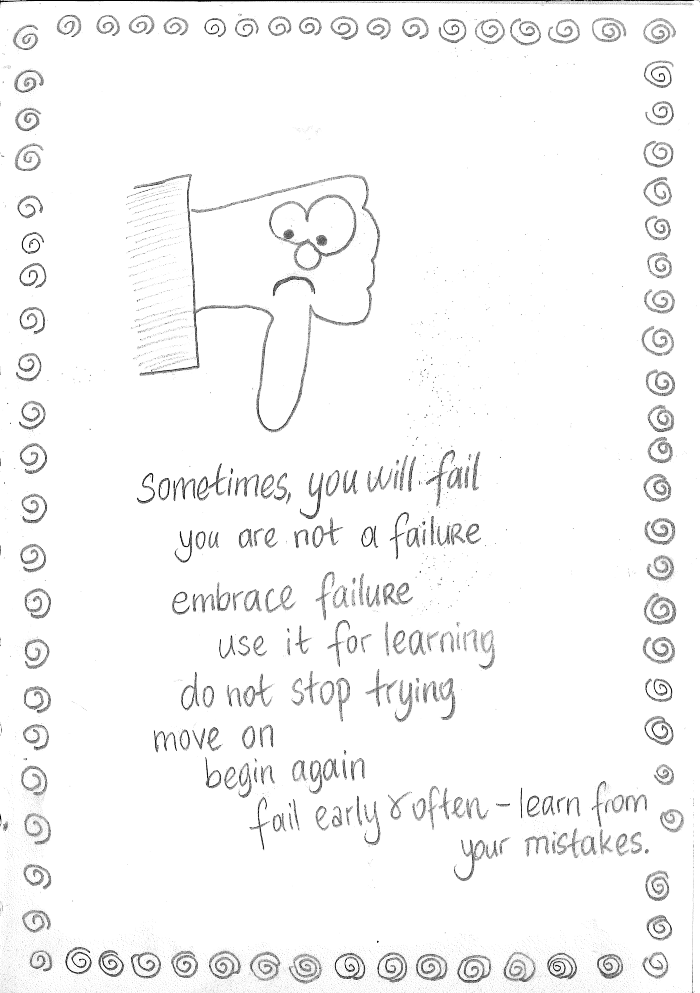
Tom Watson, the founder of IBM, advises us to embrace failures and mistakes on the path of success:
“Would you like me to give you a formula for success? It’s quite simple, really. Double your rate of failure. You are thinking of failure as the enemy of success. But it isn’t at all. You can be discouraged by failure — or you can learn from it. So go ahead and make mistakes. Make all you can. Because, remember that is where you will find success.”
This means you need to challenge yourself to grow. On a similar vein, William McKnight says:
“The best and hardest work is done in the spirit of adventure and challenge. Mistakes will be made.”
Change Your Mindset
Trying and failing at something is not fun. You do feel disappointed, tired, and angry after failures. If you are not careful, failures will shut you down and make you not want to try anymore. Therefore, you need to change your psychological relationship with failures. If you can learn to celebrate your failures as valuable experiments that eventually lead to success, then you will grow tremendously and develop perseverance as an individual.
Think Long Term
This requires a focus on the longer term: You will achieve tremendous lifelong success if you allow yourself thousands of opportunities for failures and experimentations. Sir James Dyson tried 5126 times and he failed each time — until he invented Dyson’s bagless vacuum cleaners. This means you need to provide yourself with a lot of opportunities for failures and mistakes, especially if you are in the fields of creativity, content creation, and experimentation.
13 Proven Steps for Dealing with Failures
How can you develop a new and fresh relationship with failures? How can you learn to reframe failures as stepping stones to success? Below, I present you with a mental framework and guide that I use myself. Please look at the poster and go over each step to shift your perspective.
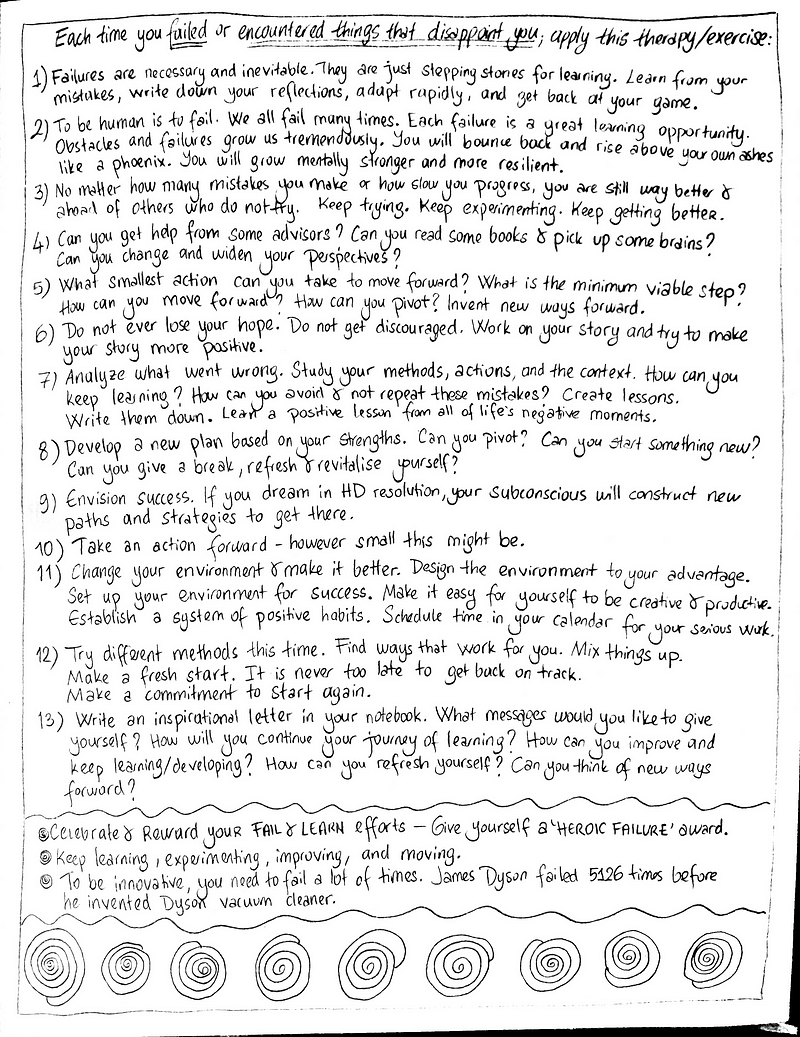
- Learn from your mistakes, write down your reflections, adapt rapidly, and get back at your game.
- Treat each failure as an instrumental stepping stone and a great learning opportunity. How can you bounce back and rise from your own ashes? Create strategies for bouncing back.
- Keep trying and experimenting. Do not give up. Try again and get better each time.
- Engage in deeper learning. Get some mentoring and guidance. Try to pick up some brains. Read books on this topic and do research on the Internet.
- Figure out the smallest action point to go forward. What is the minimum viable step? How can you pivot? What is your next experiment and action? Can you invent new ways of going forward?
- Do not ever lose your hope. Everything will be eventually OK. Do not get discouraged. You do have a good story to tell now — work on your story and try to make it reflective/positive.
- Analyze what went wrong and why. Study your methods, actions, and context. Capture your learning. How can you avoid doing similar mistakes next time? Learn a positive lesson from all of life’s negative moments or experiences.
- Develop a new plan based on your strengths. How can you revise or pivot? What can you do differently? How can you resolve problems? Can you start something new? Can you give a break to refresh and revitalize yourself?
- Envision success. Visualize it and take notes in your diary about your ideal vision and world. If you dream your success in HD resolution, your subconscious will find new ways and strategies for getting there.
- Take the smallest action you can take to go forward. A tiny miny action. There is nothing to lose when you do this action.
- Change your environment and make it better. Design your environment to your advantage. Set up your room and environment for success. Make it easy for yourself to be creative and productive. You need to establish a system of positive habits. Schedule time in your calendar for deep work.
- Try different methods this time. Find ways that work for you. Mix things up. Try to incorporate more fun and play into your work. Make a fresh start. Remember that it is never too late to get back on track. Make a commitment to start again.
- Write an inspirational and reflective letter to yourself. What messages would you like to give yourself? How will you continue your journey of learning? How can you keep learning and improving? How can you reinvent yourself?
Please make sure you go over and implement all these 13 steps. These 13 steps will help you avoid negative self-talk like telling yourself you’re no good. You will be able to eliminate your negative behaviors and replace them with reflective thinking, resilience, creativity, and hard work. If you fail to do something you said you would do, you can simply relax, take a deep breath, figure out a new way, re-commit, and get back on your feet.
Make sure you keep your inspiring letter with you or close to you. You can reclaim your resolution, excitement, and inspiration by reading this letter whenever you feel exhausted or defeated. Notice your improvements and progress, even if your progress is really small.
Remember: There is a silver lining behind every failure. Failures are your friend, because they make you be stronger, work harder, learn more, stretch your capabilities, unleash your full potential, and fulfill your own greatness.
When you stop seeing problems as threats, but as signals that you need to change and improve yourself, then the whole situation will improve. All challenges are actually invitations for you to change. When you challenge yourself to be better, you will open up, learn, grow, invent better methods, and approach the problem from multiple fresh angles. In the process, you will learn new things that you have never considered, realized, or known before.
Takeaways:
- When there is no challenge and risk, there is no joy, creativity, or success. As poet Rainer Maria Rilke says, the purpose of life is to be defeated by ever greater things.
- Challenges will help you to unleash your full potential, reclaim your authentic self, and reach new heights of excellence.
- Failures are causes for celebration. They challenge you to become a better person.
- Allow yourself a lot of opportunities for experimentation. It is all about trial and error. Make mistakes and learn from these mistakes.
- Learn how to fail soon and often. Do not wait for too long and learn to fail faster. Launch quickly, move rapidly, view all feedback as a gift, and iterate faster.
- Fail differently each time and make progress. Get up and do better next time.
- To turn failures into learning opportunities, understand what went wrong. What did you set out to do? What did actually happen? Why? What will you do next time if a similar situation arises again?
- Ask yourself: What is the minimum viable action or experiment?
- When you fall over, pick yourself up and learn to go forward. Next time, you will fall over with a little less pain.
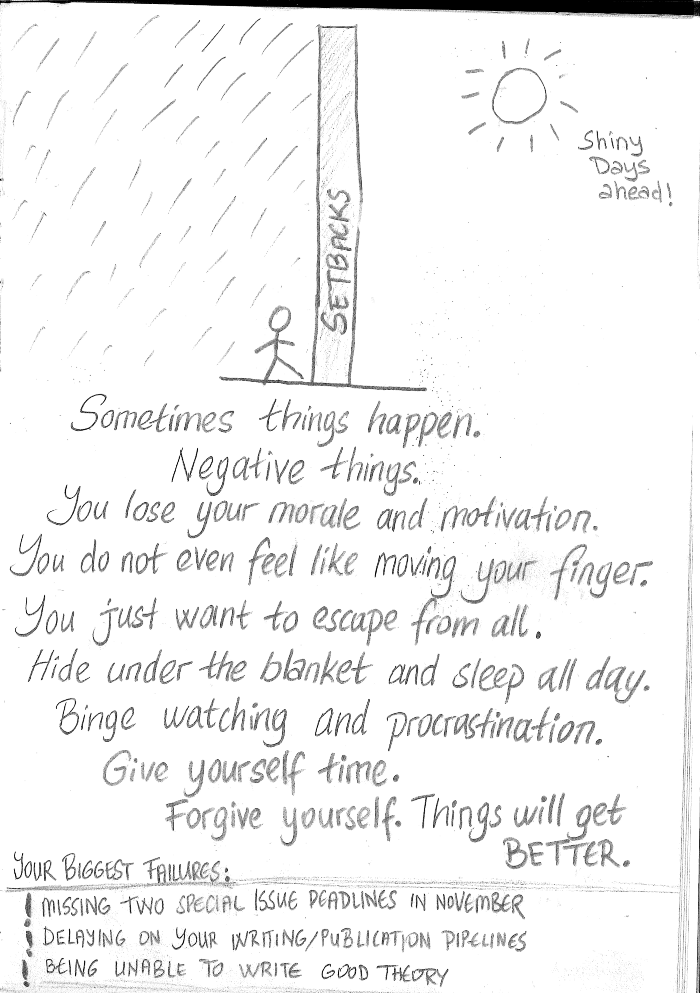
- Recount your biggest failures. Did you learn from these failures? What did you learn? Can you celebrate these failures — since they have probably helped you grow? Write down your reflections below to make peace with your failures.
- When you are blocked, ask yourself: What blocks you? Why are you not progressing? How do you limit yourself? How can you stop it? Write down the issues. Think of a lot of solutions.
- Always have alternatives and contingency plans. Try different methods, ideas, and approaches to go forward.
- Create a CV for your intelligent failures and celebrate them. Prepare yourself a heroic failure award and hang it on your wall with pride.
- Life in the 2020s is all about adaptation, evolution, survival, resilience, cognitive load management, mental stamina, and handling complexity. Success is all about how you respond to new threats, new trends, and new technologies.
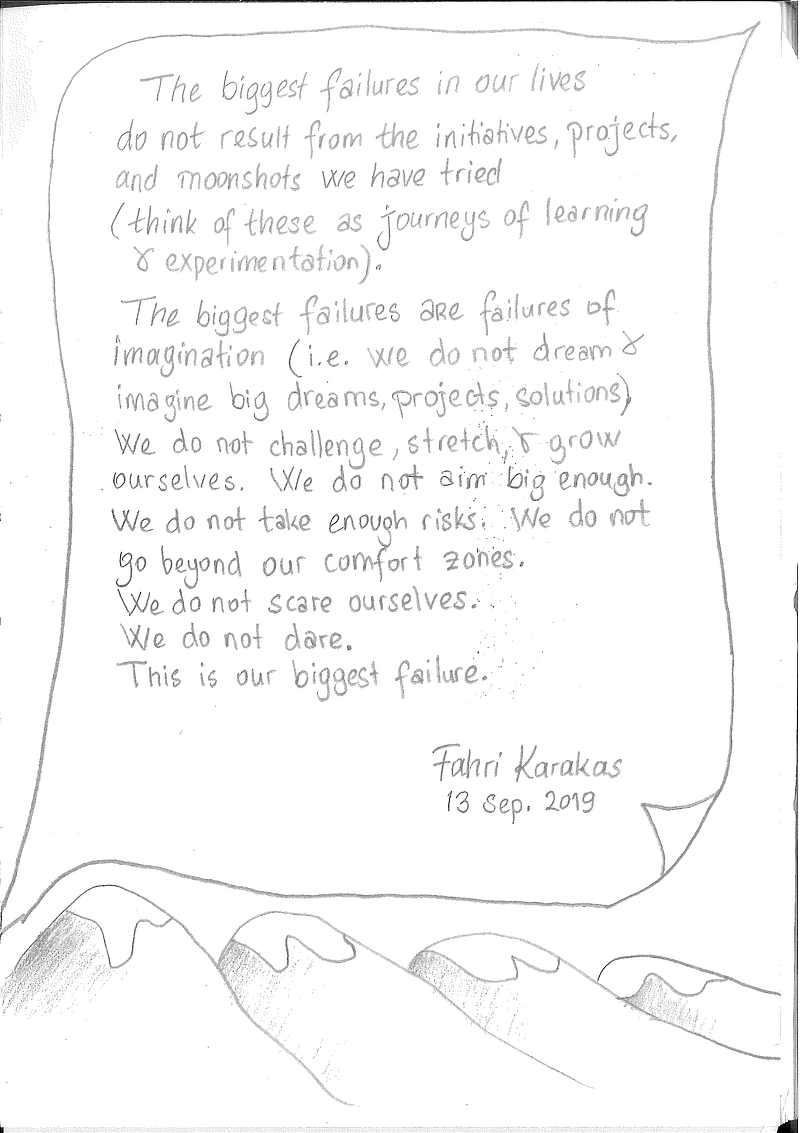
- The biggest failures in our lives do not result from initiatives, projects, and moonshots we have tried — think of these as adventures. The biggest failures are failures of imagination — we do not dream or imagine big enough. We do not take enough risks. We do not go beyond our comfort zones. We do not scare ourselves. This is our biggest failure.