
13 Chess Tips That Will Help Any Beginner Chess Player
I wish I knew these tips before I started playing
Yup, I’m just another one of the millions of people that got sucked into Chess after watching The Queen’s Gambit. It’s been a blast. Over the last few months, I’ve played over a thousand games and have worked my way up to a rating of 1378 on Chess.com.
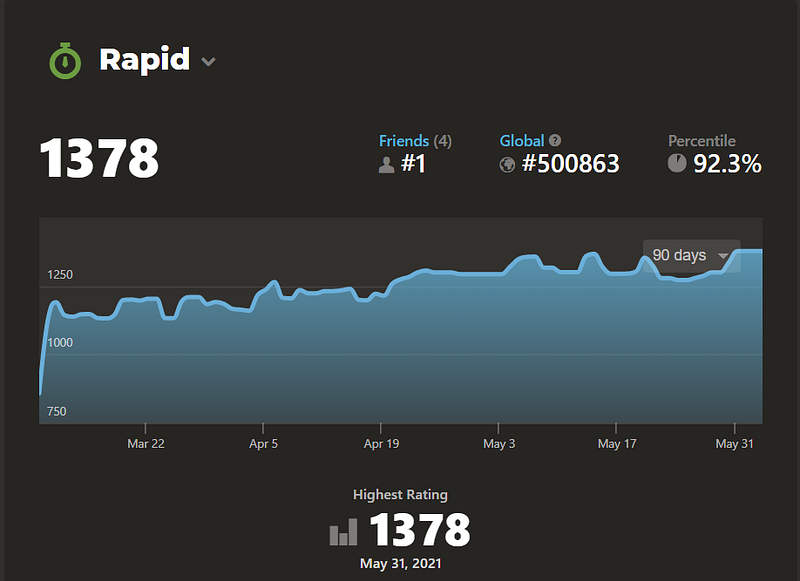
This puts me among the top 10% of the player pool. It sounds a lot more impressive than it is as I’m not even one of the top 500,000 players. You could populate a small city with all those people!
The top players have ratings of 2600+. So, if you can draw anything from this, it’s that there are a ton of beginners playing online. Fortunately, it also means some of my tips could help you improve.
1. Don’t Play Blitz or Bullet Games
Blitz games on Chess.com give each player a 3 or 5-minute time bank. That’s the time you have to make all your decisions for the whole game. And Bullet games are even more hectic as they only give you a minute.
For a beginner who doesn’t have a solid repertoire of openings or gambits, there just isn’t enough time to think through each move in a meaningful way. So it’s easy to develop bad chess habits and compound mistakes when playing these faster games.
I understand it’s exciting and it can be more fun. But if the aim is to get better, I would recommend playing rapid chess with 10-minute timers instead. This will give you more time to think through critical moves, analyze a variety of different scenarios and develop better playing habits.
2. Learn a Limited Number of Openings
Unless your job is to play chess, you won’t have enough time to play and master every chess opening. Actually, even the best players in the world have preferred openings.
Beginners should really focus on learning one solid opening for white and black pieces. This gives you an appropriate framework to learn from repeated scenarios that commonly occur for that opening.
As a result, you will be able to anticipate many of the responses your opponents play in the future. If your opponents frequently play different openings, they will be far less familiar than you with the situations that come up. When you develop a solid set of responses, you will have the edge in both strategy and timing against most beginners.
3. Every Move Has a Purpose
You should have a reason why you are moving a piece. Making unnecessary or redundant moves will give your opponent the opportunity to develop their pieces quicker.
Whenever you are thinking of moving a piece, you should be thinking:
- What opportunities would this move open up?
- Are there threats to doing so?
- How could the opponent counter it?
- Is there a better move I could make?
In situations where you are playing for a draw, all you can do is shuffle your pieces back and forth and play for the draw through repetition. That is a valid purpose. If in the shuffling, your opponent makes a mistake, your solid play should allow you to take advantage and win.
4. Practice Puzzles
A great free resource of chess puzzles is on Lichess.org.
Even if you don’t know how to solve the puzzles, you can still see the solution. This helps you think more critically about what the most optimal move is in certain situations.
It helps you identify recurring patterns and opportunities that you may not see at your current level. The great part of doing the puzzles on Lichess is they are based on actual games others have played — so these are real game scenarios and not just theoretical setups.
5. Learn From YouTube Videos and Twitch Streamers
It’s incredible how much valuable content is out there that can educate you in chess for free. If you aren’t a fan of reading books about chess theory, you can pick up a lot of knowledge from YouTube videos and Twitch streamers. I particularly enjoy the content by Gotham Chess and Eric Rosen.
The best teachers aren’t always the top players in the world. The two players I mentioned aren’t Grand Masters but they’re still great players. It’s their ability to explain concepts in a way that people can understand and stay interested that makes them world-class.
6. Play Against Real Players
In the beginning, it can seem intimidating to play against other players online. But the chess rating system is so efficient and the player pool is so large that you are usually matched with players at your skill level.
Some beginners would rather play bots but bots are really weird. They don’t play like people. They play pretty normally but then do something bizarre that no human would ever do. And when you’re first starting out, you won’t know which moves are weird.
If you want to get better at competing against other players, you should play against other players.
7. Don’t Leave Your Pieces Unprotected
It’s amazing how many beginners don’t protect their pieces — particularly their pawns. Even when they know that their opponent can take their pawns for free, they don’t protect them.
Why?
Because beginners don’t think pawns are important. When pawns don’t do nearly as much as the other pieces, it’s easy to neglect them. But don’t neglect them! And certainly don’t give them away for free.
If you are at a pawn disadvantage and the opponent ends up trading equivalent pieces with you, you will lose in the end when they eventually promote one of their pawns into a queen.
If every piece you have is protected by something else, you are more able to defend it properly. If you leave too many pieces on their own, you can end up losing them when opponents check you and you’re forced to move the king instead of the unprotected piece.
8. Keep Your Pawns Connected
Pawns that are connected are much stronger than isolated pawns.
I guess it’s kind of a default move to push a pawn forward when you don’t know what to do. But push it too far and your defenses will break down.
Sometimes, beginners are tempted to push pawns forward to threaten the opponent's pieces, but once the opponent moves their piece away, you’re left with an awkward position and a more exposed defense.
Unless you can follow up with the threat or your opponent doesn’t have an easy escape, it’s not worth pushing a piece too far away from the rest of your pawns.
Also, connected pawns are a pain to play against. When they progress together, they can take help you gain space and control over the board and restrict the movements of your opponent’s pieces.
9. Don’t Be Afraid to Trade
Some people shy away from the trade, particularly if it involves their queen. But in order to progress in chess, you’ll need to play with and without the queen at some point and just push whatever advantages you have. Relying on a single piece when you have other very capable pieces is going to hold you back.
I understand the hesitance in trading pieces if you are already behind. It’s generally a good idea to avoid trades when you’re behind. But if everything is more or less equal, and you don’t have any obvious disadvantages, you shouldn’t waste a move just because you’re afraid to trade.
10. You Don’t Have to Initiate the Trade
This point follows on from the last. If your opponent is trying to trade pieces with you, you don’t have to be the one to initiate the trade. Instead, you can keep the tension there. And you can put one of your other pieces in a more advantageous spot.
There are times, however, where you want to be the one to trade first. If taking one of their pieces weakens their position or prevents a weakness on your own side (doubled pawns or exposed king), it can make a lot of sense to initiate the trade.
11. Practice Pawn End Games
The end game is probably the hardest to play and one of my biggest weaknesses. It may seem boring to some players when the end game is about competing with the king and pawns (or something similar).
But tightening up your play at the end and making fewer mistakes than your opponent will give you an enormous advantage. It’s amazing how much a single move in these situations can win or lose you the game.
When you get really into it, pawn-end games can be super interesting.
12. Practice Checkmates With Different Combination of Pieces
The amount of beginners who don’t know how to do basic checkmates is astounding. I’ve definitely been in situations where I had a king and a queen against an opponent's king and I failed to win. It’s pretty embarrassing.
So how did I mess up?
- I allowed the opponent to get into a position where they couldn’t move but they weren’t in check so the game ended in a stalemate.
- I kept chasing them around the board unable to corner them.
- I repeated moves too many times by accident and drew.
- I couldn’t checkmate them before the time ran out.
Don’t make the same mistakes. These are situations where you have worked so hard to put yourself into a winning position so you should close out the win. Learning how to checkmate your opponent properly will ensure that you win when you’re way ahead.
13. Review and Learn How to Analyze Your Games
Every time you get into a situation where you aren’t sure what you should be doing, make a note to review the game afterward. Actually, it’s good to get into the habit of reviewing every game you play before you move on to the next one. This includes the games you win.
It will help you identify potential inaccuracies, mistakes, or blunders so you can correct them in the future.
These days, we can make use of chess engines to help us calculate what the best moves would be in any situation. There will be some odd moves that you’d never see or understand but through experience, you will identify which moves you can reasonably spot in-game.
Quick Recap
- Don’t Play Blitz or Bullet Games
- Learn a Limited Number of Openings
- Every Move Has a Purpose
- Practice Puzzles
- Learn From YouTube Videos and Twitch Streamers
- Play Against Real Players
- Don’t Leave Your Pieces Unprotected
- Keep Your Pawns Connected
- Don’t Be Afraid to Trade
- You Don’t Have to Initiate the Trade
- Practice Pawn End Games
- Practice Checkmates With Different Combination of Pieces
- Review and Learn How to Analyze Your Games
I hope you found these tips helpful, good luck and have fun!