
12 XKCD strips that show the truth about AI
Stick figure insights into fake AI, reverse Turing tests, superintelligence, and more.

XKCD, a 15-year-old “webcomic of romance, sarcasm, math, and language,” ingeniously distills complex ideas, like AI, into simple strips.
XKCD graciously allows re-printing with attribution, so here are 12 XKCD strips that show the truth about AI.
Biological vs Artificial Neural Nets

Your brain is an interconnected network of 86 billion neurons — a neural net, if you will. Artificial neural nets are inspired by this design, and while the simplest construct — a perceptron — is just a single neuron, modern neural nets (NNs) can reach up to a billion weights and millions of neurons.
By learning patterns from data, NNs can accomplish a wide range of tasks, from image recognition to forecasting.
However, if we take it too far, we might waste time building models when doing the work manually would work better.
Fake AI

By all accounts, AI seems ubiquitous. Turn to Product Hunt, Twitter, or /r/startups, and it’ll look like new AI solutions are popping up every minute.
But is that really the case — or are some companies “cheating”? As it turns out, several companies have been caught in the act, claiming to use AI while actually outsourcing menial tasks. As Forbes reports, these are just some of the companies guilty of “pseudo-AI”:
- Hanson Robotics
- X.AI
- Clara Labs
Theory

Though futurists and thought leaders might tell you otherwise, we really have no idea what will happen after a superintelligent AI is created.
Will it be benevolent? Malevolent? Neutral? Non-sentient yet superintelligent? Whatever happens may surprise us all.
Data Pipelines

Building data pipelines isn’t easy. To build data products, you need to be able to collect data from potentially millions of users and process the results in near real-time. Your pipeline needs to be robust, scalable, efficient, and with monitoring capabilities.
With how difficult it is, many pipelines don’t check all the boxes.
Training

By training a neural network — or passing training data through a composite function many times, so as to learn patterns — we can predict new data. If you don’t train long enough, your model will “underfit,” or simply not have learned patterns in the data.
You might end up with a chatbot that speaks gibberish, or a self-driving car that only drives straight.
Chatbots

Cleverbot was released in 1997, so there’s a long history of somewhat-decent chatbots.
However, there’s a big difference between an AI that creates something new and unique, and one that just retrieves what humans have done or said in the past — like Cleverbot.
To be fair, modern chatbots have drastically improved on the technology, and are astonishingly accurate.
Data ➡️ Answers
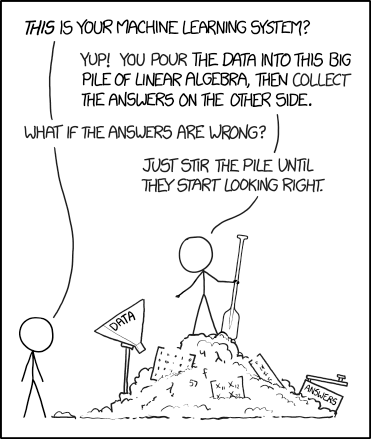
For all the progress we’ve made on AI, relatively little has been done in the way of explainability. While the idea of “black box” AI is a bit of a myth — as there are ways to interpret the results — there isn’t complete transparency or intuition into how most AI models, especially deep learning, really work under the hood.
Sentience

Asimov’s third law of robotics is that a robot must protect its own existence. Nuclear blasts trigger EMPs that destroy electronics, so a sentient AI that abides by Asimov’s laws may seek to destroy our nuclear weapons, rather than use them against us.
Shouldn’t we be worried about humans?

There’s a lot of fear-mongering about AI, some justified (AI may bake in racial and sexual biases, AI may spur job loss, and so on), others irrational (AI will kill us).
However, all this fear forgets one thing: Humans, not AI, are the danger. The unfortunate truth is that up to a billion people have been killed in wars throughout history.
Turing Test

In the seminal paper on Artificial Intelligence, Computing Machinery and Intelligence, Turing asked: “Can machines think?” — or, more accurately, can a machine imitate thought?
So far, the answer is “no,” but we’ll likely get there one day, and perhaps raise the bar with a new test.
Humans are better at…

With every new AI advancement, cynics keep shifting the goalposts, and AI keeps catching up.
Easy vs Impossible Tasks

In computing, two tasks that may seem similar to a lay-person could easily be the difference between trivial and near-impossible. Today, years after the creation of the strip above, image recognition tasks have been made far easier, but many other tasks prove incredibly challenging.
For example, how can we create a neural network that is not only explainable, but intuitively interpretable? How can we create new state-of-the-art neural networks without simply adding more compute, more data, and more parameters? How can we create general AI, as opposed to narrow AI? How can we make level 5 autonomous driving — which can handle things like a road-worker holding a stop sign, while motioning, to the driver next to you, via eye contact, to proceed?
There are many unanswered questions in the field, which makes it all the more exciting!
Want More Content Like This?
If you’d like to learn more about AI and data science, then follow me on Towards Data Science, and Apteo’s data science blog that I contribute to.


