
12 Very Creative Ways to Promote Your Writing
Besides the big ones of Facebook and Twitter
If you are having trouble viewing this content here’s how to fix that.

If you are having trouble viewing this content here’s how to fix that.
As writers, the hustle to self-promote is more exhausting than the actual work of writing. As necessary as it is, we can get really bored really fast doing this thing day in and day out. It seems endless, right?
Facebook, Twitter, Instagram. Over and over. But there are a few other things you can do to mix things up and get your work out there. Set yourself up with a rotation of these and your links will get more “airtime” and in more places, which is favorable for search engine algorithms.
Here are a few self-promotion options you may not have considered.
- Goodreads quotes I often search online for quotes and inevitably Goodreads shows up in the search. Have your author page polished up there and start posting quotes of your work on your page. You never know when your work may appear as others search for quotes. Building your following on Goodreads is also helpful if you intend to release books. On the author page there is also an “ask me questions” feature, which is a good way to connect with readers. People who love reading kind of readers!
- Canva quote graphics for Pinterest Canva is an excellent source for creating graphics that will draw clicks and engagements. You will have to research the correct sizing for the graphic you will create. It will depend on which site you want to share it to. I name the pictures as I save them as “A World Without Butterflies — Insta” of “A World Without Butterflies — FB cover” etc so that I know which graphic can be used for which site based on the dimensions. If your dimensions are off the site you post it to will cut off the edges or stretch your image, distorting your image and sometimes making it really blurry.
- Podcast interviews Shortly after my book was released I received several invitations to interview. Do this! It doesn’t matter if you hate your speaking voice. Consider it great practice for book signings or speaking engagements. One of the most fun things I have ever done to promote my work was the Words from the River podcast interview with Laurie Livingston Nave.
- Quora I’ll admit, Quora didn’t appeal to me for a long time. I recently went in, changed my whole profile to be “author specific” and started leaving very thorough poetry answers on existing questions with a plug for one of my poetry articles slid carefully into the answer. It is a great way to find your audience. If you’ve written “How to Line Dance Without Looking Stupid,” then go on Quora and find the people asking questions about line dancing or country music and find a way to creatively and honestly answer, while linking your article in the answer.
- YouTube and Soundcloud readings Seriously, get over hating your own voice. Recording readings or making quick videos on the topics you write in can give you one more way to promote your work. The video-clickers on your social media may be more tactile learners that need a visual. This is a good way to draw them to your site and your work. I did a 14 minute video discussing my book and reading a few poems and shared it on my YouTube channel (the one with 3 followers) and shared the link a few places. It garnered 47 views in a day or two. I posted the link to my author pages on Goodreads, Amazon, and to my blog.
- Use smaller sites like Mirakee and Flipboard Mirakee is a great place for poetry snippets and quotes — a very visual site with a younger following. Flipboard allows you to post your articles like a collection of online magazines that people can follow.
- Call your local newspaper You never know! My local paper is going to do a feature article on my new book. It helps that I am in a small town and being an “author” is akin to celebrity-dom.
- Get creative with hashtags Research your hashtags. Use popular ones. But also, if it is an article about gardening, think about these readers. What will they follow and search for? Reel them in with a popular hashtag in the areas of their interests. For example, my book title is “organic” so when I share it with #organic I may end up with followers of homesteading or gardening. These are the same kind of folks who may like poetry that is deeply nature-based. It works. If the name of the book were “airplanes” I would get a very different response from the hashtag #airplanes. Hashtag not to mark your work but to lure your readers. — Christina Ward
- Create share groups This is an idea I have been kicking around for a while. Creating a small group of 3–5 people who agree to do a share rotation of work. If there are 3 of you, each person can share their “promo-of the-day” link or two to the group, and as you make your promotion rounds you share yours, then theirs, and they do the same for you. Set an agreed number of sites to share to and number of shares so you each benefit from the sharing collaboration.
- Manystories or other social groups for your platform Whatever your writing platform, find the social groups. Don’t forget to check Reddit (subreddits), Linkedin (groups), and Twitter (lists). If you are a Medium writer, you need to be sharing daily to Manystories. I have very few followers there (less than 50) but I still get clicks from there on my articles. Manystories also selects stories to share on the front page of the site each day and will notify you if your work is selected to distribute.
- Find influencers who post affiliate links I’ll admit — I am a bit fuzzy on how all this works but people who have very large social media followings will often set themselves up in affiliate programs. Find these people. See if you can get them to include affiliate links to your work on their sites or newsletters. They get a cut of any sales that come from their affiliate link on your book (or other sales item.)
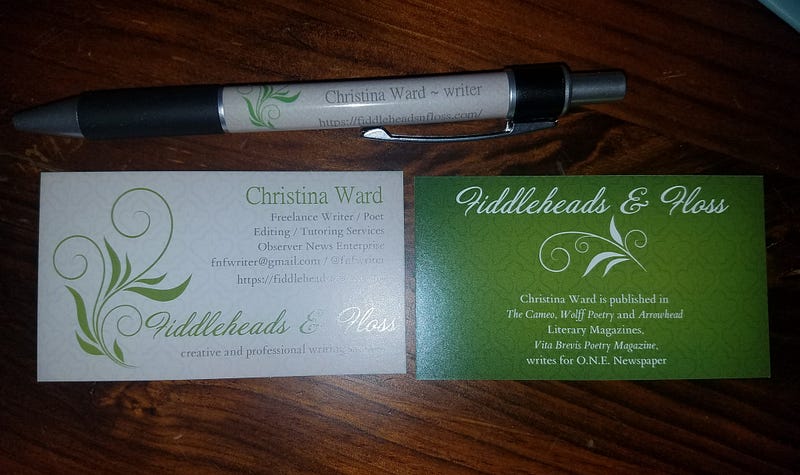
- Business cards / word of mouth Yes. Good old-fashioned business cards. (I designed mine at Vistaprint.) When you are out and about, name drop yourself as an author. Strike up natural conversations with people and give them your business card. Invite them to read your work. You never know when these brief encounters could lead to book sales. List a professional email on your business cards as well for any follow-up questions they may have.
These are just a few ideas but if you take a bit of time to think “outside of the box” you may come up with a few others. I’d love to hear your tips if you’d like to drop them in the comments.
Happy promoting!
Other articles by this author:
Owning Your Niche as a Writer
You know who you are — unapologetically Own it.
writingcooperative.com
Christina Ward is a poet, writer, author, and blogger. She’s a Top Writer in 8 topics, owner of 2 medium publications, editor to 9, and writer for 58 others. Her work has appeared in The Writing Cooperative, Better marketing, Scribe, Lit Up, Publishious, The Startup, and The Ascent, among others. She has just published her first poetry collection.


