
Make Good Art
12 Inspiring Writing Quotes From Neil Gaiman
Learn From One Of The World’s Greatest Writers
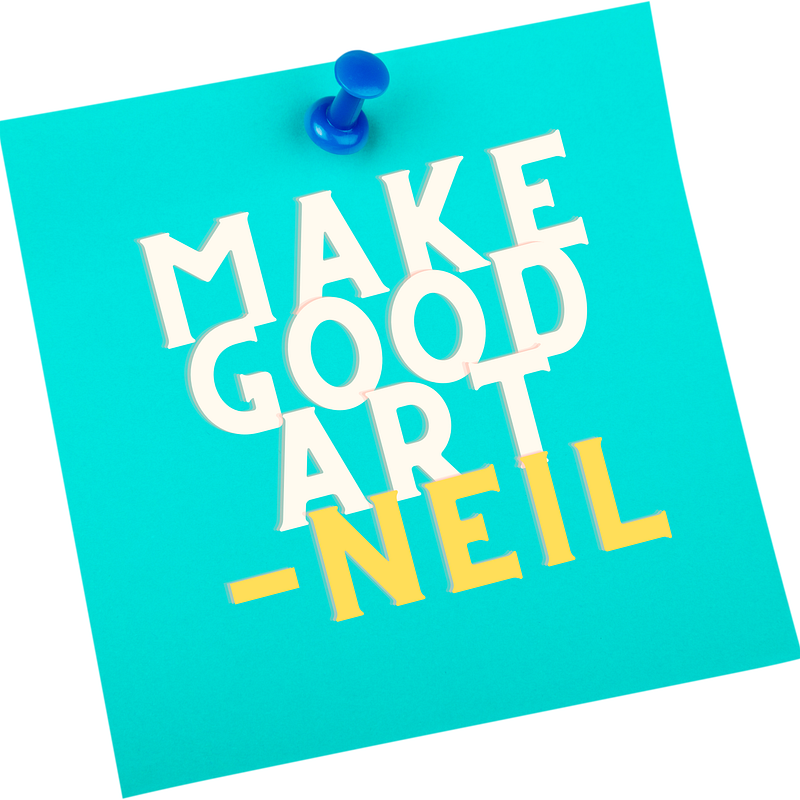
When determined to become great at something, look to those that do it best.
Few writers in this or any age have achieved the superstar status of Neil Gaiman. He’s written comic books, novels, non-fiction, television, movies. For crying out loud, the man has written for Doctor Who.
Neil is a rockstar.
If I were Neil, I’d be able to speak with that British accent my wife says she loves so much. I’d also probably be a bit full of myself.
Not Neil. He’s nice and kind. He’s also full of great advice on art in general and specifically on writing.
1. On Fairy Tales and Fiction
Fairy tales are more than true: not because they tell us that dragons exist, but because they tell us that dragons can be beaten.
From the introduction to the novel Coraline.
Never underestimate the importance of truth found in fiction.
2. On what to do.
On the whole, anything that gets you writing and keeps you writing is a good thing. Anything that stops you writing is a bad thing. If you find your writers group stopping you from writing, then drop it.
Neil has said that he learned to write by writing. Writers sometimes fall in love with the idea of writing more than writing itself. When deciding how to spend your time in pursuit of writing, anything that leads to writing is the right direction.
3. On where ideas come from.
You get ideas from daydreaming. You get ideas from being bored. You get ideas all the time. The only difference between writers and other people is we notice when we’re doing it.
People ask writers where they get ideas all the time. It’s why writers often come up with funny but nonsensical answers. In this case, Neil was asked by a group of young children and felt the need to give a real answer.
4. Write your first million words… quickly!
Assume that you have a million words inside you that are absolute rubbish and you need to get them out before you get to the good ones. And if you get there early, that’s great.
The more you write the better you write.
5. The magical moment when your writing comes to life.
The best thing about writing fiction is that moment where the story catches fire and comes to life on the page, and suddenly it all makes sense and you know what it’s about and why you’re doing it and what these people are saying and doing, and you get to feel like both the creator and the audience. Everything is suddenly both obvious and surprising… and it’s magic and wonderful and strange. — Neil Gaiman Journal Entry.
Most writers, I think, have experienced similar feelings. These are those moments when everything clicks and you’re surprised at how brilliant your subconscious mind must be. The nice part, Neil has said, is that when reading your work later, it’s nearly impossible to tell when it came together and when you struggled to find the words.
6. Neil talking about fixing and editing.
You can fix dialogue that isn’t quite there. You can fix the beginning of something. But you cannot fix nothingness, so you have to be brave. You have to just start.” From Neil’s Masterclass.
I’ve written about not overediting. The fact remains that it is far better to write something that needs fixing than it is to write nothing that is perfect.
7. Good writing requires stepping outside of your comfort zone.
I wasn’t really prepared to say anything true about who I was. I didn’t want to be judged. I didn’t want people reading any of my stories to know who I was or what I thought or to get in too close. And I realized that if you’re going to write…you had to be willing to do the equivalent of walking down a street naked. You had to be able to show too much of yourself. You had to be just a little bit more honest than you were comfortable with.
This is extremely helpful advice. My worst writing has involved trying to conceal myself from the world. The more vulnerable I allow my writing to be, the better it turns out.
8. How to handle feedback from readers.
You always have to remember, when people tell you that something doesn’t work for them, that they’re right. It doesn’t work for them. And that is incredibly important information. You also have to remember that when people tell you what they think is wrong and how you should fix it, that they’re almost always wrong.
An experienced writer may be equipped to help you fix structure and story. That is different. When working with first readers, beta readers, or even just readers, always listen to when they tell you something isn’t quite right. This doesn’t mean they know how to fix the issues.
Quotes 9–12 are all from the Make Good Art speech.
9. Not knowing the rules.
When you start out on a career in the arts you have no idea what you are doing.
This is great. People who know what they are doing know the rules, and know what is possible and impossible. You do not. And you should not. The rules on what is possible and impossible in the arts were made by people who had not tested the bounds of the possible by going beyond them. And you can.
If you don’t know it’s impossible it’s easier to do. And because nobody’s done it before, they haven’t made up rules to stop anyone doing that again, yet.
Neil Gaiman. Make Good Art.
Some of the best art has come from people creating what others thought couldn’t be made.
10. Learn to write by writing.
I learned to write by writing. I tended to do anything as long as it felt like an adventure, and to stop when it felt like work, which meant that life did not feel like work.
Neil Gaiman. Make Good Art.
Write. Learn to write by writing. Make it an adventure, and it will become one.
11. Making Mistakes.
I hope you’ll make mistakes. If you’re making mistakes, it means you’re out there doing something. And the mistakes in themselves can be useful. I once misspelled Caroline, in a letter, transposing the A and the O, and I thought, “Coraline looks like a real name…”
Neil Gaiman. Make Good Art.
Make making mistakes a good thing.
12. Make Good Art.
I’ll finish this list of quotes with one of the most important one’s from Neil, also from the speech.
Make good art — Neil Gaiman
Scott Hughey is not Neil Gaiman. Any resemblance to Neil’s writing, or for that matter, to his accent, are purely in Scott’s head.