
12 Centuries in 12 Months January Update
What this project is teaching me…
In this post I want to round up lessons learned this month about note-taking, projects and Capacities, and I’ll mention what I’m changing for this month…
I have had so much fun with this project so far. It’s taught me that I’ve been missing out on so much by “starting” my notes in the early modern period. I’m so grateful that this project has put an end to that.
My approach
As mentioned in the introductory post, I asked ChatGPT for an outline for what to study. These looked fine after a quick skim but when I actually began research, it quickly became clear that there were entire continents of the world that were not included.
The 9th century outline included nothing about the Americas or most of Africa and I just couldn’t understand ignoring 2 continents, so I asked for further clarification and did some research on what ChatGPT told me about.
But this leads me to the biggest problem, there’s so much to learn and 26 days in which to learn it (I started late!).
I don’t want to ignore parts of the world, but that means I can’t look in depth at things which is what I’m used to. But by definition, this is a breadth study not a depth study so I need to recalibrate.
In fact, I reminded myself that I literally identified this in the introduction and then got distracted by the ChatGPT outline. How does it make sense to say “I’m focusing on England” and then start of researching the Carolingian Empire? Because that’s exactly what I did…
So I need a different approach for the 10th century.
My plan is to go in depth on Vikings, and England in the 10th century, and then because nothing exists in isolation, I will then move onto to look at the outline set by ChatGPT. Everything on this outline will be read about, but I think I need to lower my expectations for how much I can know about each one. I have started making a list of things to research outside of this project, which I imagine will be huge by the end of the year. But that’s ok, this is a life practice!
Eras vs centuries
Honestly eras vs {any time period} is something I think about a lot. I’m always thinking about time and calendars and how that intersects with knowledge work.
This month though, it was eras vs centuries. They are not complimentary. The Vikings taught me this. I avoided reading anything about the Vikings that happened after 901 as if it were a spoiler, but I think I damaged my own understanding doing this. Or at least that’s my theory.
I assume that understanding the era as a whole would help me understand the snapshot of it (the 9th century) more. I found it very difficult to synthesise information because I’m trying to polish something half done or half read about.
So in February, I will read about the Vikings era first, and then Anglo Saxon England, even though that ends in 1066, and see if I find it easier to talk about the 10th century with a fuller understanding of the actors within it. I’m not 100% convinced it will be, but why not try?
This can’t be a universal change though because some eras or topics are centuries long. For example, the Holy Roman Empire was revived in 962, so is part of the 10th century curriculum. However it lasted until 1806. I cannot read its entire history in order to write about it in the 10th century, that makes no sense.
So my strategy, in sum, is to evaluate the topics of the century, told to me via ChatGPT outline, and decide whether to bend the boundaries of the century or not. I’m happy to bend the boundaries a little bit if I think it could help. This works for the Vikings and Anglo-Saxons, it doesn’t for the Holy Roman Empire.
Lowering expectations (but in a nice way)
All of this has made me realise that I will not have a finished MOC every month to show you. Notes are never finished! That’s the beauty in them. You’re always learning, and there is always opportunity for more connections.
In the age of aesthetics I feel a lot of pressure to show off finished notes, but if you look across my content, I don’t, because they don’t exist. I haven’t mastered anything yet. And even if I felt I had, that doesn’t close off that topic from ever being looked at again. But somehow, I forgot this and assumed at the end of each month I’d have a beautiful map of content to show you in my beautiful Capacities pages.
I’m lowering my expectations there. From now on, I plan to go as far as I feel I can with each MOC at the end of each month, but then move on. I don’t have to close or archive the MOC of the previous century, it’s a living, breathing part of my space, I can come back and apply what I’ve learned after.
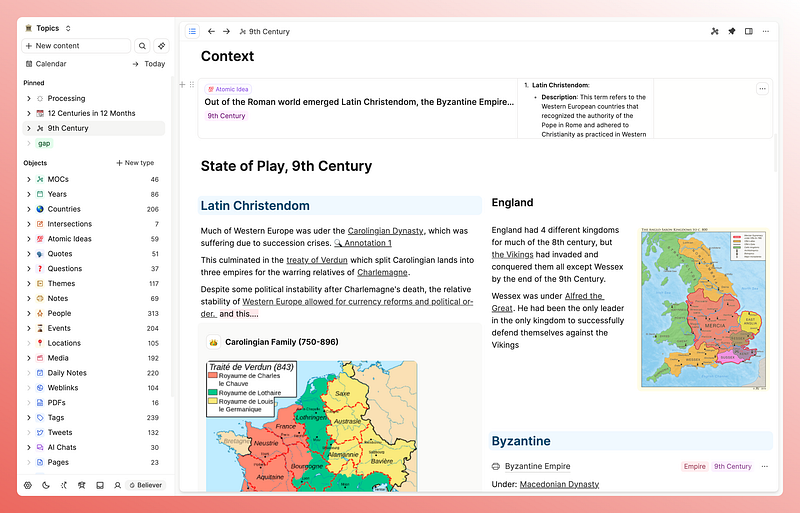
Capacities- the perfect host for this project.
Of course I’d say that, it’s my favourite tool ever, but here’s what I appreciated in January:
Queries
These have just launched and I’m loving them. I’ve got a video coming soon about 5 ways I’m using queries and most are to do with this project :)
Bulk Edit
This is just one of those quality of life improvements that is a delight to use. I used it for bulk tagging which helped my queries (again, more in the video!)
The right-hand sidebar in my objects
Part of using queries (or at least the object type queries which I like) means keeping up with adding metadata to your objects.
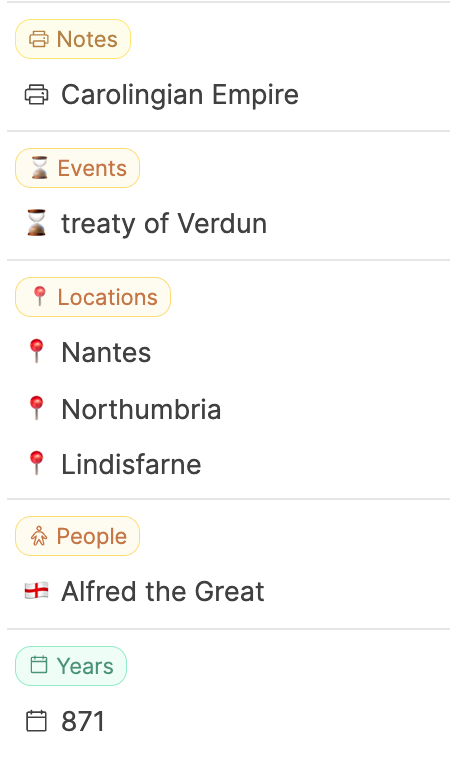
Capacities makes that easy in a lot of ways, but the one I was most impressed with was after tidying up a long note about the Vikings. I had linked to loads of objects and I thought “mm I wish I could see everything I’ve linked to but grouped by type”, so all people, all locations etc.
That exact functionality exists in the right-hand side-bar. Yay!
Conclusion
So there’s what I learned project-wise in January. I think some very valuable reminders.
And to sum up my approach for February…
- Less dedication to the exact boundaries of a century, if bending them slightly will aid my understanding.
- Less pressure for an in-depth understanding of everything. It’s neither realistic nor my goal, so why did I forget that in January?!
- Less pressure for a pretty MOC at the end of it
All in all, I’ve had an excellent time with this project so far. I’ve learned so much, I’m so ready to continue this journey.
If there’s any particular content that would be helpful or interesting about this, let me know!