
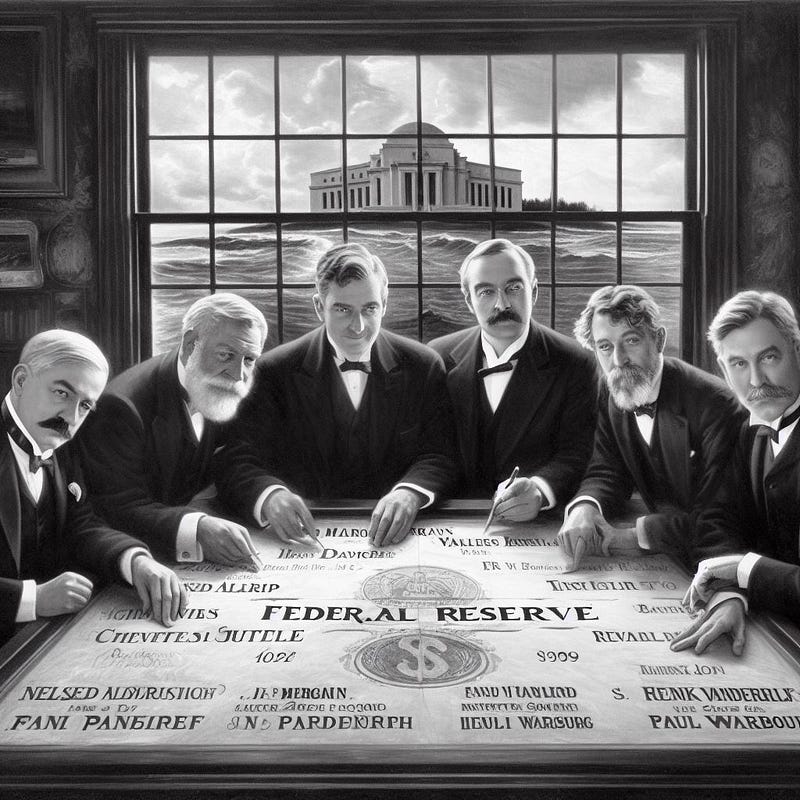
113 Years Ago This Week, JP Morgan and His Bankster Buddies Started a Cartel Called The Federal Reserve
Since taking over money, they’ve been ransacking the commons ever since
Editor’s note:
On August 1st, this website changed its algorithm so that only articles favored by their elitist editors receive distribution. I have nearly 38,000 followers and growing, but now less than 1% of you actually see my stories. So subscribe for free via Substack or you’ll miss Surviving Tomorrow’s articles.
This Week In Money by Greg Coleridge helps you discover the history of economics:
NOVEMBER 19
1831 — BIRTH OF JAMES GARFIELD, PRESIDENT OF THE UNITED STATES “Whosoever controls the volume of money in any country is absolute master of all industry and commerce, and when you realize that the entire system is very easily controlled, one way or another, by a few powerful men at the top, you will not have to be told how periods of inflation and depression originate.” (attributed quote)
2021 — CAN MMT AND JUST MONEY BE FRIENDS? WITH VIRGINIA HAMMON Alliance for Just Money Coffeehouse video Building Bridges: Is MMT a solution, a step in the right direction, or a swizzle? Can MMT and Just Money be friends? Virginia Hammon, author of US Money: What is it? Why we must change, How we can (2018), and (with Mark Pash), How We Pay for a Better World (2019) will explore the similarities and differences in the goals, values, definitions, and worldview of Modern Money Theory and Just Money.
NOVEMBER 20
2014 — UK PARLIAMENT DEBATES MONEY CREATION FOR FIRST TIME IN 170 YEARS From a press release from the UK group, Positive Money “Parliament places huge scrutiny on how taxpayers’ money is spent. But for the last 170 years, parliament has ignored the question of how money is created in the first place. This will change on Thursday 20th November when MPs will attend a debate on money creation and society. Money creation affects almost every aspect of our lives and is directly connected to almost all public policy, including public and private debt levels, house prices, and rising inequality, but it’s very poorly understood. A recent poll found that 7 out of 10 MPs believed that only the government could create money, when in fact banks create 97% of money when they make loans, as recently confirmed by the Bank of England. There is cross party support calling for a debate on money creation. The problems resulting from private money creation have not been debated in Parliament since 1844, when Sir Robert Peel brought in the Bank Charter Act, forbidding the private banks from printing paper money. In light of the financial crisis, we welcome this debate to discuss the foundations of the economy: the monetary system.” [NOTE: Lack of basic understanding of money creation is no doubt as much a reality of U.S. Senators and Representatives as English MP’s. Needed is a similar debate in the U.S. Congress to increase their monetary literacy and raise the issue for public discussion.]
2019 — THE FEDERAL RESERVE IS LOOKING INTO DEVELOPING A DIGITAL CURRENCY IN THE US, POWELL CONFIRMS “A digital currency backed by the central bank in the largest economy would be unprecedented and raise a host of legal and operational questions. Powell said it would be closely considered by policymakers but added that the US could be in some ways better positioned than other countries that have looked into such a proposal.” https://markets.businessinsider.com/news/stocks/the-federal-reserve-is-looking-into-developing-digital-currency-us-2019-11-1028705211?fbclid=iwar2w7bdoo27_pjzxnv8loj6vkogvx0rwxpuid9arf-oqgsqdsl00j_5sn4m [NOTE: A Fed-backed national digital currency would not change the fact that the Fed would continue to create money out of thin air as debt.]
2019 — MEMBER SUCCESS STORIES: THE AMERICAN ALLIANCE FOR JUST MONEY, ONLINE REPORT “Over the last few months the Alliance has been supporting two of our members How We Pay Campaign. Board member Virginia Hammon (Author of US Money: What is it? Why we must change. How we can) and AFJM member Mark Pash (Author of Creating a Win-Win Economy: Solutions for the Robotic Age) collaborated to publish their joint work entitled How We Pay For A Better World. The campaign is a multifaceted effort to bring awareness about monetary reform to U.S. citizens. It involves not only a book but also a country wide tour visiting various conferences, fairs and gatherings to spread an understanding of how Just Money can pay for a better world. Below is a link to a video narrated by Virginia Hammon promoting the campaign.” Watch video at
NOVEMBER 21
1933 — PRESIDENT FRANKLIN D. ROOSEVELT — FINANCIAL ELEMENTS OWN THE GOVERNMENT “The real truth of the matter is, as you and I know, that a financial element in the larger centers has owned the Government ever since the days of Andrew Jackson — and I am not wholly excepting the Administration of W.W. (Woodrow Wilson). The country is going through a repetition of Jackson’s fight with the Bank of the United States — only on a far bigger and broader basis.” — Franklin Roosevelt, letter to Presidential advisor Col. Edward Mandell House
1939 — BIRTH OF MARGRIT KENNEDY, AUTHOR OF “OCCUPY MONEY” “But we humans, not God, created our monetary system. And we are the ones who can change it. We must go beyond blaming the greedy bankers and investors whom we hold responsible for the ongoing financial disaster. Our own ignorance, comfort, and insecurity are part of the problem. To awaken from our slumber, we must expand our knowledge and shake off our fears.” 1944 — BIRTH OF DICK DURBIN, US SENATOR, ILLINOIS “And the banks — hard to believe in a time when we’re facing a banking crisis that many of the banks created — are still the most powerful lobby on Capitol Hill. And they frankly own the place.” Interview on WJJG 1530 AM’s “Mornings with Ray Hanania,” April 2009 [NOTE: The FIRE sector — Finance, Insurance, and Real Estate — is the #1 sector of political campaign investments (mistakenly called “contributions” or “donations”) to federal political candidates. They also employ hundreds of lobbyists who often write the laws and regulations on financial issues.]
NOVEMBER 22
1879 — BIRTH OF RALPH HAWTREY, FORMER SECRETARY OF TREASURY, ENGLAND. “Banks lend by creating credit. They create the means of payment out of nothing.”
2012 — WHERE DOES MONEY COME FROM? video Short 2 minute video of Michael Kumhof, IMF Economist and Dirk Bezemer, Associate Professor, University of Groningen explaining where money comes from.
NOVEMBER 23
1910 — JEKYLL ISLAND MEETING TO PLAN FOR US PRIVATE CENTRAL BANK Attending this secret meeting were US Senator Nelson Aldrich; A. Piatt Andrew, Assistant Secretary of the Treasury; Frank Vanderlip, president of the National City Bank of New York; Henry P. Davison, senior partner of J.P. Morgan Company; D. Norton, president of the Morgan-dominated First National Bank of New York; Benjamin Strong (a lieutenant of J.P. Morgan); and Paul Warburg, connected to the banking house of Kuhn, Loeb. The meeting would lead to the Aldrich bill, which eventually led to the Federal Reserve Act, passed in 1913.
2000 — WRITTEN ANSWER TO LORD BEAUMONT OF WHITLEY, HOUSE OF LORDS, BY JAMES ROBERTSON, CO-AUTHOR OF “MONETARY REFORM — MAKING IT HAPPEN” “Many people, even in government and parliament, don’t know how new money is now created, and what the consequences are. Most people find it hard to believe, if they think about it at all, that almost all the money in circulation has been created by commercial banks at profit to themselves. In reply to questions, a government spokesman may say that the funds which banks lend to customers ‘must either be obtained from depositors or the sterling money market, both of which usually require the payment of interest’ — thus appearing to deny that banks are allowed to create new money and to profit from doing so.”
NOVEMBER 24
1911 — AMERICAN BANKERS’ ASSOCIATION ENDORSES SO-CALLED “MONETARY REFORM” PLAN The ABA at their annual conference in New Orleans endorsed a “monetary reform” plan by U.S. Senator Nelson Aldrich. The plan was actually to deform the ability of citizens to create and distribute their/own own money (see above November 23, 1910 entry).
2018 — CONFERENCE ON THE FUTURE OF MONEY, FRANKFURT, GERMANY “How does the digitalization change the monetary system? Which problems are occurring in the current money system? Will central banks introduce digital cash? How would this new form of money change the structure of the money system? Will it evolve into a sovereign money system (Vollgeld)? And what part will blockchain technology play? Will private cryptocurrencies create a new stable monetary system? All these questions will be discussed at the Conference” http://conference2018.monetative.de/
2020 — “HOW BANKS CREATE MONEY” VIDEO “However, where these banks deposits come from is often misunderstood. A common belief is that banks simply act as intermediaries. They accept deposits from society’s savers, and they lend the same money to society’s borrowers.This would mean that bank deposits are created by the decision of consumers to save, with banks then lending out these savings or deposits to borrowers. But it’s not true. The actual relationship is the inverse of that usually assumed. Commercial banks decide how much they can profitably lend in the market, and then that lending activity creates new bank deposits.” (9 min, 12 sec mark) “Tim Skeet is a banker with more than 35 years experience in the financial markets. Tim has been an ICMA board member and an ECBC steering committee member. Tim is also a Freeman of the City of London… “Finance Unlocked produced this video and is the world’s first comprehensive, on-demand video-delivered learning platform built specifically for finance professionals.”
NOVEMBER 25
1874 — GREENBACK PARTY FOUNDED The Greenback Party was founded on this day at a convention in Indianapolis. Many of its members were farmers hurt by the financial Panic of 1873 (also known as the “Crime of ‘73”). The party supported “Greenback” paper money (U.S. Notes) issued and spent into circulation by the Lincoln administration. They opposed all money systems backed by any precious metal, believing that those who owned gold or silver (banks and corporations) would possess the power to define the value of products and labor. Government control of the US money system would also ensure sufficient quantity of money was in circulation to help small businesses and farmers. Twenty independent congressmen, mostly Greenbackers, were elected in 1878.
2008 — QUANTITATIVE EASING (QE) PROGRAM ANNOUNCED BY THE FEDERAL RESERVE The Fed announced that on December 1 it would create money and use it to purchase $500 billion in toxic mortgage backed securities from Fannie Mae and Freddie Mac and an additional $100 billion of debt from both entities. This phase of QE (called QE1) extended until March 2010. Two additional rounds, QE2 and QE3, followed it. A total of $4.4 trillion from the Fed was issued. It went disproportionately to financial corporations (Wall Street), not “Main Street” (for small businesses) or to “Side Streets” (to bail out homeowners facing foreclosures). QE money was also spent to purchase US Treasury bonds (debt) following the decline of purchases by other nations as a means to stimulate the economy. At its peak, $85 billion per month in Treasury debt and mortgage backed securities was purchased. Many within the financial industry have since admitted that QE contributed to the rising gap between rich and poor and the rise and size of too-big-to-fail banking corporations.
This Week In Money by Greg Coleridge helps you discover the history of economics. Get TWIM delivered directly to your email inbox for free.
Thanks to the new algorithm you probably missed:
Jews Vs. Muslims — A Christian Perspective
“Smart” Devices Are Just Trojan Horses for Surveillance Capitalism
Nevermind This Dip — House Prices Will 10X In Our Lifetime
Airbn-banned: New York Finally Cracks Down on Illegal Landlords


