
11 Writing Tips from a Self-Proclaimed Bad Writer Who Persevered and Won a Pulitzer
“You’re supposed to write what you have to write”

What do you do if you want to be a writer, but your writing is bad? So bad you can’t even get into a creative writing class and you know you don’t have the writing chops to tell the story you want to tell.
If you’re Colson Whitehead, you keep writing anyway.
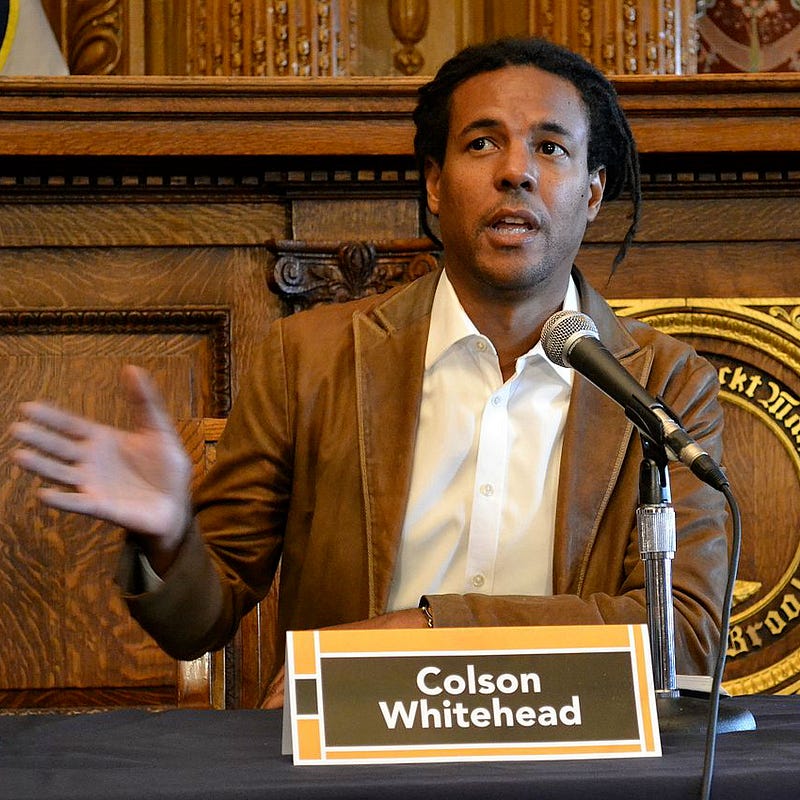
His book, The Underground Railroad was published the summer of 2016.
It won the Pulitzer Prize, the National Book Award, the Carnegie Medal for Fiction, Arthur C. Clarke Award, and was a #1 New York Times Bestseller.
It made Oprah’s Book Club.
Not bad for a self proclaimed lousy writer.
It took almost 20 years of persistence to get there.
He always wanted to be a writer…
When he was 10 or 11, he reasoned that a writer wouldn’t need to wear clothes or talk to people and he could spend all day making things up.
Trouble was, he says, his writing was awful.
He tried applying for writing classes, but they always included sending in a sample and he got rejected, every time, because his sample writing was so bad they didn’t think he had the aptitude to be a writer.
After repeat rejections, he decided he’d just write a book. I’m sure you know how that went.
As the rejection letters piled up, he finally decided maybe that book wasn’t so good. So he started writing another book.
His debut novel was published in 1999.
Today, his writing has appeared in The New York Times, The New Yorker, New York Magazine, Harper’s, and more. He’s the recipient of both a MacArthur Fellowship and a Guggenheim Fellowship.
Along the way, he learned a few things.
1. Let your subject find you
“Don’t go searching for a subject, let your subject find you. How do you think Capote came to “In Cold Blood”? It was just an ordinary day when he picked up the paper to read his horoscope, and there it was — fate.”
We love to believe we can “think up” ideas, don’t we? Self growth people tell us to sit down every morning and take time to “think” and plan.
Which is fine and well in business, but perhaps not terribly productive for writers. Because ideas don’t come from thinking. They come from flashes of inspiration that seemingly come out of the blue.
For writers, the Eureka Effect is likely to be the best source of our inspirations. You’re taking a shower or going for a walk, or peacefully reading the newspaper when — bam. There it is. The idea that eluded you.
The ideas don’t really come out of the blue. But when you’re not actively thinking, when you’re walking or relaxing or doing anything mindless, that’s when your subconscious connects the dots.
As Kurt Vonnegut said; “I tell you, we are here on Earth to fart around, and don’t let anybody tell you different.”
And of course we are — because that’s when our best ideas show up.
Which is probably why so many writers keep a notebook to jot down the ideas that show up when you’re farting around and least expecting them.
2. Write what you have to write
“Other people have hang-ups about what’s literary or genre or whatever, and that’s sort of not my problem. You’re supposed to write what you have to write”
The world has plenty of ideas about genres and topics and how writing fits into those classifications. There’s no shortage of people sniffing their nose at Stephen King, saying he’s not exactly writing “literature.”
Snobbery is a popular pastime in every industry. If that’s not enough, the world is filled with people who have ideas about how everyone else is supposed to fit into the world, too. Back in 1927, one of the Warner Brothers said no one wants to hear what actors think.
Everything new is protested before it’s accepted and there’s no shortage of people telling you what you should write, and what you shouldn’t write.
Alas, creativity doesn’t work that way.
You are a patchwork quilt of experiences and beliefs and things that delight you and things that make you angry and you have to write about that which you care about deeply, regardless of whether they fit neatly into a category or not and whether other people like them or not.
Don’t write what the world expects you to write. Write what you have to write. Pay attention to the topics and themes and cares that whisper your name in the middle of the night and write about those.
Doesn’t matter if you weave them into fiction or blast them as an op-ed. How you write them is optional. That you write them, I think, less so.
As Neal Gaiman says: “The moment that you feel that, just possibly, you’re walking down the street naked, exposing too much of your heart and your mind and what exists on the inside, showing too much of yourself. That’s the moment you may be starting to get it right.”
3. Don’t write what’s popular
“Early on my career, I figured out that I just have to write the book I have to write at that moment. Whatever else is going on in the culture is just not that important. If you could get the culture to write your book, that would be great. But the culture can’t write your book.”
When Harry Potter came out and hit all the bestseller lists, the market was flooded with copycat books about magic. Publishers tend to love this.
This is how the book industry works. Publishers love to publish more of “what’s working” — at least that’s the theory.
None of the copycat books sold like Harry Potter. There is only one Harry Potter. One J.K. Rowling.
None of the other books that used F*CK in the title sold as well, either. There’s only one Mark Manson.
Writers struggle with this a great deal. We see what’s popular, what’s hot and think we might find some shred of success if we hop on that bandwagon.
It seldom works.
It worked for that writer because they wrote what they were compelled to. When we write what we’re compelled to write, the honesty and integrity of shines through the writing. Copying seldom has that sparkle.
If you only write on a topic because it’s popular, because it’s hot or because someone else is doing well with it, it ends up lacking something and that disconnect screams at the reader without words
4. Give yourself a chance to learn how to write
“There’s a time to wait, and there’s a time to bite off the project you don’t think you can pull off.”
When Whitehead got the idea for Underground Railroad, he said knew he didn’t have the chops to write that book. So he sat on the idea.
For over 15 years.
He knew he wasn’t ready, as a writer, to tackle the ambitious idea when he first thought of it. He knew his skills were not sufficient to do justice to the story idea he had.
He didn’t have the writing chops to write that book.
But just because he didn’t have the skills yet, didn’t mean he couldn’t develop them. He reasoned that with each book he wrote, his writing skills would improve. So he wrote a different book.
And another, and another.
It took a lot of unpublished writing, followed by seven published books before he felt he was ready to tackle the story that would become his Pulitzer winning book.
The value in waiting, he said, was that he learned how to calibrate realism with fantasy in a way that would do justice to the story.
You’ve got to give yourself time to learn to write, and you don’t learn by not doing.
5. Pay attention to what captivates you
“If I have three ideas and I’m working on one more than the others, that sort of tells me that I should work on that one.”
It would be nice if ideas would show up one at a time, or at least in an orderly queue like the bodies standing in line for their turn at the roller coaster or perhaps Splash Mountain.
But no. That’s now how ideas show up. They show up like zombies banging on the doors and breaking windows the only house with live meat inside.
Which explains the number of drafts you have. Me, too. I don’t even want to count the drafts anymore. It’s ridiculous. Embarrassing.
I think it’s supposed to be that way. The ideas flood in and you make drafts, or perhaps notes in a notepad or word document or a lined notebook.
Because when they show up that way, in droves and bunches, it’s inevitable that some of them will scream at you louder than others.
Maybe it’s a story. Maybe it’s a topic. I don’t know. But I do know that they are not all equal. Some of them haunt you more than others. In life, many things will catch your eye. Only a few will catch your heart. Write those.
6. You learn from failure, not success
“It is failure that guides evolution; perfection provides no incentive for improvement, and nothing is perfect”
It’s easy and fun to celebrate the wins, isn’t it? To pin that story to the top when it has 1K or 2K likes and makes you feel like you hit one out of the park.
Of course, those aren’t the ones we learn anything from. We learn from the flops. The duds.
The trouble, of course, is that we have to get out of our own ego to learn anything. If I’ve built an audience by writing about business, and then I write a poem and it flops, is it the poem? Or the audience?
If I’ve built an audience around poetry and a poem flops, there’s more likely to be something to be learned there, you see?
It’s hard to analyze what failure has to teach you if you’re looking at everything through the filter of ego.
Too easy to fall into the trap of thinking no one likes you, or whine about curation jail and fall head first into the pit of despair.
As Jim Rohn observed, neither success nor failure are a single cataclysmic event. Does anyone know that better than a writer?
7. It’s not about you…
“The story is more important than you.”
You know what stories are? They’re lumps of coal, and the writer is tasked with polishing them into the shining gems they can be.
This is why so many self published writers struggle.
I’m not just talking about books. Writers on sites like Medium are, essentially, self published writers, too.
Take, for example, Harper Lee. Her first draft was essentially a biography and no one wants to read a biography by someone they’ve never heard of. Luckily, an excellent editor could see the glint of diamond in that first lump of coal.
Through much coaching and many re-writes, they found the story buried in the words. The same applies to you, and me.
There is a story buried in that first draft. The story is more important than you, which is to say it’s more important that your ego or your attachment to the first words that spilled from your fingers.
Often, writers think their “experience” is the story. It seldom is. Usually, your experience is anecdotal to the story and the real story is about that which leaves the reader changed after reading.
8. Be concise
“Never use three words when one will do. Be concise. Don’t fall in love with the gentle trilling of your mellifluous sentences. Learn how to “kill your darlings,” as they say.”
Stephen King tells a wonderful story that goes something like this…
Here’s a table covered in a red cloth. On the table is a cage the size of a small aquarium. In the cage is a white rabbit with a pink nose and pink-rimmed eyes. On its back, clearly marked in blue ink, is the numeral 8.
The most interesting thing isn’t the carrot-munching rabbit, but the number on its back. Not a six, not a four, not nineteen-point-five. An 8. It’s what we’re all looking at, and we all see it.
Here’s the thing. Most novice writers would spend pages of ink to describe the rabbit and the cage and the table and the room — and they’re all excess words. Because they don’t matter. That number is what matters.
Why is there an 8 on the rabbits back? Why it is in blue ink? That’s what we’re all wondering and all the flowery descriptions of the wooden table and what the cage is made of just detract from the thing that matters.
That’s why we have phrases like “kill your darlings” — which only means that all the lovely words and cleverly crafted descriptions don’t matter and don’t belong there unless they move the story forward.
This is what being concise means. It means determining which words are needed and which are not. Most writing would be much better reading if it were cut in half. If you want a 5 minute read, be prepared to start with an 10 minute so that you have 5 minutes left when you cut what’s not necessary.
9. Allow for the reader’s imagination
“What isn’t said is as important as what is said. In many classic short stories, the real action occurs in the silences. Try to keep all the good stuff off the page.”
The iceberg theory or theory of omission is a writing technique coined by Ernest Hemingway. The writer knows more than appears on the page.
It’s classic “shoulders of giants” — Hemingway learned the theory of omission from Kipling and dubbed it the iceberg theory.
Here’s an example. There’ a scene in one of Hemingway’s books where a man is focused intensely on fishing. Reading the scene, the reader is intensely aware that the man is trying not to think of war experiences that haunt him. Hemingway didn’t need to say that for the reader to know it.
That’s a mistake novice writers often make, thinking they need to spell everything out. As though they need to take the reader by the hand and not just tell the story, but explain it along the way, too.
Another one — describing everything. Does it matter if her hair is chestnut brown with highlights in the sun that remind you of wheat on a sunny summer day? Or would the story move along just fine if I imagined her blonde? Does it matter that his skin is white, or black or brown?
When a story only tells that which is necessary, no two people read the same story and that’s perhaps the best reading of all.
10. Revise, revise, revise…
“Revise, revise, revise. I cannot stress this enough. Revision is when you do what you should have done the first time, but didn’t.”
If you’re lucky enough to work with a developmental editor and a line editor, you’ll have less editing to do. Most writers are not so fortunate.
So let’s talk a little about what those 2 editors do, so you understand what he means by revise.
If you were fortunate enough to have a developmental editor, he or she would read your story and zero in on the real story like a laser. Harper Lee is a great example. Her first draft was written in a biographical fashion, covering a time span from childhood to adulthood.
A great developmental editor read it and focused on the summer of the trial. That’s the real story. Then they had to make revisions to make that summer the focus. Not so much chopping the rest, but determining which parts were relevant and how the material could be woven into the revised story.
Several revisions later, a line editor would take over.
A line editor went through the story line by line, paragraph by paragraph, looking for the parts that don’t move the story along or don’t feel right. Killing her darlings, if you will. More revisions.
That’s what revise means. It means finding the story and then revising and chopping and adding to make the story stronger. Writing is rewriting.
11. Focus on growth
“The thing I fear most about creative work is just not knowing when I’m coasting.”
I love this one. In a world of “writer faster” and “write more,” I love the idea of stopping to ask ourselves — are we growing as a writer? Or have we become formulaic, churning out more of what works?
Seth Godin tells a story of artists in a developing country sitting hour after hour to paint replicas of famous works. While they have to have talent and skill to do that, they are not making art.
Not all writers want to grow as a writer. Some writers see words the same way other people see jobs. As income. Find the formula that works, and replicate. Nothing wrong with that.
Awareness is key. Knowing whether you’re simply seeking to find the formula that works for you, so you can replicate it like the artists copying famous works — or if you’re looking to grow at your craft. I think that’s an important thing to think about.
You Might Enjoy…
If you liked this, you might like my newsletter about writing, Medium and marketing. Read the back issues at: https://lindac.substack.com/