
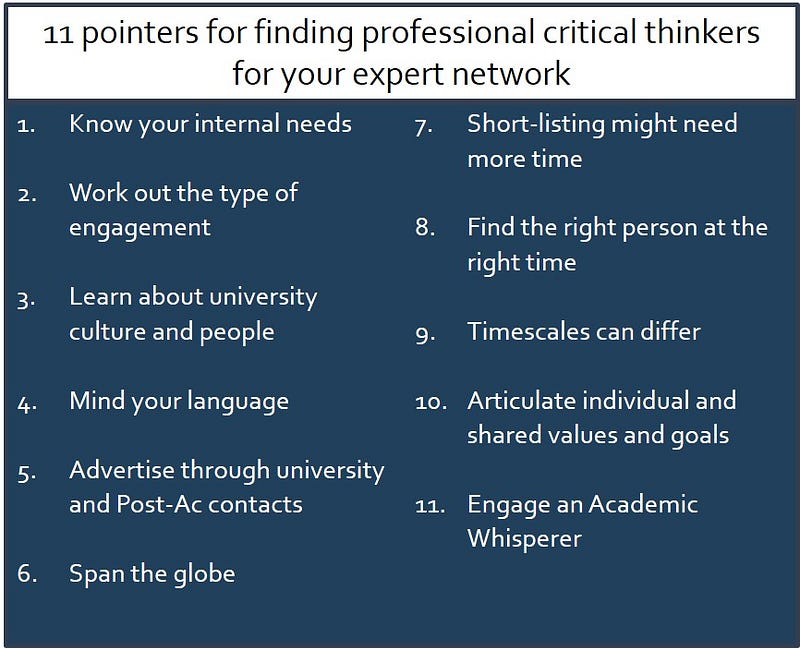
11 pointers for finding professional critical thinkers for your expert network
When your executive team is ready to recruit a critical thinker or two into your expert network it pays to have realistic expectations for the practicalities of the exercise. Even though the process will likely be different than usual and possibly require more resources, the additional intellectual power gained will be a significant advantage.

Professors and other PhD graduates bring diverse knowledge and skills to the executive’s expert network. I previously wrote about the benefits of having these ‘professional critical thinkers’ as an intellectual resource for the executive team in the Information Age and Exponential Era.
After the decision has been made to include professional critical thinkers in the expert network, the next step is to plan and then implement a ‘recruitment’ process. As with any recruitment, the process must be tailored to internal needs and to the target audience — in this case, professors and other PhD graduates (e.g. university researchers or Post-Ac members). For some executives, this means venturing into the less familiar territory of the university sector and its cultural nuances.
Here are 11 points to consider when planning your search for the best candidates and for creating fruitful relationships with experts who are used to operating within the cultural norms of the university environment.
1. Know your internal needs.
What is the particular problem, project or transition that needs assistance, or are you in need of general intellectual insight? What must be achieved, by when? What level of technical knowledge will be needed by our expert thinker? When your internal needs are clear then the SMART goals for engaging a critical thinker can be specified.
2. Work out which type of engagement will work best for you.
There’s no standard structure for an expert network and perhaps the only rule is that the network must be fit for purpose. Consequently, integrating professional critical thinkers into the expert network requires a deep understanding of the aims of the engagement. Three possibilities for engagement are:
- A CEO engages an expert critical thinker on a one-to-one basis for on-going personalised discussion and advice.
- A company appoints an expert critical thinker to the formal Advisory Board.
- A critical thinker is engaged to advise on a short-term situational basis for a specific project.
An informal group of experts may be an appropriate resource for one business, whereas a structured Advisory Board could suit another. When a business is faced by a significant challenge or is venturing into uncharted territory, the support of an Advisory Board can be an invaluable asset.
3. Learn about university culture and people.
The more familiar you are with the university research environment and the spectrum of cultures and climates, the more effective the engagement process will be. Gather information about who is doing what in your local universities, and even those further afield.
4. Mind your language.
There is a language divide between academia and business — terminology, meaning and communication styles differ. Make sure adverts and position descriptions cater to the intended audience. An excellent candidate might not realise they are qualified and well-suited if there’s too much corporate jargon in the position description. Engage a facilitator who can revise the language for maximum impact of adverts (see ‘Academic Whisperer’ below).
5. Advertise through university and Post-Ac community contacts.
The search process will depend on the type of engagement (e.g. informal one-to-one discussions, or appointments to an Advisory Board) as well as your organisational culture and resources. A targeted search or an open advertisement or a combination of both can be used to reach and recruit critical thinkers to your expert network.
Ensuring that your advert reaches a range of people in the academic and Post-Ac spaces can be a challenge, particularly if they aren’t actively seeking advisory positions or when there’s no overlap between your respective networks. Some practical tips for widening the net:
- Create an e-advert that’s easily shared because reach relies on other people sharing by email and social media.
- Share the e-advert with your personal contacts in universities and Post-Ac and ask for their help with word-of-mouth distribution.
- Post the e-advert on your social media sites that are open to the public e.g. LinkedIn, Twitter.
- Send the e-advert to groups and prominent people in the target community (e.g. Post-Ac influencers) and request their help with distribution.
- Advertise in peer-reviewed research journals. These are often discipline-based so pick the right one to reach your target audience.
- Advertise through organisations that facilitate business-academia connections e.g. STEM Women, SmartTribe.
6. Span the globe.
If policy and resources allow, prioritise recruiting for the thinking skills you need regardless of the geographic location of the expert. Team members no longer need to be in the same place at the same time for productive discussions. Take advantage of ICT to expand the possibilities and perspectives of your expert network. Even local experts may prefer the efficiency of virtual meetings sometimes to save travel time and maximise personal productivity.
7. Short-listing might need more time.
Just as business-speak may foster a perceived skill gap, ‘academese’ can delay the usual short-listing process. It can take longer to navigate through applications written in a different style. Having a degree of familiarity with academic-speak is useful, as well as access to facilitators who can translate and summarise. Critical thinking is a transferable skill which can be applied to new content, so it’s also important to find a balance when assessing a candidate’s experience in unrelated technical areas and their potential to adapt their skill set.
8. Find the right person at the right time.
When a candidate with the requisite professional expertise is found, the time commitment should be raised at the earliest opportunity. The ‘right’ person might not be available at the time you need them; even the most willing and capable may not be able. For example, professors can have research, teaching and service obligations plus stringent performance evaluation criteria. What’s more, professors with experience in business can be in high demand.
To procure the services of a preferred candidate it may be necessary to revise the objectives, type and timing of engagement. Alternatively, consider others who have relatively fewer external commitments, or postdoctoral fellows, early-career professors or the Post-Ac community. Focus on finding the right person for your needs who has time for your project, not a well-known name who is an advisor in name only.
[Sidenote: Advocate for innovation that supports cross-pollination. University performance evaluations traditionally prioritise research and teaching activities over external engagement. Consequently, professors allocate their time in proportion to evaluation criteria, particularly in readiness for promotion or tenure. This has resulted in a relative dearth of experts available for collaboration with other sectors. Fortunately, a growing number of universities are adding a community engagement or social responsibility pillar to their missions. In turn, performance evaluation criteria are being revised and the emphasis on external engagement slowly increasing. If you are in a position to do so, raise awareness amongst your contacts in university leadership about how their performance evaluation systems are impacting collaboration between business and academia.]
9. Timescales can differ.
Due to the nature of their work, the career-CEO and career-professor can think in very different timescales. University research projects tend to span 3–5 years rather than quarters, months or weeks. The researcher, therefore, is proficient in macro perspective and long-term impact. Exposure to this type of thinking can provide the executive team with new insight into the rationale for long-term strategy and practices. The executive team should, however, be explicit about hard project timelines and milestones to optimise relevant contributions.
10. Articulate individual and shared values and goals.
Similarly, the values and goals by which a professor or PhD graduate operate can differ. A lack of shared or complementary goals can doom a relationship before it even begins. Honest and open dialogue, and even some stretching, is required to identify mutually beneficial goals for the CEO and the advisor.
If there aren’t any shared or complementary goals then the relationship won’t work. For example, if you encounter a professor biased against any association with business, saying “industry is the enemy” and warning peers or students, “don’t sell out and work with a company, they only want to make money” then the easiest path is not to engage them as an advisor. Having a conversation might still be useful though to learn about their reasoning and provide them with information that could replace perception with reality because they can influence others.
11. Engage an Academic Whisperer.
The Post-Ac community is not only a rich source of professional critical thinkers, it also contains Academic Whisperers — people with dual-sector experience who can facilitate interactions between academia and business. Consider engaging an Academic Whisperer on a permanent or situational basis to support the recruitment of critical thinkers and all your growing interactions with universities and academics.
When your executive team is ready to recruit a critical thinker or two into your expert network it pays to have realistic expectations for the practicalities of the exercise. Even though the process will likely be different than usual and possibly require more resources, the additional intellectual power gained will be a significant advantage.
Every situation is unique, so use these pointers as a general guide and contact me for independent advice and support for your specific circumstances.
Kristen Sadler, PhD is an independent advisor, speaker and author. She uses futures thinking and strategic foresight to explore possible, probable and preferable futures and how to take action today to shape tomorrow.