
11 Lessons For Life From 21 Years of Martial Arts Training
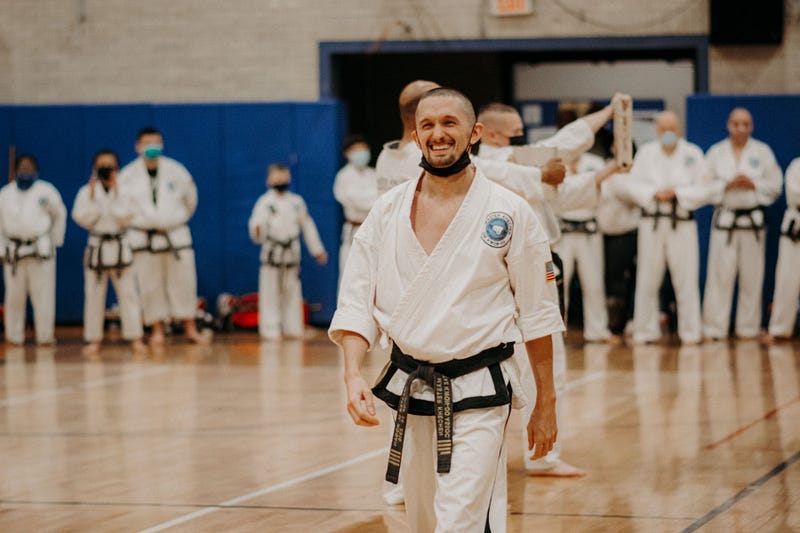
On April 11, 2001, I took my first Martial Arts class. I was overweight, shy, and desperately wanted to improve. Martial Arts helped me evolve into the person I wanted to become. What follows are a few of the life-changing lessons that fueled that transformation.
1) BE IT THEN BECOME IT
You don’t start acting like a black belt when you get a black belt.
It’s only after you’ve acted like a black belt long enough that you finally receive one. The same is true for any other identity you want to embody in life. You become it by acting like it long enough.
The “becoming” doesn’t happen first.
2) FOLLOW YOUR PASSION IS BAD ADVICE
Being passionate about martial arts is great. You can watch the movies, read the books, collect the posters, etc. But, until you learn how to execute techniques, teach students, run a business, etc. — your passions are of little to no value.
Pay attention to your passions — sure! But, focus primarily on building skills in those areas of passion. That’s how you’ll elevate yourself to a purposeful opportunity you can be proud of. Being passionate about something, in-and-of-itself, is of little value in the business world.
3) YOU DON’T START GOOD
Let me assure you that approximately none of us start “good” at anything.
Take meditating for example. Expecting to be “good” at meditating when you first start is like expecting to be “good” at Martial Arts when you come to your first class.
The point isn’t to arrive “good” — the point is to start where you are and improve. Besides the rare few who are “born enlightened,” I’m of the opinion that all of us have crazed monkey minds which make meditating hard.
…Which is precisely why we should be practicing it.
What we need to do isn’t *not* meditate because it’s hard. What we need to do is better manage our expectations. Meditating isn’t about closing our eyes and being able to experience a magical ceasing of all incoming thoughts. Not a chance.
It’s about stopping the flow of incoming information and allowing what’s there to settle. When I meditate, I spend probably less than a minute out of twenty actually free from thinking. This is an excellent day of meditation for me.
In fact, any day I practice meditating is an excellent day of meditating — because I practiced it. Get it? The practice is the reward.
Just like in Martial Arts.
…After all, what are belts but an external motivation tactic to encourage training?
The end goal (black belt) is simply a motivation tactic that’s designed to get you to practice. So, if you want to become a “black belt” in meditation (or anything), humble yourself and start practicing like a white belt.
4) THE JOURNEY SHOULDN’T BE TORTURE
Most people try to “punish” themselves into being fit.
- They “kill” themselves at the gym.
- Sign up for military-like bootcamps.
- Pay personal trainers to scream at them when they’re fatigued.
But, torture isn’t a good long-term strategy.
Fitness (self-improvement) should be a celebration. How do we do this? By aligning ourselves with forms of movement that we enjoy doing (at least more so than others).
For me? It’s (you guessed it) Martial Arts. The power is that it’s exercise, character development, community, and self-defense all wrapped into one. Exercise is often they byproduct of simply doing something I love doing.
Find your form of movement celebration.
5) DISCIPLINE DOESN’T HAVE TO BE HARD
The reason most people have a hard time with discipline is because they don’t want to take small, easy, confidence-building steps.
- They want to sprint.
- They want to rush the process.
- They want results NOW.
THIS is what makes it hard.
If you want to make discipline easy — you have to make the daily steps easy.
Otherwise, doing the tasks that require discipline will always look gigantic, daunting, and intimidating. This isn’t the path to a disciplined life.
6) MAKE WHAT’S HARD, EASIER
Earning a black belt in martial arts is hard. Attending one class is easy.
Writing a book is hard. Writing one sentence is easy.
Freeing yourself from the grips of anxiety is hard. Meditating for a few minutes is easy.
Everything in life that’s hard, is just a series of things that are easy.
You just have to break things down further and take the first, small step. And then take it again. And again. Until you’ve done what’s hard.
7) CALLOUS YOUR MIND
“It takes twenty years to gain twenty years of experience, and the only way to move beyond your 40 percent is to callous your mind, day after day. Which means you’ll have to chase pain like it’s your damn job!” ~ David Goggins, via MoveMe Quotes
According to Goggins, “40%” is how far we’ve actually pushed ourselves when we think we’ve pushed ourselves 100%. When we start experiencing enough pain, our mental chatter becomes so loud that we can’t ignore it anymore. And we quit.
Until we callous our mind.
On August 23, 2020, I ran my second marathon. I didn’t follow any specific running plans and did but only one training run (13.1 miles) leading up to it the week before. The most I had done besides that was a mile or two around my block at any given time the whole year prior.
Why do I tell you this? Because while I didn’t do any official running training for that run, I have been training my body for war for over two decades. And if you start doing the same, your body might be able to perform in ways that surpass your wildest expectations as well.
To be clear, “40%” efforts shouldn’t be done daily. Or weekly for that matter. Unless your goal is to burnout as fast as possible.
“40%” efforts should be done strategically and should be used as a tool to test and develop indomitable spirit. Because without it, it’ll weaken.
8) MAKE THE WARRIOR WALK YOUR EVERY DAY WALK
You don’t step into a Martial Arts Academy and suddenly start focusing on being more balanced. You don’t turn into a different person when you put on a uniform with a specific colored belt. The training is all one and the same.
How often are we going to need to defend ourselves against a malicious opponent? Hopefully never.
How about the physical threats of living a sedentary lifestyle? What about against the threats of sugar and sodium? Or against the mental threats of passive entertainment? Or gossip?
What about the emotional threats of less physical connection and more digital communication? Or untamed anger? Or learning how to deal with the feelings of sadness or aloneness?
THIS is what you have to defend yourself against every single day.
The challenges are all of the time and everywhere. How can you defend yourself against “bad” foods? “Bad” physical habits? “Bad” people? “Bad” media? “Bad” influences? You’d be surprised at how many of these answers you already know.
Ask the right questions. Challenge yourself accordingly. Defend appropriately and to the best of your ability. Then improve your skills so that you can defend better tomorrow. That’s what Martial Arts training is all about. Not the once in a lifetime fight — the daily fights.
9) DEFEND YOURSELF
In self-defense situations, you do everything you can to avoid the fight — but you also defend yourself when necessary. Getting swung at even once is just cause for self-defense. And defending yourself isn’t curling into a ball; defending yourself is hitting back.
This is what you have to do when life decides to hit you, too. You have to hit back. Not by punching, kicking, or elbowing. But, by confronting, transforming, and responding.
Just like you block a punch by confronting it with your arm, you block a problem by confronting it with your mind.
Just like you transform a person’s energy against them in Martial Arts, you transform emotional energy into a creative outlet in life.
Just like you respond to an aggressor’s attack based on training, you respond to life’s challenges based on experience.
And if you don’t know what to do against an attack and get hit — what do you do? Curl into a ball? Or figure out what went wrong and learn how to defend against it? The latter of course.
So, expand your mind!
- Find the right book.
- Write to find clarity.
- Talk to more experienced people.
- Broaden your understanding.
And hit back.
Don’t just give life a different target; make life the target and take your shots.
10) DETAILS MATTER
In Martial Arts, the direction of your toes — matters. The placement of your hands — matters. The distribution of your weight — matters. Even the height of your shoulders, the tilt of your head, and the squint of your eyes — matters.
Of course, the general coordination of the move matters, too, but it’s precisely the above mentioned details — the fine motor adjustments — that puts the “Art” in “Martial.” It’s the great divide between what makes “okay” and what makes “great.”
What separates an amateur punch from a professional punch isn’t their ability to quickly extend their hand from their face to a target and back — it’s how the details were minded in the process.
As is the case with basketball dribbles, hockey slap-shots, football throws, etc. — details are what separate beginners from masters and amateurs from pros. Anybody can dribble — few dribble professionally. But, attention to detail isn’t just activity specific.
The way you do anything is how you do everything. Attention to detail is a character trait that some choose to develop and some choose to overlook.
Attention to detail is:
- A careful awareness.
- A trained devotion to excellence.
- A rigorous loyalty to the minutiae.
- A deliberate decision to improve — beyond where most people stop.
- A drive for inches when most people park after miles.
It’s not for the faint of heart, preoccupied, or careless. It’s for the people who choose to be passionate, focused, and committed to paying details the attention they require — in any and every chosen task. It’s why attention is *paid* and not granted.
And it’s why masterpieces are so valuable — because they’ve been paid for in attention, energy, effort — details — many times over. Details that others find too expensive to pay. Details that bring the big picture to life. Details that, when removed leave masterpieces as just pieces.
11) DO RIGHT BY YOUR PAST SELF
On December 11, 2021, I got to test for my 5th Degree Black Belt in ITF Tae Kwon-Do. As I prepped for that day, I thought about what 11 year old me — the one who started Martial Arts all those years ago — would think if he watched me perform.
I imagined that overweight, self-conscious, always-hard-on-himself kid and I thought about everything he wanted to become: fit, confident, disciplined, looked up to, able to perform under pressure — and able to do cool moves, of course.
And it was an overwhelmingly emotional moment for me when I finished the test and thought to myself: I think he would’ve been proud.
If you liked this, you’ll probably enjoy my daily, insightful, 1-minute emails.