
11 Fundamental Principles to Change Our Behaviors, Leading Me to…
Develop my morning routine. All thanks to “Atomic Habits”¹

Change is a fantastic word because it represents our desire to fulfill something we have missed — as long as we recognize it first.
I have written numerous articles that implicitly and explicitly leverage James Clear’s four laws to build better habits. I think it’s also interesting to see how his words practically changed my life.
11 Fundamental Principles for Behavior Change
Before going in-depth about my changes, I will distill eleven fundamental principles I followed to meet Clear’s behavior change flow:
After I [current habit], I will [habit I need].
After I [habit I need], I will [track the habit].
Then I will [habit I want].¹
1. Be Aware of Our Current Behavior
Before doing anything else, we must understand how we behave currently. We can document our current behaviors and define whether they are “effective,” “ineffective,” or “neutral” in solving our problem.
2. Give Our Expected Behavior a Space in Our Lives
Bundle our current behavior with our desired new habit to know when and where to take action.
3. All About Our Environmental Design
There are two stages where Clear emphasizes developing a “friendly” environment that provokes us to implement our “expected” habits.
Firstly, make the cue for our desired habit a big part of our environment so that it is unforgettable.
In the later stage, we aim to reduce the “friction” associated with our desired habit to ensure that it would not interfere with our current lifestyle.
4. Use “Rewards” to Stimulate Our Initiatives
Situate our wanted behavior right after the behavior we “need” to implement to make it attractive.
Ideally, the wanted behavior won’t contradict the expected identity we seek to establish. The key is finding the right balance between our wants and needs.
5. Design Your Social Circle
Human beings seek acceptance and belonging. The best way to encourage our desired habit is to find a group where we share commonalities and treat this habit as “normal.”
6. Set up Our Motivation Ritual
Practice our enjoyment and let it prepare us to welcome the demanding habit’s arrival.
7. Time Won’t Matter if We Lack Repetitive Action
There’s no magic with time. The magic comes in frequent action. We don’t build habits because “21 days” have passed. We establish the habits by actively practicing them regularly.
8. Make it Easy to Start
In “Atomic Habits,” Clear introduces the “2-Minute Rule¹” for his readers to practice the desired habit with less demanding effort. Given its simplicity, this principle reinforces principle 7, where we want it to show up frequently even if we are not in the mood to do it.
9. Level Up to the Next Adventure
Once we promise frequent participation in our desired habit, we can gradually proceed to the next stage, from easy to intermediate, and from intermediate to advanced.
10. Visualize Our Progress (or Avoidance)
There are two things about which I strongly agree with Clear: humans are visual creatures, and we tend to fall in love with numbers. Integrating these two observations, building a tracking system to record whether we do our desired habits is a powerful mechanism we can leverage to make us feel satisfied with our progress and increase the chance of the associated habit’s future occurrence.
11. Give Ourselves a Buffer
Give ourselves a chance to make a comeback if we miss a day accidentally. It’s okay if we can’t achieve our desired habit for a day or two. But it’s not okay to self-judge and give up in all respects simply because of those few misses.
Now, the beauty of Clear’s words comes when they change my daily routine to greet every morning’s sunrise and start my day fresh. The diagram below shows a minimal yet optimal change in my morning routine, which enables me to meet my expected productivity.
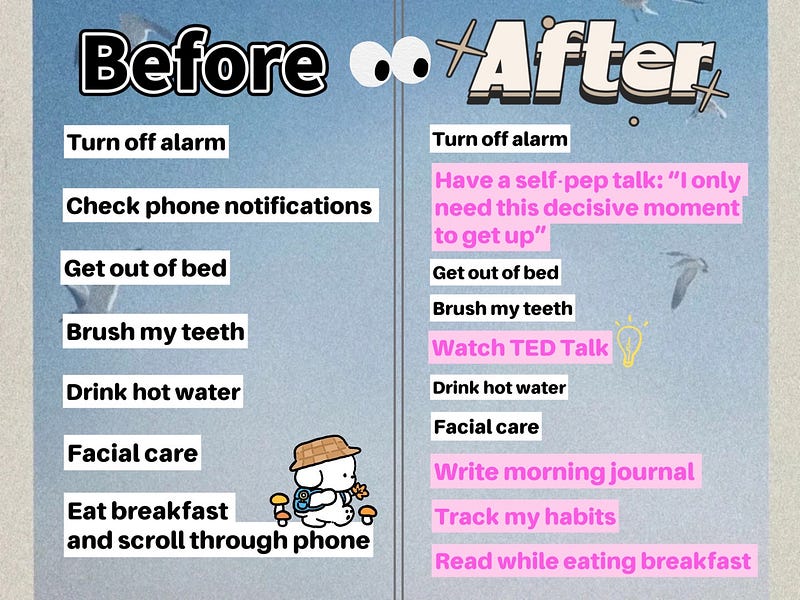
By evaluating my initial behavior, I found the opportunity space to insert three desired habits and one avoidance into my morning routine.
For the avoidance, I replaced it with a less detrimental habit (self-pep talk) and visualized my progress toward the end of my routine. For the other desired behaviors, I used a combination of temptation bundling, habit stacking, and environmental design to make them show up naturally in my lifestyle.
“Habit Stacking” Stimulation:
- Watching TED Talk: stacking it between need and want (brushing my teeth and drinking hot water, respectively).
- Writing a morning journal: a familiar habit, but it is a habit that wouldn’t show up repetitively before. After I learned the magic of creating space for vital behavior, I now know precisely when and where to perform it.
Tempted to Know My Progress
- Habit tracker: my ending ritual to demonstrate whether I have completed my desired habits and avoidance: waking up (and getting out of bed) early, watching informational resources, and writing my morning journal.
Put it Right in Front of Me — No Reason to Escape!
- Reading: I put my books (or e-book devices) on my kitchen table, which prompts me to read while eating breakfast instead of scrolling through social media.
It’s unquestionable that as I repeat my routine, I will discover new ways to improve. This is the beauty of such a process — seeking “better” is a lifelong journey.
Reference
¹ Clear, James. (2018). “Atomic Habits: An Easy & Proven Way to Build Good Habits & Break Bad Ones” Penguin: Avery.
You may also enjoy reading:
7 Steps to Fix Your Sleep Schedule for Good | by Nathan Chen | Small Steps | Nov, 2023 | Medium