avatarOlga G

Summary

The provided text discusses the fundamental Buddhist teachings on the nature of existence, impermanence, suffering, non-self, and the concept of liberation as an unconditioned state.

Abstract

The text, titled "108. BUDDHA SPEAKS ABOUT CHARACTERISTICS," is part of a collection of Buddhist parables. It emphasizes three core truths: the transient nature of all formations, the inherent suffering in them, and their lack of a permanent self. Despite these truths, a disciple questions how liberation and eternal bliss are possible. The Buddha responds by describing a state beyond the physical elements and the dualities of existence, a state that is unborn, unoriginated, and uncreated, which offers an escape from the cycle of birth and death. This state is presented as the ultimate reality and the path to liberation. The text also provides links to previous parables and printed collections of these teachings.

Opinions

  • The text conveys the Buddhist perspective that the nature of reality is characterized by impermanence (anicca), suffering (dukkha), and non-self (anatta).
  • It suggests that these characteristics are independent of the presence of a Buddha, implying they are universal truths.
  • The disciple's question reflects a common philosophical inquiry about how eternal peace can exist in a world defined by impermanence and suffering.
  • The Buddha's answer posits the existence of an unconditioned state, referred to as the "uncreate," which transcends the limitations of the conditioned world.
  • The teachings imply that understanding and mastering these truths leads to the discovery of the path to liberation, which is a central goal of Buddhist practice.
  • The text encourages the reader to explore these concepts further through additional parables and printed literature, suggesting a didactic purpose.

108. BUDDHA SPEAKS ABOUT CHARACTERISTICS

108 Buddhist Parables

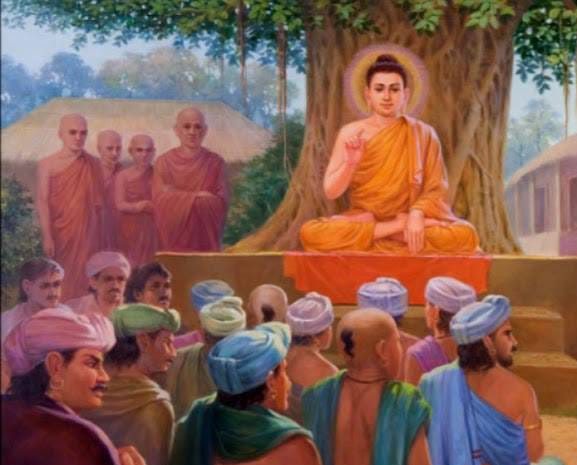
“Whether Buddhas arise, O Monks, or whether Buddhas do not arise, there are three facts. It remains a fact and a necessary constitution of being that all conformations are transitory. It remains a fact and a necessary constitution of being that all conformations are suffering. It remains a fact and a necessary constitution of being that all conformations are lacking a self. These facts any Buddha discovers and masters, and when he has discovered and mastered it, he announces, proclaims, minutely explains them.”

On hearing this, one disciple, who still had some doubt left in his heart, asked the Blessed One, “The Buddha teaches that all conformations are transient, that all conformations are subject to suffering, that all conformations are lacking a self. How then can there be liberation, a state of eternal bliss?”

And the Blessed One answered, “There is, O Monks, a state where there is neither earth, nor water, nor heat, nor air; neither infinity of space nor infinity of consciousness, nor nothingness, nor perception nor non-perception; neither this world nor that world; neither sun nor moon. It is the uncreate. It is neither coming nor going nor standing; neither death nor birth. It is without stability and without change. It is the eternal which never originates and never passes away. There is an unborn, unoriginated, uncreated, unformed. Since there is an unborn, unoriginated, uncreated and unformed, therefore there is an escape from the born, originated, created, formed.”

— — — — — — — — — — — — — —

Previous Parable: 107. BUDDHA SPEAKS ABOUT KARMA

— — — — — — — — — — — — — —

All parables in printed book format: 108 Buddhist Parables and Stories and 108 Zen Parables and Stories

Buddha
Buddhism
Religion
Wisdom
108 Buddhist Parables
Recommended from ReadMedium