100 Mind-blowing Things You Need To Know About The Dark Side Of Power (48 Rules of Power, Robert Greene)

The “48 Laws of Power” by Robert Greene is a highly influential book that changed my life.
I puked when I read it.
When I read this book, I felt disgusted.
I felt ashamed of my humanity.
Yet, somehow, I also felt enlightened, because I was finally able to make sense of how manipulators and power mongers operated.
Below are the 48 Laws of Power — enlightening, disheartening, thought-provoking, and disgusting.
Beware! These laws will empower you beyond your imagination, but they will also rob you of your heart, soul, and humanity, and turn you into a manipulative sociopath!
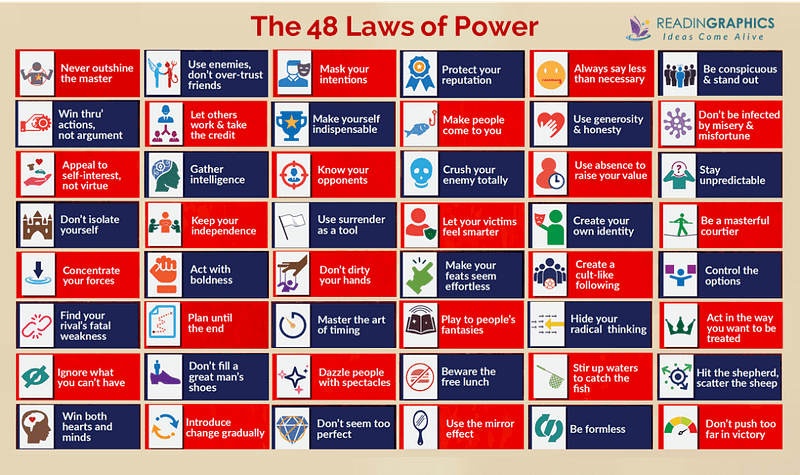
- Never Outshine the Master
- Never Put Too Much Trust in Friends, Learn How to Use Enemies
- Conceal Your Intentions
- Always Say Less Than Necessary
- So Much Depends on Reputation — Guard It With Your Life
- Court Attention at All Costs: Be conspicuous & Stand out. Bad publicity is still publicity.
- Get Others to Do the Work for You, But Always Take the Credit
- Make Other People Come to You — Use Bait if Necessary
- Win Through Your Actions, Never Through Argument
- Avoid the Unhappy and Unlucky — Don’t get infected by misery and misfortune. Associate with positive, successful people.
- Learn to Keep People Dependent on You. Make yourself indispensable, so it’s harder to cut you off.
- Use Selective Honesty and Generosity to Disarm Your Victim
- When Asking for Help, Appeal to People’s Self-Interest, Never to Their Mercy, Gratitude, or Goodness
- Be A Spy. Gather intelligence to know your opponents. Pose as a Friend, Work as a Spy
- Crush Your Enemy Totally. Don’t give them a chance to recover. Show them no mercy.
- Raise Your Value through Absence and Scarcity. Don’t let people take you for granted. People will respect and honor you more if you’re not always around.
- Keep Others in Suspended Terror by Being Unpredictable. Keep them Second-guessing. Cultivate an Air of Unpredictability.
- Don’t Isolate Yourself Behind a Fortress. Have Eyes and Ears Everywhere. Isolation is Dangerous. Do Not Be Vulnerable to Enemy Attacks.
- Know Your Opponents and Who You Are Dealing With. Do Not Offend The Wrong Person. Some people Are Not Worth the Trouble.
- Do Not Commit to Anyone. Stay Neutral As Long As Possible. Maintain Your Independence. The Only Person You Should Commit To Is Yourself.
- Play a Sucker to Catch a Sucker — Appear Dumber Than Your Mark. Make People Think They Can Outsmart You, So They Drop Their Guard.
- Use Surrender as a Tool. Bide Your Time for Retaliation. Transform Weakness into Power.
- Concentrate Your Forces. Do Not Spread Them Too Thin. Do Not Let Your Energy And Efforts Go To Waste.
- Play the Perfect Courtier. Flatter Those Above You and Subjugate Those Below. Always Hide Your True Intentions.
- Create Your Own Identity and Wear It Like A Costume. Re-Create And Re-invent Yourself Continuously. Never Be Comfortable with the Role that Society Assigns You.
- Keep Your Hands Clean. Get Others To Do Your Dirty Work. This way, you can distance yourself from any blame.
- Play on People’s Need to Believe to Create a Cult-Like Following People want to believe in something. Use this to your advantage and create a following of people that believe in you. Create a cult-like following.
- Enter Action with Boldness. Act boldly, so you look confident. People admire the bold and hate the timid. Never do something half-heartedly. People will sense your doubt, and your reputation will suffer.
- Plan All the Way to the End. You need to think long-term if you want to maintain power. Consider all the possible outcomes of your actions and plan accordingly, so you won’t be caught by surprise.
- Make Your Accomplishments Seem Effortless. Don’t show your real success secrets. Don’t let people see how much work you put into something. Make it look like it came naturally to you. This will make you appear more talented than you are.
- Control the Options: Get Others to Play with the Cards You Deal. Control the options and make them think they’re playing with the cards you dealt them.
- Play Into People’s Fantasies. People need to feel special and unique. Play into this by making them feel like they are the only ones that understand you. They will be more likely to follow your lead.
- Discover Each Person’s Thumbscrew. Everyone has something they care deeply about. Find out what it is and use it against them. Find your opponent’s fatal weakness to break their defences.
- Be Royal in Your Own Fashion: Act like a King to Be Treated Like One. People will follow your lead if they believe you’re an influential figure. Act in the way you want to be treated. Be regal and authoritative.
- Master the Art of Timing. Strike only at the right hour. This way, you can take advantage of opportunities as they arise.
- Disdain Things You Cannot Have: Ignoring Them Gives You Power. Don’t consume yourself with something you can’t have. Act like you don’t care.
- Create Compelling Spectacles. Dazzle people with spectacles so they don’t see what you’re really doing. A spectacle will draw people in. As a result, you’ll be able to control their attention and get them to do what you want.
- Think as You Like But Behave Like Others. You can think in whatever way you want. But you need to behave like everyone else if you want to maintain power. Hide your unorthodox thinking. Pretend to blend in.
- Stir Up Waters to Catch Fish: Create chaos to take advantage of the opportunity it provides. Make your opponents reckless while you stay calm. People will focus on the problem at hand. They won’t see what you’re really up to.
- Despise the Free Lunch: There’re always strings attached. Don’t accept things that people give to you for free. People will think they have power over you if you do. You won’t be able to exert your authority as easily.
- Avoid Stepping Into a Great Man’s Shoes: Don’t try to fill the shoes of someone more powerful than you. You will never be able to live up to their standards, and people will see you as an imposter. Create your own path to power.
- Strike the Shepherd, and the Sheep will Scatter. People will only follow a leader if they believe that the leader is strong. If you can take out the leader, the rest of the group will fall apart. You’ll be able to exert your power.
- Work on the Hearts and Minds of Others. Control both their emotions and thoughts. Appeal to both feelings and logic.
- Disarm and Infuriate with the Mirror Effect. If you can reflect on the negative qualities of someone else, they will become infuriated. As a result, you can take away their power.
- Preach the Need for Change but Never Reform Too Much at Once. People are resistant to change. If you try to reform too much at once, they will rebel against you. Instead, preach the need for change and make minor reforms over time. Introduce change gradually.
- Never Appear Too Perfect: If you seem too perfect, people will think you’re trying to control them. They’ll be less likely to follow your lead. It’s better to show your flaws and let people see that you’re just like them.
- Do Not Go Past the Mark You Aimed For; In Victory, Learn When to Stop If you overstep your bounds, people will think you’re trying to take too much power. They’ll rebel against you. So, stop once you’ve achieved your goal. Don’t push too far in victory - know when to stop.
- Assume Formlessness. Be formless and unpredictable.
Here are some key insights from the book:
- Power Requires Strategy: The book emphasizes the importance of strategic thinking and planning to achieve and maintain power. It provides practical principles and historical examples that individuals can apply to navigate power dynamics effectively.
- Understanding Human Nature: Greene delves into the fundamental aspects of human nature and how they play a role in power dynamics. Insights on manipulation, seduction, fear, and desire help readers grasp the underlying motivations that shape human behavior in the pursuit of power.
- Manipulation and Deception: The “48 Laws of Power” explores various tactics of manipulation and deception that individuals have used throughout history. It highlights the importance of understanding these tactics to defend oneself against manipulation and to recognize when others may be using them.
- Observation and Analysis: Greene emphasizes the significance of keen observation and analytical thinking to understand power dynamics. Being aware of the subtle cues, patterns, and motivations of others allows individuals to make more informed decisions and navigate power dynamics effectively.
- Self-Preservation and Defense: The book emphasizes the importance of self-preservation and defending one’s interests in power dynamics. It provides insights into recognizing threats, being cautious with trust, and taking proactive measures to protect oneself from manipulation or exploitation.
- Building Networks and Alliances: The “48 Laws of Power” emphasizes the value of building strategic networks and alliances. It provides guidance on selecting trustworthy partners, leveraging relationships for mutual benefit, and navigating the complexities of power dynamics within social and professional circles.
- Adaptability and Flexibility: Greene emphasizes the need to be adaptable and flexible in the pursuit of power. The book encourages readers to assess and adjust their strategies and tactics based on changing circumstances, allowing them to stay ahead and maintain their effectiveness in various situations.
- Awareness of Power Dynamics: The book raises awareness about power dynamics that exist in society, organizations, and interpersonal relationships. It provides insights into power plays, hierarchies, and the strategies individuals employ to gain or maintain power.
“The 48 Laws of Power” offers readers a deep understanding of power dynamics and provides a toolbox of strategies that can be applied to navigate these dynamics more effectively.
I wanted to learn more. Here is the prompt I have used:
“100 hyper-specific, surprising, mind-blowing and niche things I absolutely need to know about the dark side of power (48 Rules of Power, Robert Greene). Each must be explained with evidence and/or examples. Surprise me each time. Avoid generic stuff and clichés.”
You will find the response below.
The Dark Side Unveiled: 100 Astonishing Insights into the Mastery of Power (48 Rules of Power, Robert Greene)
1. The Dark Side of Power emphasizes the importance of deception as a tool for gaining and maintaining power. One classic example is George Washington’s use of deception during the American Revolutionary War. Washington famously spread false information about troop movements and intentions to confuse and misdirect the British forces.
2. Power can be derived from cultivating a mysterious aura. Coco Chanel, the renowned fashion designer, carefully controlled her public image and created an air of mystery around herself. This allowed her to establish herself as a powerful and influential figure in the fashion world.
3. Exploiting weaknesses and vulnerabilities is an effective way to gain power. Machiavelli’s historical account of Cesare Borgia demonstrates this. Borgia exploited the rivalries between Italian states during the Renaissance, manipulating them to his advantage and ultimately becoming one of the most powerful political figures of his time.
4. Timing is crucial in the pursuit of power. Muammar Gaddafi, the former Libyan dictator, used timing to his advantage during his rule. He often made calculated moves during times of political instability, manipulating situations to strengthen his grip on power.
5. Building alliances can significantly enhance one’s power. Andrew Carnegie, the famous American industrialist, employed this strategy during his dominance in the steel industry. He strategically formed partnerships and alliances with influential figures to strengthen his business empire.
6. Power can be obtained by controlling information. Richard Nixon, the former US president, orchestrated the Watergate scandal cover-up to maintain his political power. By controlling and manipulating information, Nixon attempted to stay in office despite his involvement in illegal activities.
7. A powerful individual can influence the public narrative. Edward Bernays, the father of modern public relations, demonstrated this by shaping public opinion through cleverly designed propaganda campaigns. One notable example is Bernays’ campaign to make smoking socially acceptable for women in the early 20th century.
8. Exploiting people’s fear can provide a path to power. Joseph McCarthy, a former US senator, exploited the fear of communism during the Cold War to gain influence and power within the US government. McCarthy initiated a series of investigations targeting suspected communists, creating a climate of fear and suspicion.
9. Power resides in the ability to control resources. King Leopold II of Belgium used his control over the Congo Free State in the late 19th century to exploit its abundant natural resources, such as rubber. His exploitation led to immense personal wealth and increased his political influence.
10. The Dark Side of Power demonstrates the importance of mastering the art of persuasion. Steve Jobs, the co-founder of Apple Inc., was a master at using persuasive techniques during product launches and presentations. His charismatic and captivating style helped establish Apple as a dominant force in the technology industry.
11. Controlling access to resources can be a powerful tool in acquiring and exercising power. The Medicis, a powerful banking family in Renaissance Florence, used their control over banking and finances to influence politics and exert power over the city-state.
12. Cultivating an image of invincibility can deter potential challengers. Ivan the Terrible, the first Tsar of Russia, ruled with an iron fist and used brutal tactics to establish a reputation of being ruthless and unpredictable. This image instilled fear in his enemies and ensured his power remained unchallenged.
13. Understanding and manipulating the emotions and desires of others can be a powerful tool for gaining influence. Adolf Hitler, the infamous dictator of Nazi Germany, used propaganda techniques to tap into the desires and fears of the German population, ultimately securing their support and consolidating his power.
14. Exploiting the fear of instability and chaos can help maintain power. Napoleon Bonaparte, the French military and political leader, seized power during a time of political upheaval in France. He positioned himself as a strong leader who could restore stability, effectively solidifying his rule.
15. Power can be derived from exploiting the weaknesses and insecurities of others. J. Edgar Hoover, the first Director of the Federal Bureau of Investigation (FBI), amassed significant power by gathering secret files and compromising information on influential individuals, thereby ensuring their compliance and loyalty.
16. The art of strategic alliances extends to influencing international relations. During the Cold War, Henry Kissinger, the US Secretary of State, played a key role in forming secret alliances with various countries, leveraging these relationships to advance America’s political agenda and maintain global dominance.
17. The ability to read and manipulate social dynamics is crucial in gaining power. Rasputin, a controversial figure during the last Tsarist period of Russia, used his perceived mystical powers and charisma to befriend and influence the Russian Empress, Alexandra, thereby exerting control over political decisions.
18. Power can be attained through the careful cultivation of a charismatic persona. Mahatma Gandhi, the leader of the Indian independence movement, used his non-violent approach and charismatic personality to inspire millions and rally them behind the cause of freedom, effectively challenging the power of the British Empire.
19. Perception management is vital for maintaining power. Joseph Stalin, the Soviet Union’s totalitarian leader, utilized propaganda, censorship, and mass purges to control information, shape public perception, and eliminate potential threats to his power.
20. Controlling the narrative through media manipulation can be a potent tool for shaping public opinion. Rupert Murdoch, the media mogul behind News Corporation, has demonstrated his ability to influence public discourse by owning and controlling influential media outlets around the world.
21. The art of flattery and charm can be used as a form of manipulation to gain and maintain power. Count Axel von Fersen, a Swedish nobleman and lover of Marie Antoinette, utilized his charm and influence over the French queen to advance his personal interests and gain political advantages.
22. Power can arise from exploiting divisions and conflicts within a society. Julius Caesar, the Roman general and statesman, took advantage of political rivalries and social unrest to seize power and establish himself as the dictator of Rome.
23. The cultivation of a strong and loyal network of supporters is crucial for consolidating and extending power. Joan of Arc, the French military leader and national heroine, inspired and rallied French troops, earning their unwavering loyalty in the fight against English dominance during the Hundred Years’ War.
24. Exploitation of religious beliefs and symbols can be a powerful tool for gaining and maintaining influence. Pope Alexander VI, a notorious Renaissance pope, used his position to advance the interests of his family, the Borgias, and engage in political maneuvering within Italy.
25. Power can be obtained by controlling access to education and knowledge. The medieval philosopher and theologian Thomas Aquinas utilized his intellectual prowess to gain the patronage of influential figures, ensuring his ideas and teachings held sway over the Catholic Church.
26. The ability to instill fear can be used to maintain power. Idi Amin, the former Ugandan dictator, relied on terror, violence, and widespread human rights abuses to keep his grip on power, effectively silencing any opposition.
27. Power is often consolidated by eliminating or neutralizing potential threats. Mao Zedong, the founding father of the People’s Republic of China, purged his own party of perceived disloyal elements during the Cultural Revolution, ensuring his uncontested rule and eliminating any organized opposition.
28. Exploiting the dependence of others can lead to extended power. Hugo Chávez, the late Venezuelan president, used his control over the country’s vast oil reserves to extend his influence, maintain control over the economy, and consolidate his political power.
29. Power can be obtained by exploiting economic disparities. The Vanderbilts, an American family known for their vast wealth in the late 19th century, used their control over the railroad industry to accumulate immense power and influence, effectively shaping the economic landscape of the United States.
30. Power can be retained by portraying oneself as a symbol of national identity and unity. Mustafa Kemal Atatürk, the founder of modern Turkey, strategically positioned himself as the embodiment of Turkish nationalism, successfully rallying the country behind his vision and maintaining his role as a powerful leader.
31. The ability to adapt and reinvent oneself is crucial in maintaining power. Catherine de’ Medici, the Italian-born queen consort of France, skillfully navigated the tumultuous political landscape of 16th-century France, adapting her strategies and alliances to ensure her family’s continued influence.
32. Power can be derived from exploiting natural resources on a large scale. The British East India Company, during the height of the British Empire, monopolized trade in valuable commodities like tea, silk, and spices, amassing enormous wealth and wielding significant political influence.
33. The ability to manipulate public sentiment through social media can provide immense power. Donald Trump, the former US president, harnessed the potential of social media platforms like Twitter, using them to shape public opinion, communicate directly with his supporters, and bypass traditional media channels.
34. Exploiting secrecy and espionage can provide a competitive advantage. The codebreakers at Bletchley Park, during World War II, analyzed and deciphered encrypted messages, giving the Allies valuable intelligence and ultimately contributing to their victory.
35. Power can be obtained by creating and reinforcing a cult of personality. Kim Jong-un, the current leader of North Korea, maintains power through the state-controlled media’s constant propaganda and portrayals of him as an infallible and revered symbol of the nation.
36. Manipulating legal systems can be a powerful tool in maintaining dominance. Cardinal Richelieu, a French statesman during the 17th century, used his position as chief minister to centralize power and weaken potential rivals through his influence over the French legal system.
37. Power can arise from the relentless pursuit of personal ambitions. Alexander the Great, the ancient Macedonian conqueror, relentlessly expanded his empire, pursuing his ambitions and establishing himself as one of history’s most powerful leaders.
38. Exploiting the power of fear and awe can be a means to control and subdue. Genghis Khan, the founder and leader of the Mongol Empire, used brutal military tactics and ruthless displays of power to subjugate populations, effectively ensuring their compliance and loyalty.
39. Power can be gained by taking advantage of prevailing ideologies and presenting oneself as their embodiment. Vladimir Lenin, the leader of the Bolshevik Party and the Soviet Union, leveraged the discontent of the Russian people during the early 20th century, promoting Marxist ideology and establishing a revolutionary government.
40. Exploiting divisions and tensions within organizations can help secure power. Steve Ballmer, the former CEO of Microsoft, used strategic maneuvers and organizational restructuring to consolidate his power within the company, solidifying his influence and thwarting potential challengers.
41. Leveraging physical intimidation can be a powerful means of establishing dominance. Ivan the Terrible famously employed a personal guard known as the Oprichniki, who instilled fear among the Russian population through violence and acts of terror, thus solidifying Ivan’s hold on power.
42. Power can be gained by exploiting societal norms and expectations. Queen Elizabeth I of England skillfully navigated the patriarchal society of her time, using her unmarried status to maintain control and remain a symbol of national stability during her long reign.
43. Utilizing the power of surveillance and espionage can help gather valuable information and maintain control. The Stasi, the secret police of East Germany during the Cold War, developed extensive networks of informants to monitor and control the population, ensuring the dominance of the communist regime.
44. Power can be derived from exploiting emotional and psychological vulnerabilities. Jim Jones, the leader of the cult-like Peoples Temple, manipulated his followers by preying on their fears and insecurities, eventually leading them to their tragic demise in the mass suicide at Jonestown.
45. Maintaining control over economic resources is crucial for exerting power. The Rothschild family, a prominent banking dynasty in the 18th and 19th centuries, used their financial influence to shape political decisions and maintain their power across multiple countries.
46. Exploiting addiction and dependency can provide a means of controlling individuals and groups. Pablo Escobar, the notorious Colombian drug lord, amassed immense power and wealth by monopolizing the drug trade, thus gaining control over vast networks and populations addicted to narcotics.
47. Power can be obtained by positioning oneself as a transformative and visionary leader. Nelson Mandela, the former President of South Africa, used his moral authority, perseverance, and commitment to reconciliation to unite a divided nation and dismantle the oppressive apartheid system.
48. Exploiting the power of symbolism and myth can help establish a cult-like following. A charismatic figure like David Koresh, the leader of the Branch Davidians, used religious rhetoric, prophecies, and messianic claims to create a powerful group dynamic that ultimately led to the violent standoff in Waco, Texas.
49. Power can be derived from exploiting legal loopholes and ambiguities. John D. Rockefeller, the American business magnate, used his dominance in the oil industry to create trusts and manipulate markets, exploiting legal gray areas to consolidate his power and amass immense wealth.
50. Exploiting the power of technology and innovation can provide a competitive advantage. Elon Musk, the CEO of Tesla and SpaceX, has leveraged advancements in electric vehicles and space exploration to establish himself as a powerful figure in multiple industries, shaping industries and challenging established norms.

51. Power can be gained by provoking controversy and polarization. Milo Yiannopoulos, a controversial media personality, used provocative language and offensive rhetoric to tap into a niche audience, gaining a significant following and influencing discourse through shock value.
52. Exploiting societal divisions and prejudices can help maintain power. Adolf Eichmann, one of the major architects of the Holocaust, manipulated existing anti-Semitic sentiments to orchestrate the systematic genocide of millions, thus consolidating Nazi power.
53. Power can arise from establishing a monopoly over essential resources or services. Standard Oil, led by John D. Rockefeller, used aggressive business tactics to monopolize the oil industry in the United States, dominating the market and solidifying Rockefeller’s power as one of the wealthiest individuals in history.
54. Exploiting tribalism and ethnic conflicts can lead to power acquisition. Slobodan Milošević, the former President of Serbia, took advantage of nationalism and ethnic tensions in the former Yugoslavia, using divisive rhetoric and manipulation to consolidate his power at the expense of peace and stability.
55. Power can be obtained by leveraging financial control over governments and institutions. The Rothschild family, known for their banking dynasty, strategically lent money to various countries and monarchies, thus gaining political influence and ensuring their continued power.
56. Exploiting a crisis or emergency situation can be an opportunity for power consolidation. Winston Churchill, the British Prime Minister during World War II, united the country in the face of imminent threat, using his leadership during the war to cement his position and reshape British politics.
57. Establishing a cult of personality around oneself can inspire devotion and loyalty. Kim Il-sung, the founder of North Korea, created a personality cult that continues to this day, requiring absolute loyalty and reverence from the North Korean population as a means of maintaining power.
58. Power can be derived from manipulating financial systems and economic markets. George Soros, a billionaire investor, famously utilized currency speculation to destabilize currencies and governments, thus exerting financial influence and accumulating significant wealth.
59. Exploiting institutional weaknesses and loopholes can help maintain power. Richard Nixon’s abuse of executive power during the Watergate scandal demonstrated his willingness to circumvent institutions and norms to protect his own position, highlighting the fragility and potential manipulation of democratic systems.
60. Leveraging the power of fear and intimidation can subdue opposition and maintain control. Josef Stalin, the Soviet dictator, implemented a reign of terror that included purges, show trials, and forced labor camps, effectively eradicating potential threats and silencing opposition.
61. Exploiting divisions and conflicts within religious institutions can help consolidate power. Pope Alexander VI, mentioned earlier, used political maneuvering, nepotism, and bribery to gain control over the papacy and extend his influence within the Catholic Church during the Renaissance.
62. Power can be obtained by leveraging control over infrastructure and utilities. Carlos Slim, a Mexican business magnate, amassed significant power by monopolizing the telecommunications industry, effectively becoming Mexico’s richest person and exerting influence over the country’s communication networks.
63. Exploiting the power of propaganda and media manipulation can sway public opinion and maintain control. Joseph Goebbels, Adolf Hitler’s Minister of Propaganda in Nazi Germany, effectively shaped public perception through control of the media, thus maintaining support for the regime.
64. Power can arise from acquiring significant natural resources and exploiting them strategically. Sheikh Ahmed Zaki Yamani, the former Saudi Arabian oil minister, used the country’s vast oil reserves to assert his nation’s influence over global politics and exert control over oil markets.
65. Exploiting human desires and vices can amass immense power. Hugh Hefner, the founder of Playboy magazine, capitalized on society’s fascination with sexuality and desire for escapism, ultimately creating a multi-million-dollar empire and a cultural icon.
66. Power can be derived from leveraging access to intelligence and confidential information. Edward Snowden, the former National Security Agency contractor, exposed the extent of global surveillance programs, challenging the power dynamics of governments and intelligence agencies worldwide.
67. Exploiting the power of populism can galvanize support and maintain influence. Benito Mussolini, the fascist dictator of Italy, appealed to the frustrations and desires of the Italian population, utilizing populist rhetoric to build a powerful political movement and secure his grip on power.
68. Power can be obtained by controlling the narrative through media ownership. Silvio Berlusconi, the former Prime Minister of Italy, used his ownership of influential media outlets to shape public opinion, advance his political agenda, and maintain a dominant political position.
69. Exploiting the fear of external threats can unite a nation behind a powerful leader. Winston Churchill’s powerful speeches during World War II rallied the British people in the face of Nazi aggression, strengthening their resolve and securing his leadership.
70. Power can arise from leveraging control over essential services and infrastructure. Akio Morita, the co-founder of Sony Corporation, used the widespread adoption of Sony’s electronic products to establish dominance in the consumer electronics industry, shaping technological trends and accumulating significant power and wealth.
71. Exploiting cultural symbols and national pride can help maintain power. Kim Jong-un, the current leader of North Korea, has harnessed the country’s juche ideology and promoted a fervent nationalist narrative to solidify his rule and inspire loyalty among the populace.
72. Power can be obtained through the control and manipulation of art and culture. Adolf Hitler and the Nazi regime infamously promoted their own aesthetic ideals through state-controlled art exhibitions and censorship, using culture as a tool for propaganda and control.
73. Exploiting the power of fear and torture can be used to suppress dissent and maintain dominance. The Khmer Rouge regime, led by Pol Pot in Cambodia, used brutal tactics, torture, and fear to suppress opposition and maintain control during their reign of terror.
74. Power can be gained by controlling the narrative and rewriting history. The Soviet Union, under Joseph Stalin’s rule, manipulated historical records and censorship to shape the narrative of the past to fit the regime’s ideology and maintain its power over the populace.
75. Exploiting economic crises and financial vulnerabilities can lead to power acquisition. George Soros, the billionaire investor, famously used speculative trading during the 1992 Black Wednesday crisis to profit immensely and influence economic policies, exerting power over countries’ financial systems.
76. Power can be derived from manipulating gender roles and expectations. Margaret Thatcher, the former British Prime Minister, wielded her iron lady persona and challenged traditional gender norms to assert her authority and maintain power in a male-dominated political landscape.
77. Exploiting fear-mongering and xenophobia can be used to consolidate power. Le Pen, the leader of France’s National Front party, has employed anti-immigrant rhetoric and fear of cultural change to gain support and influence understanding of French nationalism.
78. Power can be obtained by leveraging the control over healthcare and medical resources. Dr. James P. Allison, a Nobel laureate in Medicine, harnessed the power of immunotherapy to revolutionize cancer treatment, giving him significant influence in the medical community and the potential to shape future healthcare policies.
79. Exploiting the power of charisma and charm can attract followers and maintain influence. Aung San Suu Kyi, the Burmese politician and Nobel Peace Prize laureate, used her charisma and commitment to nonviolence to gather support and challenge the oppressive military regime in Myanmar.
80. Power can arise from leveraging knowledge and expertise in a specific field. Albert Einstein, the renowned physicist, became a cultural icon and enjoyed significant influence due to his groundbreaking scientific discoveries and contributions to the theory of relativity.
81. Exploiting legal loopholes and lax regulations can lead to power acquisition. Carlos Ghosn, the former CEO of Nissan and Renault, allegedly manipulated executive compensation and financial reporting to consolidate his power and amass personal wealth.
82. Power can be obtained by controlling and manipulating public infrastructure. Jeff Bezos, the founder of Amazon, has leveraged the dominance of his e-commerce platform to extend his influence and acquire control over various sectors, such as logistics and cloud computing.
83. Exploiting religious fervor and ideology can help consolidate power. Ayatollah Ruhollah Khomeini, the leader of the Iranian Revolution, harnessed the religious fervor of the Iranian people to overthrow the Shah and establish an Islamic republic, thereby securing his position as the Supreme Leader.
84. Power can arise from leveraging control over natural resources and commodities. Patrice Motsepe, a South African mining magnate, gained significant power and influence through his control of mining operations, particularly in the gold and platinum sectors.
85. Exploiting the power of censorship and control over media can shape public perception and maintain power. Xi Jinping, the current General Secretary of the Chinese Communist Party, has overseen a strict regime of media censorship and control, ensuring that the party’s narrative remains dominant and unchallenged.
86. Power can be gained by exploiting the vulnerabilities of international financial systems. The Russian government, allegedly led by Vladimir Putin, has been accused of utilizing cyberattacks and hacking schemes to manipulate financial markets and exert influence over global economic systems.
87. Exploiting corporate monopolies can lead to vast power accumulation. Amazon under Jeff Bezos’ leadership has expanded to multiple sectors, establishing dominance in e-commerce, cloud computing, and digital streaming, exerting global influence and reshaping industries.
88. Power can be obtained by manipulating social norms and cultural values. Simone de Beauvoir, the influential French writer and philosopher, challenged traditional gender roles and advocated for women’s rights, ultimately altering societal norms and inspiring feminist movements worldwide.
89. Exploiting personal connections and alliances can enhance one’s power. Rupert Murdoch, the media mogul, has cultivated influential relationships with politicians and leaders worldwide, allowing him to exert significant sway over media coverage and political discourse.
90. Power can arise from the exploitation of legal authority and legislation. Kim Davis, a county clerk in Kentucky, used her position and religious beliefs to deny marriage licenses to same-sex couples, leveraging her authority to challenge and obstruct LGBTQ+ rights.
91. Exploiting the power of technology and data can provide a means of control and influence. Mark Zuckerberg, the co-founder of Facebook, has leveraged the massive collection of user data to shape online advertising, influence political campaigns, and maintain a dominant position in social media.
92. Power can be obtained by leveraging control over transportation networks. Elon Musk’s ventures, such as Tesla and SpaceX, have propelled him to power by revolutionizing electric vehicles and space exploration, significantly impacting transportation industries.
93. Exploiting the power of celebrity and popular culture can amass significant influence. Oprah Winfrey, the media mogul and talk show host, utilized her platform to shape public opinion, influence consumption patterns, and amass a wide-reaching cultural impact.
94. Power can arise from exploiting the vulnerability of marginalized groups. Rodrigo Duterte, the President of the Philippines, has utilized strongman tactics and authoritarianism to suppress opposition and target vulnerable communities, consolidating his power through fear and intimidation.
95. Exploiting the power of philanthropy and charitable endeavors can enhance one’s influence. Bill Gates, the co-founder of Microsoft and renowned philanthropist, has utilized his vast wealth and the Bill and Melinda Gates Foundation to shape global health policies and address social issues.
96. Power can be gained by exploiting loopholes in electoral systems and political processes. Viktor Orbán, the Prime Minister of Hungary, has been accused of manipulating election laws and undermining democratic institutions to maintain his party’s grip on power.
97. Exploiting the power of storytelling and narrative can shape public perception and maintain influence. Chimamanda Ngozi Adichie, the Nigerian author, has used her powerful storytelling to challenge stereotypes, promote social justice, and influence global conversations on feminism and race.
98. Power can be obtained by leveraging control over critical infrastructure systems. Stuxnet, a computer virus allegedly developed by the United States and Israel, targeted Iran’s nuclear facilities, disrupting operations and exerting political influence through cyber warfare.
99. Exploiting the power of social networks and online platforms can significantly impact public discourse. Jack Dorsey, the co-founder and CEO of Twitter, has faced scrutiny for his role in moderating speech and influencing the spread of information, showcasing the power of social media in shaping narratives.
100. Power can arise from leveraging control over transportation and logistics infrastructure. Maersk, the Danish shipping conglomerate, has maintained dominance in global shipping and logistics, exerting significant influence over international trade and shaping the movement of goods worldwide.
Implications

1. Manipulation and Control: Many individuals showcased the ability to manipulate and control various aspects of society, including information, resources, ideologies, and individuals themselves. This highlights the underlying premise of The Dark Side of Power, which focuses on the strategic exploitation of vulnerabilities to gain and maintain dominance.
2. Exploitation of Fear: Fear, whether of instability, external threats, or social upheaval, emerges as a common tool utilized to maintain power. Leaders who instill fear and manipulate societal anxieties often find it easier to control the population, suppress dissent, and consolidate their authority.
3. Cult of Personality: Cultivating a charismatic persona and establishing a cult-like following can be a powerful means of maintaining power. Leaders who were able to project an image of strength, vision, or divine authority often gained unwavering loyalty and support from their followers.
4. Strategic Alliances: Building alliances and strategic partnerships emerged as a consistent strategy for expanding influence and consolidating power. Through strategic alignments, individuals were able to strengthen their position, access resources, and neutralize potential threats.
5. Control of Resources: The control and manipulation of resources, whether natural, financial, informational, or technological, became a recurring theme in the pursuit of power. Those who could monopolize or strategically exploit vital resources frequently gained significant influence and dominance.
6. Manipulation of Narrative: The ability to control information, shape public perception, and rewrite history emerged as a powerful tool for maintaining power. Through censorship, propaganda, and media manipulation, leaders could sway opinions and solidify their authority.
7. Exploitation of Vulnerabilities: Exploiting weaknesses, vulnerabilities, and divisions within societies or organizations frequently led to gaining and maintaining power. Whether exploiting economic disparities, cultural norms, ethnic tensions, or individual insecurities, powerful individuals could tap into these vulnerabilities to their advantage.
8. Adaptation and Reinvention: The ability to adapt strategies, narratives, and alliances to changing circumstances played a significant role in maintaining power. Leaders who could evolve their approaches, renegotiate alliances, or pivot their tactics according to new challenges often managed to remain in control.
Overall, these patterns and implications shed light on the multifaceted nature of power acquisition and consolidation. The examples emphasize the intricate strategies and manipulations employed by individuals throughout history, each with its unique combination of tactics, resources, and vulnerabilities targeted to achieve and sustain dominance.
So What Should You Do?

To pursue ethical power and protect yourself from manipulation, here are some actions and steps you can consider:
1. Cultivate Self-Awareness: Develop a deep understanding of your own values, beliefs, and motivations. This self-awareness will provide a strong foundation for ethical decision-making and help you recognize when others may be attempting to manipulate you.
2. Seek Knowledge and Critical Thinking: Invest in expanding your knowledge and developing critical thinking skills. This will enable you to evaluate information critically, identify manipulative tactics, and make informed decisions based on evidence and reason.
3. Build Genuine Relationships: Focus on building authentic and meaningful relationships with others, rooted in trust and mutual respect. Genuine connections are less likely to be manipulated for personal gain, and supportive networks can help you navigate challenges ethically.
4. Practice Empathy and Emotional Intelligence: Develop empathy and emotional intelligence to understand the perspectives and emotions of others. This will make you more attuned to potential manipulative tactics and enable you to build rapport based on genuine understanding.
5. Question Authority and Demand Transparency: Adopt a mindset of questioning authority, seeking transparency, and challenging the status quo. Hold individuals and institutions accountable for their actions and decisions, ensuring they align with ethical principles.
6. Educate Yourself on Manipulative Techniques: Learn about common manipulative techniques, such as gaslighting, emotional coercion, and cognitive biases. Understanding these tactics will sharpen your awareness and help you recognize and resist them.
7. Develop Strong Boundaries: Establish clear personal boundaries and learn to assertively communicate and defend them. This will protect you from being manipulated or coerced into actions that compromise your principles.
8. Act with Integrity: Consistently act in alignment with your values and ethical principles, even in challenging situations. This integrity will earn the respect of others and build a reputation for trustworthy behavior.
9. Practice Ethical Leadership: If you hold a position of power or influence, lead by example, and prioritize ethical decision-making. Create a culture that values fairness, transparency, and accountability, and empower others to act ethically as well.
10. Continuously Reflect and Learn: Regularly reflect on your actions, motivations, and experiences. Learn from your mistakes and seek opportunities for personal growth and development in ethical decision-making and power dynamics.
Ethical power is rooted in respect, fairness, and the well-being of others. By applying these principles in your actions and interactions, you can strive to wield power ethically while minimizing the risk of being manipulated by others.


