
10 Ways to Do Inner Work When Therapy Isn’t An Option
Easy healing… without breaking your bank account!

In my last piece, I discussed what it means to do the work. Now how do you do it? Simple answer: go to therapy.
But, therapy isn’t for everyone; it is neither affordable for everyone, nor is it something that everyone believes in. Also — not all therapists are good therapists.
“We may not all have access to therapy or the desire to go, but we can all benefit from the insights discovered through therapy.” — Nedra Glover Tawwab, MSW, LCSW
How do we get those insights outside of therapy? Good news! There are many ways to do your own inner work in the absence of/in addition to traditional therapy.
**Disclaimer: this is my longest article yet. It took weeks to write because I wanted to add value to your life, dear reader. Please let me know if it was at all relevant!**
1. Don’t just read self-help books — study them.
Audiobooks are a game-changer for the world of literacy, but when it comes to self-help books, I have to go old school. Why? Focus.
There’s no multitasking when there’s a book in your hands.
Our eyes also work harder for our retention by instantaneously double-checking words on a page as we read along, cementing information in our minds.
“About 10 to 15% of eye movements during reading are actually regressive — meaning [the eyes are] going back and re-checking. This happens very quickly, and it’s sort of seamlessly stitched into the process of reading a sentence.” — Daniel Willingham, a professor of psychology at the University of Virginia
I choose to approach self-help like a student … of life; highlighters, pens, bookmarks, and all.
Certain books have become part of life’s milestones; I read The Alchemist around NYE and Year of Yes around my birthday. Reading through pages accessorized with the notes I wrote during previous reads serves as a reminder of how far I’ve come.
Audio is great, but to supplement physical copies when possible. I listen to the Audible version of The Power of Now when I need a mental workout during my physical one. Otherwise, my physical copy is painted in the colors of my thoughts.
2. Get the corresponding workbooks for self-help books.
In my attempt to purchase Nedra Glover Tawwab’s book on boundaries, I accidentally purchased the workbook instead and I’ve never been so pleased with a mistake.
With their prompts and activities, self-help workbooks make you devote time to the digestion of the material as well as reflection and planning to facilitate concrete change, rather than simply reading a book cover to cover.
The workbook poses questions you might not have thought of around bite-sized sections of your readings.
This is not to say you cannot digest the information in a book without its corresponding workbook. The main books remain the meat and potatoes.
There are also thousands of stand-alone self-help workbooks around various topics from, alchemy to unhealthy relationships with food and alcohol.
I recently learned on The School of Greatness podcast that Lori Gottlieb’s Maybe you Should Talk to Someone now has a corresponding workbook.
Workbooks often present questions that a therapist might have asked, so even if you are in therapy, using a workbook might help you spend less time pondering over answers during your session. (Yay you! Saving every $1 on those 50 minutes because you did the homework.)
Whatever you need to heal, there’s a workbook that helps you focus on healing one issue at a time.
3. Journal
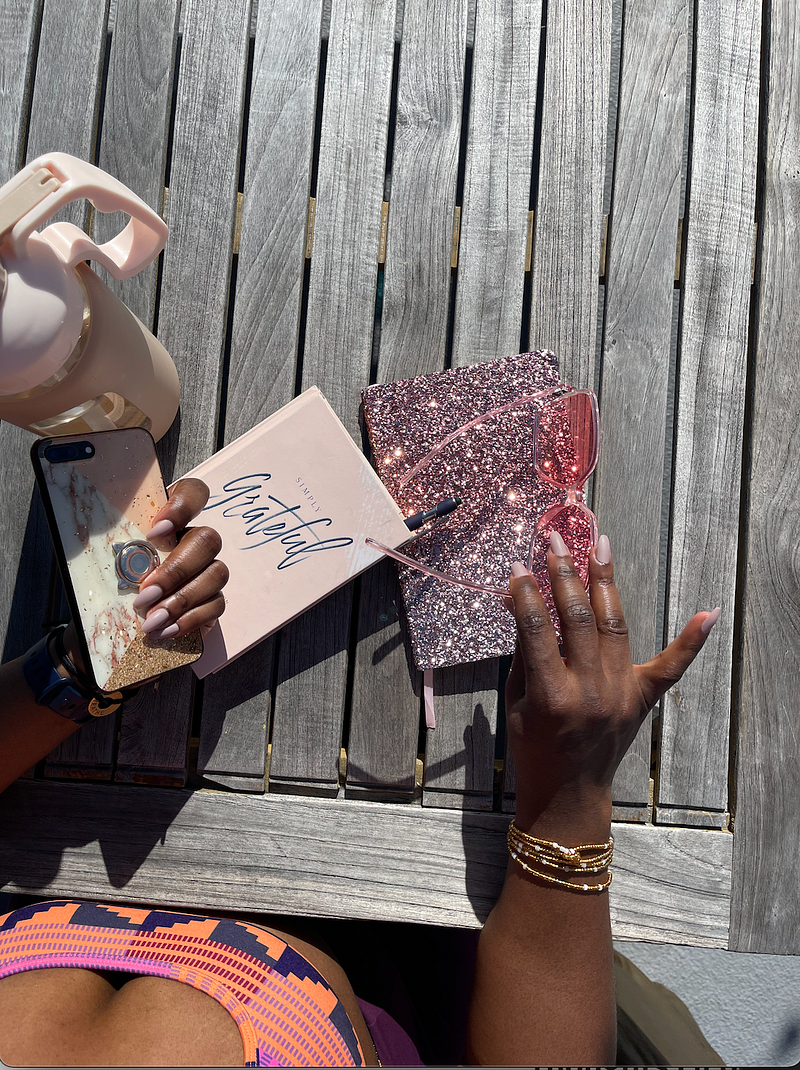
Journaling means different things to different people.
Someone once told me “write down basic events of the day; the feelings surrounding them will come to you when you read it back.”
While it was fun to read about where I had been and what I did on a particular day in history, it did not come to serve me very much beyond entertainment.
That journaling style is not wrong, it just serves a different purpose. There are different journaling styles for different needs. Some people have a gratitude journal, a mood journal, or a motivation journal with different prompts and quotes.
I have about 3 journals I cycle through in the morning. One for factual events, one to document my emotions, and the third for thoughts I’ll bring to therapy.
If my morning meditation is about a topic that strikes a chord with me, I give myself an extra chunk of time in the morning to write the thoughts that came up, the feelings around them, and jot down anything substantial for my therapist.
For example, if my meditation is about self-trust, I might ask myself:
In what areas of my life do I trust myself the most? The least? How come?
If I notice that I feel stuck or have uncomfortable emotions, I make a note to dig deeper. First, I seek the answers within myself while using journal #2 to identify the potential trigger.
When I need more help getting to the why of a feeling or how around resolving it, I whip out journal #3 for a deep dive with my therapist. Often she suggests alternative approaches to consider based on what she knows about me/ my life (or human nature in general … we aren’t all that different).
Writing out thoughts and feelings helps stay focused during meditation, knowing that there is time carved out later to entertain what comes to mind.
4. Get into breathwork
My former yoga instructor has been raving about the benefits of breathwork for remedying stress, anxiety, and other issues since he got into the space. Though I am yet to make one of his 7 am PT Sunday Zoom classes, I have given breathwork a try thanks to a few YouTube videos.
I’m not going to lie, it looks, sounds, and feels strange and uncomfortable, but…
Once you stop worrying about what you look or sound like, the breathworkexperience is transformative.
Some of the comments under this YouTube video capture experiences that were even more groundbreaking than the powerful one I had.


We don’t realize how much we hold our breath, or shorten it throughout the day, especially when we are anxious. This makes breathwork feel liberating in a way that is beyond physical release and hard to explain.
Most of us are speeding through life disconnected from our bodies; going through the motions without a chance to check in on ourselves.
Breathwork brings us back to our center.
5. Meditate
Speaking of center…You’ve probably heard of meditation a million times now, with no clear understanding of what that looks like.
Meditation is time to be still, to feel, to be.
There are many meditation styles and tools, but the good news is, that if you are breathing, you have enough tools to meditate.
Try meditating in complete silence or with light background instrumentals, perhaps the sound of a gong will do it for you.
If in the first month it feels “not for you”, or you “can’t sit still”, don’t give up; switch it up. You need it more than you realize.
Considering how busy the day can get, and how much of ourselves we give to the world, I consider my (non-negotiable) meditation time to be a little piece of me — for me.
My personal preference is to meditate on the day’s topic from my meditation app (Calm). Though most of the 10 minutes are spent in silence, each session closes off with words of wisdom and an inspirational quote related to the topic.
6. Get lost in thought
Take time out of the day to dream and reflect. It may appear unproductive at first, but the more intentional you are about this, the more you can spend the rest of your day living in the moment.
Channel thoughts towards reflection — for growth — rather than rumination.
Give yourself permission to get lost in your thoughts about how you lived the day, week, or month and allow yourself to entertain what comes up, curiously observing how it makes you feel.
A man for whom I hold great respect once told me that he asked himself this question at the end of each day:
If I live each day as I did today, would I be closer to my goals in a year?
I’ve met people who schedule time for themselves and their thoughts. Others take spontaneous moments to entertain the thoughts they find weighing heavy on their minds.
Thoughts might go dark, but sometimes facing the worst-case scenario in your mind makes it less of a threat if it manifests (and it rarely does).
If you’re anything like me, when you finally turn to your thoughts and say “OK, your turn in the spotlight,” they run backstage. They love being in the shadows giving unsolicited side commentary as you go about your life, but fear taking centerstage. Before you know it, you might find yourself bored or watching something mind-numbing.
To help with this, I have gone to sensory deprivation tanks or float tanks on a few occasions. That way, there is nowhere to go and nothing to do but float in a pool of saltwater alone in the dark for hours.
You don’t need anything besides your brain for this. No candles, incense, or classical music are necessary — although if you have them, setting a mood can make a difference. It can make downtime in a mundane space feel like a retreat, or an experience separate from the ordinary.
Be careful not to lose yourself in thought.
There is no pause button while you step away to reflect. Life goes on, people need you in the present and life happens now. Sooner rather than later, you have to get back to reality.
Remember not to invest too many emotions in a past you cannot change, or a future whose outcome is uncertain.
7. Get lost in moments
In the book 4000 Weeks, the author Oliver Burkeman discusses the reason time goes by slowly when we’re young and seemingly so quickly in adulthood — novelty is lost as we get older and more familiar with the world.
When we are young, everything is new, so we spend time appreciating and understanding it. We lose that as we age.
The good news, Burkeman says, is that rather than burden our budgets on trips to exotic locations to chase novelty, we can recreate newness in each moment by sending time appreciating and understanding it.
Sure it’s the same cup of coffee you pour every morning, but you’ve never poured this cup, on this morning at this moment. Live this for the first and last time.
Spending time with nature brings you back to your essence
Time outside and unplugged gives rise to feelings of gratitude and connectedness with a being larger than self, alleviating stresses and anxieties by putting your life into a bigger context.
If you don’t have the luxury of a park or a lake or a neighborhood you feel safe walking around in, don’t worry, you can get lost in other spaces.
- Get lost in the moment making art.
- Get lost in writing (hello!)
- Get lost in something you’re passionate about.
- Get lost in gardening.
- Get lost in something mundane
- Get lost in doing the dishes.
- Get lost in the moment doing any activity.
The goal is to bring your entire self to the present moment, regardless of what activity it is and where it is taking place.
Caution: be mindful of the difference between scrolling mindlessly through a Twitter feed or watching Netflix to numb emotions or evade responsibility, as opposed to getting lost in the moment. The line is fine.
8. Listen to relevant TedTalks, YouTube videos, and Podcasts
Speaking of YouTube…
YouTube is a starting point — to open your world to alternative perspectives and understandings of your behavior, life, and patterns.
If you don’t know what issues you might possibly have, or where to begin, don’t worry. You don’t know what you don’t know even with the internet at your fingertips.
You can start with a quiz (or 10) from a quick Google search:
Signs you’re a narcissist
Attachment style quiz
Am I a control freak?
The results are not gospel, they are just an entry point to explore further.
Also, consider a search for whatever is on your heart on YouTube:
“I feel like I let frequently disappoint people I care about.”
“I’m hitting 40 and feel unfulfilled.”
“Why am I a serial dater/monogamist?”
Another start is searching for feedback you’ve received from others — positive or negative.
Think about what you’ve heard from past and present friends, lovers, and even colleagues during your review, etc.
“Am I emotionally unavailable?”
“I don’t have workplace boundaries”
“I give too much and get little back.”
Or consider more general searches to get started
What is shadow self?
What is my attachment style?
While YouTube, TedTalks, and podcasts are great learning tools to launch your healing journey or shed some light on terms and contexts that aren’t top of mind to you, they should be filtered prior to internalizing.
Stories presented on these platforms are single stories.
They present one person’s experience that might share commonalities with you — but it also might project opinions and lifestyles that are not your truth.
Only you can determine what to take in or leave out.
9. Read and relate on Reddit
Finally, there is my BFF, Reddit. The front page of the internet.
Similar to YouTube, Reddit can take you down a rabbit hole. My sister looks at me with utter disgust as I spend hours researching Reddit for details of any movie, TV show, or piece of news that piques my interest.
But Reddit has been a critical part of my inner work journey. How?
Reddit is more than pop culture, real consumer reviews, and fintech bro stuff. It has real human stories of trials and triumphs.
On Reddit, you can find subs about most of the popular self-help books, theories, terminologies, personality flaws, and their fixes.
You can also read through threads and follow them (deep dive) to pages with even more resources for your healing.
Case Study of Reddit as an Inner Work Tool
I read the book Attached to understand why I flip-flop so much in my feeling of connectedness with others. Then I did a Reddit search for it and found mention of the book in a dating sub.
The thread had comments referencing a separate sub for the Attachment Theory that the book discusses and even more niche subs for the various attachment styles. I joined each of them.
In one of them, I saw a reference to r/healmyattachmentstyle where others with insecure attachment styles share tips and resources. From there, I discovered Thais Gibson who specializes in healing insecure attachment styles, and signed up for her emails. One of these days, I will likely enroll in a course.
Similar to my advice regarding YouTube, TedTalks, and podcasts: take comments and input with a grain of salt.
Your story is yours. Your journey is yours.
Be careful not to adopt peoples’ emotions and perspectives as your own because Reddit has more perspectives than one person can embody.
On my journey, Reddit has served as a reminder that I am not alone in my experience, in my reasoning, and in my patterns.
It doesn’t make me right, it just makes me feel seen.
Reddit has also helped me speculate the origin of certain patterns based on the work others have done in therapy to ask myself (and discuss with my therapist) if this had been a blind spot for me — not to adopt it as my truth.
10. Sign up for inner work courses
It might seem like everyone is a life coach and self-help guru these days, but some come more highly recommended than others.
Choose the specific issue you wish to tackle extensively and find a course to help you work through it — think of it as a combo solution of videos, readings, and workbooks all in one.
Thais Gibson’s Personal Development School and her free resources on YouTube, Spotify, and through her email list have been insightful (#NOTanAd).
Just like with workbooks, there are coaches and programs for whatever your issue is. Just follow the subreddit and YouTube comment threads from one post on the topic.
If you skimmed through this article, here is your TL;DR:
Everything I have ever come across related to inner work — the numerous books I’ve read, workbooks I’ve completed, YouTube videos, and podcasts I’ve listened to — reiterates this truth:
The key component to inner peace is silence, stillness, your body and your breath. Before anyone sells you anything, remember you have all these already — for free! It just takes discipline.
If you are self-aware and self-disciplined enough to venture down this path by yourself, I commend you.
The rest of us have no shame in using, any or all of the aforementioned tools to get to the same peaceful destination. Whatever it takes.
Everyone has to come to terms with their past to bring their full selves into the present. We all have to grow and evolve as people.
Heart work is hard work.
Note: Friends and family are not a substitute for therapy. Ever.


