avatarJanice Harayda

Free AI web copilot to create summaries, insights and extended knowledge, download it at here

4225

Abstract

like Denmark.</p><p id="590e">The Danish Parliament <a href="https://www.google.com/search?sca_esv=599994442&amp;rlz=1C5CHFA_enUS908US908&amp;q=Denmark+criminalizes+blasphemy&amp;spell=1&amp;sa=X&amp;ved=2ahUKEwjo56COi-uDAxXAlGoFHWzKDAQQBSgAegQIDBAC&amp;biw=1165&amp;bih=596">criminalized blasphemy</a>, outlawing the “improper treatment” in public of major religious texts, in 2023. Experts have noted that the legislation is so broad, it could be used to stifle almost any form of artistic expression.</p><figure id="65ce"><img src="https://cdn-images-1.readmedium.com/v2/resize:fit:800/1*8Csg89Qrj_tqRXO5HlM6NA.jpeg"><figcaption>An Australian protest after the death of Mahsa Amini / Matt Hrkac on <a href="https://commons.wikimedia.org/wiki/File:Solidarity_with_the_people_of_Iran_(52394248943).jpg">Wikimedia Commons</a> <a href="https://commons.wikimedia.org/wiki/Category:CC-BY-2.0">CC</a></figcaption></figure><h2 id="bc3e">Near-record numbers of journalists are going to jail</h2><p id="4108">More journalists are being imprisoned for doing their job, and 320 were behind bars as of Dec. 1, 2023, the Committee to Protect Journalists <a href="https://cpj.org/data/?status=Imprisoned&amp;start_year=1992&amp;end_year=2022&amp;group_by=year">found</a>. It was “a disturbing barometer of entrenched authoritarianism and the vitriol of governments determined to smother independent voices.”</p><p id="b2af">Russia has imprisoned the <i>Wall Street Journal</i> reporter Evan Gershkovich, who was reporting on the war in Ukraine and other subjects. Iran arrested 79 journalists in <a href="https://rsf.org/en/iran-has-arrested-79-journalists-staggering-crackdown-mahsa-amini-s-death-year-ago">“a staggering crackdown”</a> amid the protests that erupted after Mahsa Amini died in prison following her arrest for failing to wear her hijab correctly.</p><h2 id="cc88">A superstar author withdrew a book after online attacks</h2><p id="d397">Literary supernova Elizabeth Gilbert had an international bestseller in <i>Eat Pray Love,</i> made into a movie starring Julia Roberts. But it didn’t insulate her from the pressure to self-censor.</p><p id="ae61">Gilbert postponed indefinitely the publication of a historical novel set in Russia after attacks on Goodreads and Instagram deplored its arrival while the country is at war with Ukraine.</p><p id="0649"><i>The Snow Forest</i> was due out out in February 2024, and as the <i>New York Times</i> <a href="https://www.nytimes.com/2023/06/12/books/elizabeth-gilbert-book-russia.html#:~:text=Elizabeth%20Gilbert%20delayed%20her%20new,is%20at%20war%20with%20Ukraine.&amp;text=Sign%20up%20for%20Your%20Places%3A%20Global%20Update.">described it</a>, it follows a Russian family that self-exiled to Siberia the 1930s to resist the Soviet government. Gilbert said in a video on Instagram:</p><blockquote id="f7f7"><p>“I have received an enormous, massive outpouring of reactions and responses from my Ukrainian readers expressing anger, sorrow, disappointment and pain about the fact that I would choose to release a book into the world right now — any book, no matter what the subject of it is — that is set in Russia.”</p></blockquote><figure id="07ae"><img src="https://cdn-images-1.readmedium.com/v2/resize:fit:800/1*8l1Cpzm5IinA1WGuepUjFg.png"><figcaption>American Library Association poster of frequently challenged books / <a href="https://www.ala.org/advocacy/bbooks/frequentlychallengedbooks/top10">ALA</a></figcaption></figure><h2 id="2910">Attempts to ban books have hit new highs in the U.S.</h2><p id="1e55">The American Library Association reported <a href="https://apnews.com/article/books-bans-american-library-association-42b34a284a6363439de20bbb65bb43b4">a record-breaking number</a> of challenges to library materials or services in the first eight months of 2023. <a href="https://www.wbez.org/stories/new-data-shows-book-bans-are-surging-across-the-us/9cbe1d34-7bc3-4ba4-8617-855300e1d43a">Most of the targeted books</a> were written by or about people who are of color or LGBTQ. And while past campaigns to ban books have focused on school libraries, they now include public libraries in equal measure.</p><h2 id="5d7e">Even Winnie-the-Pooh is a target</h2><p

Options

id="a125">For years China has censored images of the teddy bear Winnie-the-Pooh, <a href="https://en.wikipedia.org/wiki/Censorship_of_Winnie-the-Pooh_in_China#:~:text=The%20censorship%20is%20believed%20to,the%20leader%20of%20its%20country">a symbol</a> of Xi Jinping.</p><p id="13c3">The practice seems to have begun after the rotund Xi and the tall and slender Barack Obama were photographed walking together during a state visit. The picture sparked comparisons with Winnie and Tigger that Chinese observers have since used to mock their leader.</p><p id="25b5">Last year China banned the slasher film “Winnie-the-Pooh: Blood and Honey,” which casts Winnie and Piglet as psychopathic serial killers, in Hong Kong. Credible reports have said the government also removed it from streaming platforms throughout China.</p><figure id="9a78"><img src="https://cdn-images-1.readmedium.com/v2/resize:fit:800/1*jytnkRgLxejXxpUiw_k_xQ.jpeg"><figcaption>Poster for “Winnie-the-Pooh: Blood and Honey” / Jagged Edge and ITN Studios</figcaption></figure><h2 id="c1d0">Opposition to censorship is rising</h2><p id="fe50">Censorship is on the rise, but so is opposition to it. The Florida legislature caused an uproar in 2023 when it required libraries to pull challenged books from shelves at least temporarily. As <i>Politico</i> <a href="https://www.politico.com/news/2024/01/19/florida-book-challenges-fees-00136409">reported</a>:</p><blockquote id="ccd7"><p>“The law caused a national outcry after local schools received hundreds of challenges to a wide range of books, leading to reviews of titles like Ernest Hemingway’s <i>For Whom the Bell Tolls</i> and <i>And Tango Makes Three</i>, a kids book about a penguin family with two dads. It’s also led to multiple lawsuits against<a href="https://www.politico.com/news/2023/06/20/florida-school-district-sued-kids-book-penguins-tango-00102676#:~:text=%E2%80%9CThe%20book%20was%20restricted%20because,and%20that%20same%2Dsex%20parents"> top education officials</a> and<a href="https://www.politico.com/news/2023/05/17/penguin-random-house-others-sues-florida-school-district-over-book-bans-00097501"> local school boards</a> asserting that the restrictions violate free speech.”</p></blockquote><p id="b2d0">Frustrated by attempts to remove entire categories of books from library shelves, Florida legislators recently proposed a law that would charge some people a $100 fee if they want to object to more than five books. It’s a sign that even in deep red Florida, people are fighting back against forms of censorship that hurt everyone.</p><h2 id="e43c">You can fight censorship wherever you live</h2><p id="002b"><i>If you’re not a lawmaker, you can:</i></p><ul><li><b>Write posts or stories</b> that defend free speech or call out assaults on it.</li><li><b>Support librarians’ </b>right to choose the best books for their patrons.</li><li><b>Join or donate to groups</b> that fight censorship, such as PEN America, the Authors Guild, or Reporters Without Borders (RSF).</li></ul><p id="842a">Historians say that attempts to stifle free expression are as old as the written word. But that’s not a reason to give up the fight against censorship. It’s a reason to find new ways to defeat it.</p><p id="6252"><a href="https://janiceharayda.medium.com/about"><i>Jan</i></a><i> is an award-winning critic and journalist who has been a writer and editor for </i>Glamour<i>, the book critic for a large newspaper, and a vice president of the National Book Critics Circle.</i></p><p id="ddeb"><b><i>You might like another of my stories about censorship:</i></b></p><div id="70ab" class="link-block"> <a href="https://fanfare.pub/is-china-censoring-the-simpsons-4e0fd83e2ff9"> <div> <div> <h2>Is China Censoring ‘The Simpsons’?</h2> <div><h3>An episode has mysteriously vanished from streaming services</h3></div> <div><p>fanfare.pub</p></div> </div> <div> <div style="background-image: url(https://miro.readmedium.com/v2/resize:fit:320/1*An66O8I67FijlOmLcM6btg.png)"></div> </div> </div> </a> </div></article></body>

10 Things You Didn’t Know About Censorship

An alarming surge worldwide includes self-censorship by stars like ‘Eat Pray Love’ author Elizabeth Gilbert

Image via www.vpnsrus.com on Wikimedia Commons CC

My town has its own version of the TED talks, those brief presentations by experts like Bill Gates on pandemics and Bonk author Mary Roach on “10 Things You Didn’t Know About Orgasm.”

This week I was the speaker at one that dealt with the alarming increase in censorship, including self-censorship by journalists. I’d been invited because I’ve seen the spike firsthand as writer for large newspapers and from afar as a reviewer of many books on the subject.

The point of my talk was blunt: Censorship is soaring worldwide, fueled by the rise of authoritarian leaders who use it to silence their critics.

Promotion for “Eat Pray Love” / Columbia Pictures

Countries like China, Russia, and Iran are among the worst offenders, but crackdowns on free expression have also spiked in stalwart democracies. Even literary superstars — like Eat Pray Love author Elizabeth Gilbert — have admitted to stifling themselves after online attacks.

The new curbs on free expression hurt all of us, often in ways that can be hard to spot. Here are 10 things I said at my talk on censorship.

Censorship differs from efforts to avoid ‘social friction’

Traditionalists define censorship as the suppression words, images, or other forms of free expression by a government or representative of it, such as a public library. Others use the term more loosely.

But experts agree that censorship goes beyond the tactful withholding of opinions that most of us do at times to avoid causing the tensions psychologists call “social friction.” Censorship involves actively trying to suppress others’ views.

Governments are using Covid-19 as an excuse to quash free speech

At least 28 countries have blocked websites or forced people or platforms to delete information about the pandemic, according to a survey by the democracy watchdog Freedom House.

Most notoriously, China tried to hide the Covid outbreak in Wuhan. But many other countries have also used the pandemic as an excuse to restrict free speech.
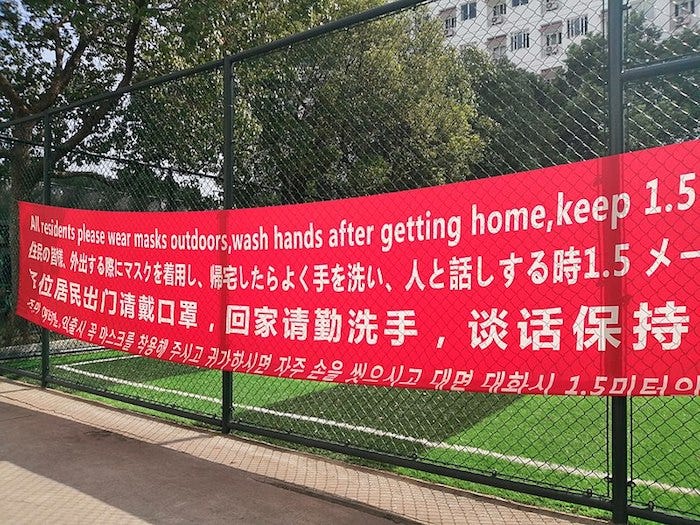
Covid prevention sign in Jiangsu province, China, in the autumn of 2020 / Wikimedia Commons CC

Blocking keywords is a growing form of censorship

To hide its inability to control the Covid-19 outbreak in Wuhan, China censored millions of pieces of content, containing over 2,000 keywords related to the pandemic, on its WeChat app.

China suppressed “both criticism of the Chinese Communist Party and innocuous questions or observations about the virus,” Freedom House reports.

Censorship is being normalized in Western democracies

Censorship has always existed under totalitarian regimes. But lately the curbs on free expression have spread to robust democracies like Denmark.

The Danish Parliament criminalized blasphemy, outlawing the “improper treatment” in public of major religious texts, in 2023. Experts have noted that the legislation is so broad, it could be used to stifle almost any form of artistic expression.
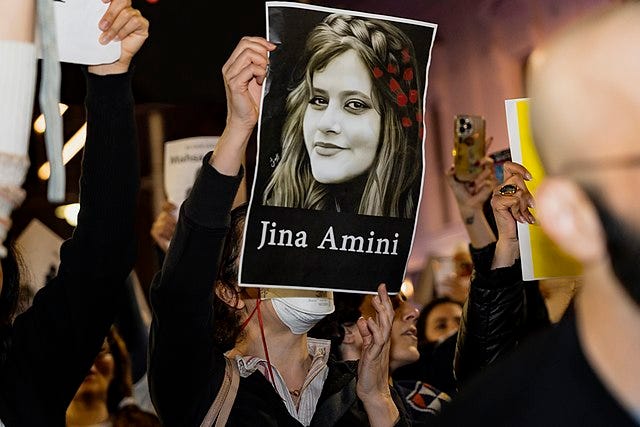
An Australian protest after the death of Mahsa Amini / Matt Hrkac on Wikimedia Commons CC

Near-record numbers of journalists are going to jail

More journalists are being imprisoned for doing their job, and 320 were behind bars as of Dec. 1, 2023, the Committee to Protect Journalists found. It was “a disturbing barometer of entrenched authoritarianism and the vitriol of governments determined to smother independent voices.”

Russia has imprisoned the Wall Street Journal reporter Evan Gershkovich, who was reporting on the war in Ukraine and other subjects. Iran arrested 79 journalists in “a staggering crackdown” amid the protests that erupted after Mahsa Amini died in prison following her arrest for failing to wear her hijab correctly.

A superstar author withdrew a book after online attacks

Literary supernova Elizabeth Gilbert had an international bestseller in Eat Pray Love, made into a movie starring Julia Roberts. But it didn’t insulate her from the pressure to self-censor.

Gilbert postponed indefinitely the publication of a historical novel set in Russia after attacks on Goodreads and Instagram deplored its arrival while the country is at war with Ukraine.

The Snow Forest was due out out in February 2024, and as the New York Times described it, it follows a Russian family that self-exiled to Siberia the 1930s to resist the Soviet government. Gilbert said in a video on Instagram:

“I have received an enormous, massive outpouring of reactions and responses from my Ukrainian readers expressing anger, sorrow, disappointment and pain about the fact that I would choose to release a book into the world right now — any book, no matter what the subject of it is — that is set in Russia.”
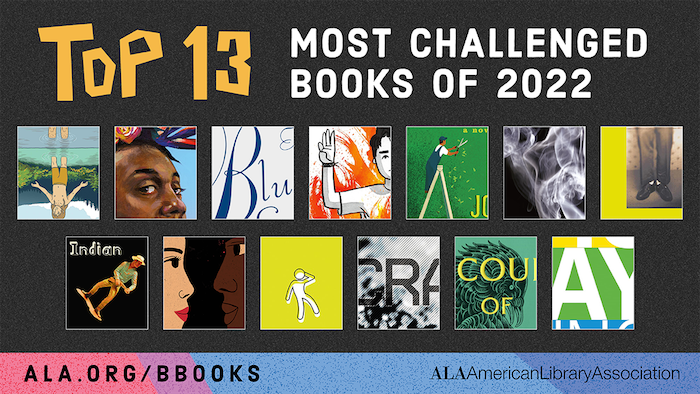
American Library Association poster of frequently challenged books / ALA

Attempts to ban books have hit new highs in the U.S.

The American Library Association reported a record-breaking number of challenges to library materials or services in the first eight months of 2023. Most of the targeted books were written by or about people who are of color or LGBTQ. And while past campaigns to ban books have focused on school libraries, they now include public libraries in equal measure.

Even Winnie-the-Pooh is a target

For years China has censored images of the teddy bear Winnie-the-Pooh, a symbol of Xi Jinping.

The practice seems to have begun after the rotund Xi and the tall and slender Barack Obama were photographed walking together during a state visit. The picture sparked comparisons with Winnie and Tigger that Chinese observers have since used to mock their leader.

Last year China banned the slasher film “Winnie-the-Pooh: Blood and Honey,” which casts Winnie and Piglet as psychopathic serial killers, in Hong Kong. Credible reports have said the government also removed it from streaming platforms throughout China.
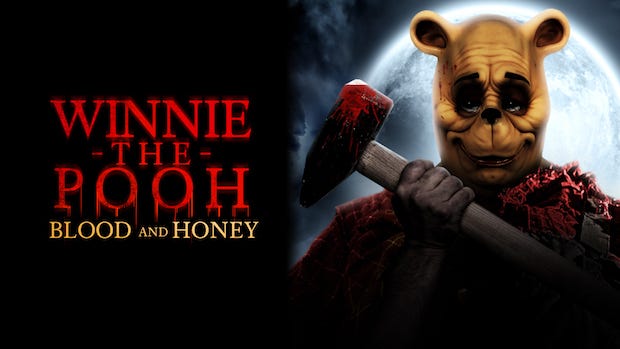
Poster for “Winnie-the-Pooh: Blood and Honey” / Jagged Edge and ITN Studios

Opposition to censorship is rising

Censorship is on the rise, but so is opposition to it. The Florida legislature caused an uproar in 2023 when it required libraries to pull challenged books from shelves at least temporarily. As Politico reported:

“The law caused a national outcry after local schools received hundreds of challenges to a wide range of books, leading to reviews of titles like Ernest Hemingway’s For Whom the Bell Tolls and And Tango Makes Three, a kids book about a penguin family with two dads. It’s also led to multiple lawsuits against top education officials and local school boards asserting that the restrictions violate free speech.”

Frustrated by attempts to remove entire categories of books from library shelves, Florida legislators recently proposed a law that would charge some people a $100 fee if they want to object to more than five books. It’s a sign that even in deep red Florida, people are fighting back against forms of censorship that hurt everyone.

You can fight censorship wherever you live

If you’re not a lawmaker, you can:

  • Write posts or stories that defend free speech or call out assaults on it.
  • Support librarians’ right to choose the best books for their patrons.
  • Join or donate to groups that fight censorship, such as PEN America, the Authors Guild, or Reporters Without Borders (RSF).

Historians say that attempts to stifle free expression are as old as the written word. But that’s not a reason to give up the fight against censorship. It’s a reason to find new ways to defeat it.

Jan is an award-winning critic and journalist who has been a writer and editor for Glamour, the book critic for a large newspaper, and a vice president of the National Book Critics Circle.

You might like another of my stories about censorship:

Censorship
Free Speech
Politics
Books
First Amendment
Recommended from ReadMedium