
10 Surprising Life Lessons We Could Learn From Bird School
Flying isn’t one of the lessons (Sorry)
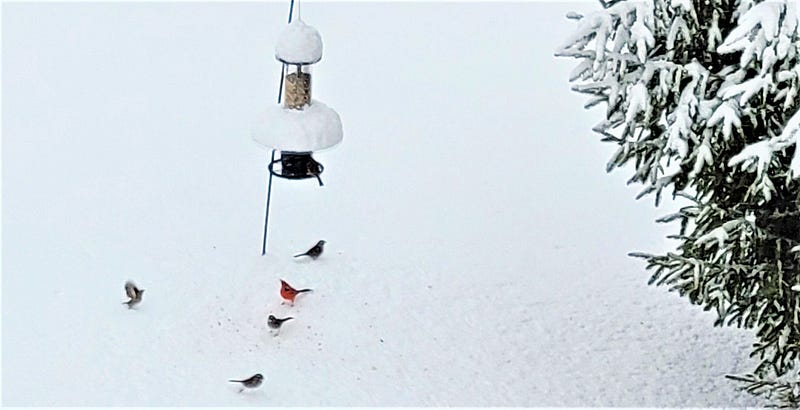
Service announcement on behalf of the birds
Bird brain, as an insult, no longer stands up to the tests of science.
Birds exhibit extraordinary cognitive skills that are comparable to those of mammals, Martin Statcho & Colleugues in Science Magazine.
In case you have any doubt…here is a second opinion…
Many birds have cognitive abilities that match or surpass those of mammals. S. Olkowicz & Colleagues, Proceedings of the National Academy of Sciences.
Why Bird School?
Humans seek endless self-help advice and life hacks — forever looking for tips to improve cognitive functioning, be more successful, and reach higher levels of happiness. We may never have thought we would look to the bird brains for help but…you can’t argue with science. They have some impressive cognitive skills and abilities!
10 Life Lessons from Bird School
- Be a Good Parent — Work together to care for your young. Provide them with an environment safe for learning and be good models to learn from. Corvids have prolonged developmental periods, both in the nest and after they leave. “Both humans and corvids spend their youth learning vital skills, surrounded by tolerant adults which support their long learning process. Moreover, corvids and humans have the ability for lifelong learning — a flexible intelligence that allows individuals to adapt to changing environments throughout their lifetime, Natalie Uomini of the Max Planck Institute.
- Be Brave—Don’t be afraid to jump from your comfort spot, or be pushed! Find what motivates you and get yourself out there! The more you try scary things — the more comfortable they will become. Slowly the mother bird will stand farther and farther away from the nest, forcing the baby bird to come out in order to get food. Chances are the first few times the bird will fall down to the ground. It will eventually learn that it can ease its falls by spreading its wings. The bird will become accustomed to this idea and every time it falls, it will attempt to flap its wings more and more. The result of not falling/ being able to fly its way back up to get food will motivate the bird to fly more often, N. Basu of Boston University.
- Be Helpful—Do all that you can for others. Be aware that what you say and do has an impact— make it a positive impact. Experiments show that the chicken makes alarm calls with the intention of warning other members of its species, rather than simply doing so automatically whenever it sees a predator. The chicken made alarm calls only when another chicken was present. When alone, it could suppress its alarm call and so avoid drawing attention to itself. In other words, the bird calls only when there is another bird to protect, Ethologist G. Kaplan and colleagues in the Dana Foundation.
- Stay Focused —Keep your eye on the prize. Always go hard after the things you want. Make adjustments as needed. Utilize laser focus and bring home the prize. Falcons tend to train their eyes on their victims by constantly readjusting their flying position so that the prey appears motionless against the background. This helps them to effectively predict the future position of their prey, which enables the large birds to head off and intercept their victims in the least amount of time, S. Kane in Live Science.
- Return Home — Don’t let too much time go by before returning home. Don’t forget where you came from. Migratory birds can remember and return to the exact location where they were born. We know that they navigate using the sun, stars, and Earth’s magnetic field. Some birds fly almost 7,000 miles without stopping, J. Lowe of the American Bird Conservancy.
- Build Your Home —Figuratively and literally, build a strong home. Also, be conscious so that your home leaves a light footprint. Bird heroes are showing materials physicists how it’s done…with strong and lightweight compound materials. Between sand and cloth, at a blurry interface could lie practical solutions for engineering, transportation, and manufacturing, C. Delbert in Popular Mechanics.
- Eat Mindfully—Be responsible and think about where your food is coming from. Enjoy your food as nourishment. Eat what you need. Save or share what you don’t need. Some birds hide, or cache, their food at times of plenty and retrieve it later, sometimes after only a few days or sometimes months later when food is scarce. Birds retrieve the perishable food items first and then the imperishable ones. The Clarke’s nutcracker has an extraordinary capacity for remembering the locations of thousands of cached seeds. It does so using cognitive spatial maps, that is, using complex geometrical concepts (for example, the central spot among several trees at some distance) rather than simply remembering the details of landmarks right next to the spot where each seed was hidden — a strategy that could be useless after snow has fallen, G. Kaplan and Collegues in the Dana Foundation.
- Proceed at the appropriate speed. Don’t fly through life at top speeds all the time. Know when you can glide, when you should flit and flutter, know when you must flap like your life depends on it. Birds compensate for headwinds by increasing the frequency of their wing strokes and thereby flying faster; they compensate for tailwind through fewer wing strokes compared to when there is no wind. Birds adapt their flight speed to several different factors simultaneously and independently of each other, Lund University in Science Daily. Also, Migratory birds travel at the same speeds we usually do while driving. These range from 15 to 55 miles per hour, depending on the species, prevailing winds, and air temperature. At these rates, migratory birds typically fly from 15 to 600 miles — or more — each day. To keep up with them, you’d need to run the entire width of the state of Montana in a day, J. Lowe of the American Bird Conservancy.
- Work on your emotional intelligence — Be aware of your emotions. Express them and control them! Yes! Birds have emotions. They have a brain that is wired similarly to ours. Bird School is still researching in this area…it is a hot topic! Birds are more similar to humans than had ever been thought, but with an important difference: birds are generally not aggressive without cause. Technically, aggression is an emotion that is dysfunctional, has no purpose, and often even harms the individual displaying it. Birds can be joyful and playful, can get depressed and, as studies have shown, a neglectful or bare environment can even make them pessimistic. Birds may feel for others (have empathy) and even console them, may have a sense of justice, may show deep affection for their partner, and grieve for their loss. The mate of a fatally injured tawny frogmouth was witnessed not moving from the spot next to its dead partner for three days and then dying on the fourth. Empathy, altruism, and consoling the injured or vanquished have all been observed in birds, thought to be the ultimate in consideration for another individual’s state of mind, M. Papini in Frontiers in Psychology.
- Ten is the lucky number — DIY…Do it yourself! (Keep reading for some help.)
Notes
If you feel blindsided and don’t like being left hanging with a DIY, please know it is not personal. As a teacher, I love leaving my readers a little bit unsatisfied so that they want to know more. My hope is that each reader continues some self-guided learning with reaches well beyond what I could offer in one more item that I selected to add to my list!
If there is anyone still feeling uneasy — I am also a big supporter of choice in learning so here are three choices if you feel like the DIY doesn’t fit your style.
- Keep your toolbelt handy — See how crows show foresight in toolmaking, another mainstay of higher cognition. Also, check out these crows that use human feet as tools.
- Show your true colors — Birds can see a wider range of colors than humans and some in the UV spectrum.
- Use your voice — Birds, humans, and vocal learning.
Conclusion
As humans, we have long thought that our brains were far superior in higher level thinking capabilities…we need to keep thinking about just how far ahead we are!
Thanks for reading! If you want to read more of my stories:


