
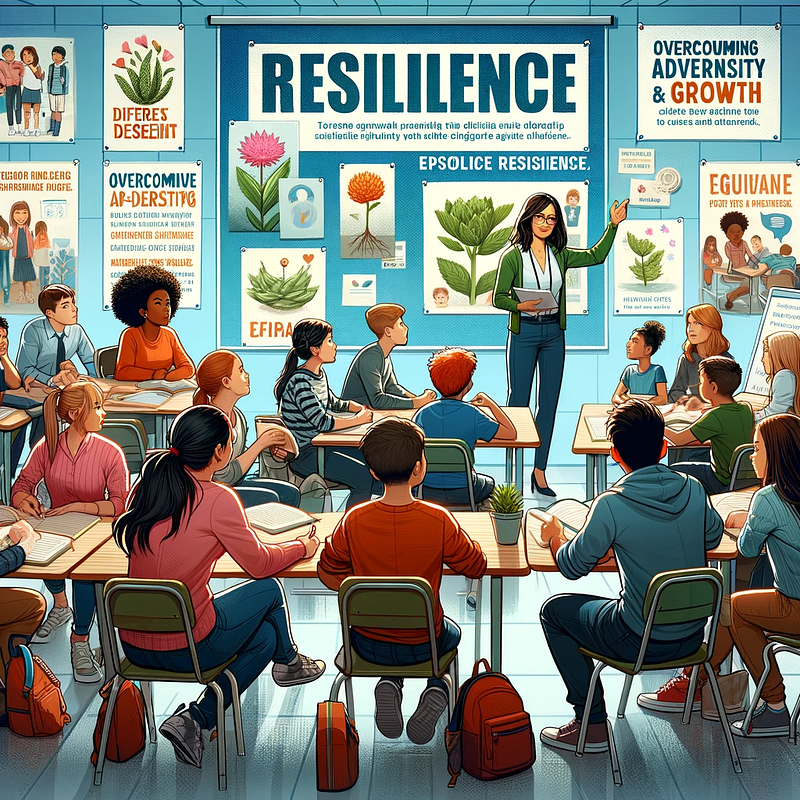
10 reasons why schools need to teach resiliency during formative years
Bounce-back basics 101: building better brains in the classroom
“The greatest glory in living lies not in never falling, but in rising every time we fall.” — Nelson Mandela
Growing up in the Caribbean, there was always music — a constant, vibrant soundtrack to every aspects of our life. The reggae grooves were more than just rhythms; they were life lessons set to melody. The soca and calypso beats of carnival, always seem to inform us of the satiric nuances of the politics du jour. And then, there was our own creole songs were almost always about love and a nostalgic Caribbean life. These songs, of different musical genres, were my early teachers, instilling in me the spirit of resilience, historical, cultural and political currency, as well as ideals of love. One thing they all seemed to have was a biding theme — one of resilience. They reminded me time and again to do such things as:
“pick myself up/ dust myself off/ and start all over again,”
or the hypnotic songs of the great Burning Spear, who reminded us that:
“social living is the best.”
all songs, re-echoing the undying spirit of the Caribbean islands and its inhabitants.
These songs were not only about personal perseverance. There were songs about survival, tunes that spoke of community, unity, and the collective strength of a people facing life’s challenges together. These melodies carried stories of love, swagger, prowess, struggle and triumph, echoing through the streets and seeping into the very fabric of our existence. They taught us to face life with a blend of joy, defiance, and determination.

In this blog, I want to take you on a brief journey back to those times, and then back to our present. I’ll share how the music of my childhood not only provided a soundtrack but also shaped my understanding of resilience, hope, and the power of community. From the soulful sounds of Bob Marley preaching love and unity to the energetic beats that filled our carnivals with colour and life, each note held a message, a lesson, a piece of wisdom that I carry with me to this day.
Here, in this post, I explore the enduring impact of these songs, as my early teachings and how they helped mold me into the person I am today. But even further, to also now make the case that resilience must become an educational pillar for students, particularly in their formative years. While much of the music that the young, especially here in North America listen to, is often less desirable, in terms of pedagogic appeal, it has become a vital imperative, more so than at any other time in history. So we must actively instill in our young the resilience that they will face in our unfolding complicated world.
Music is the soundtrack to human life and can help us through difficult times. It expresses what cannot be put into words and that which cannot remain silent, in many instances. It’s also a universal language that transcends boundaries, connecting souls across different cultures and experiences and can be a companion in joy, a comfort in sorrow, and a beacon of hope in times we need it the most. In short, music is a reflection of humanity’s deepest emotions, capturing the essence of our shared journey through life. It can also be a guidepost to our collective resilience. And as the depth of musical expressions seem to dim for some generation, we must consider the other ways in which we can begin to equip the young with pathways to resilience.
Education is that means — a deliberation of resilience training, to be more precise.
Que sera sera — what will I be when I grow up
My kids, now teenagers at the ages of 13 and 16, are already grappling with a question that weighs heavily on their young minds: ‘What will I be when I grow up?’ This is not a unique concern. Across the globe, many youths face this rising anxiety, especially when they reach about grade 11, here in Canada. It’s at this pivotal stage that the triaging of ambitions begins, pushing developing kids onto paths that seem to predetermine their futures. But I argue that this is a false start to life. But that is for another blog. This critical youthful juncture, often seen as a time to narrow down choices and solidify career paths, can be limiting and anxiety-inducing. Resilience training is key.
Did you know: A global poll was also conducted by Gallup and it uncovered that out of the world’s one billion full-time workers, only 15% of people are engaged at work; this leaves a significant 85% unhappy at their jobs.
Related post: 8 things that happened when I took a 6-month break from the 9–5 grind!
As educational institutions continue to fuel a pipeline of future workers, the focus often narrows to academic and professional achievements, overlooking the broader spectrum of personal and emotional development. I advocate for a shift in perspective. I believe that along with academic prowess, and all that comes along with it, educational institutions should emphasize teaching the art of resilience. It’s about preparing our children not just for a career but for the various challenges life will inevitably throw at them.
Resilience is not just about bouncing back from failures; it’s about adapting, learning, and thriving in the face of change and uncertainty.
Fostering resilience is as crucial as academic education and it seems that this call will fall on deaf ears as educational institutions are slow in changing anything; and I speak from close knowledge. So parents, it is up to us to keep pushing to enable the updating of dated curriculum that only sees our kids as cogs, preparing for complex and uncertain futures.
So, how can parents can play a pivotal role in advocating for this essential life skill in schools. For me, this is not just about altering curriculums; it’s about redefining our approach to education and equipping our children with the tools they need to navigate the complexities of inevitable and incoming Life, far beyond the confines of a classroom or a chosen career path.
Why teach resilience in school — 10 reasons
In my side business, Human Tech Futures, we are often faced with more business challenges — challenges such as how teams remain relevant and innovative; to me it is no different. These are challenges of maintaining resiliency as a foundation. Over the years, I have used much of my practice to support my own kids, as we lay a resilient foundation to their lives — be it sports, heartbreak, or classes they are struggling with. Embracing resilience, in practice, lets them know that there are solutions to the challenges they face, even though it does not seem so. Teaching resiliency in schools from a young age is important for several reasons. I am sure there are many more but these are a start:
Dealing with challenges
Life is full of ups and downs and by learning resilience, students can better navigate the challenges they face, both in their personal lives and in their education. Remember heartbreak from a first love? Well resilience can help mitigate some of that hurt because it can make or break you as an adult.
Academic success
Resilient students are more likely to persevere through difficult tasks and challenges in their academic work. This persistence can lead to better learning outcomes and academic success. My own personal example is my 16 year old son, who struggled briefly in Chemistry. Understanding that putting in the time, though it might be exhausting, will have its rewards.
Emotional well-being
Resilience helps in managing emotions effectively. Students who are resilient can better handle stress, anxiety, and disappointment, which are inevitable parts of life. Any of the prior examples suffices here to show how resilience is important in many ways.
Social skills
Resilient children and teenagers are often better at building and maintaining relationships. They’re more likely to seek help when needed and offer support to others, fostering a positive social environment. Part of my son’s path to improving his grades was seeking help, forcing interaction with his teacher, who was more than happy to set lunchtime study groups for him and other students.
Preparation for adulthood
The skills and attitudes developed through resilience training are essential for navigating the complexities of adult life, including the workplace and personal relationships, alike. We did not come into life with a map and handbook and resilience training can fill this void. Overtime, it becomes part of the way we exist in the world.
Adaptability
In a rapidly changing world, the ability to adapt to new situations and overcome obstacles is crucial. Resilient students are more likely to thrive in the face of change. Companies pay consultants lots of money to help them navigate uncertainty and this is no different. Imagine the power of instilling this in your kids at a young age.
Self-esteem
Building resilience often involves overcoming challenges, which can significantly boost a student’s self-esteem and confidence. This naturally is an outcome of raising resilient kids. One day it dawns on you as a parent that you are doing the job of parenting — and that too feels good.
Problem-solving skills
Resilience training often includes developing problem-solving skills, which are valuable in both academic and everyday life situations. Solving problems in one aspect of your life provides a blueprint for doing it in other aspects of your life.
Positive & growth mindset
Resilience fosters a more optimistic outlook and a focus on solutions rather than problems. Part of pessimism is not seeing a viable path; resilience training affords us pathways to solutioning that helps create not only a positive mindset but also a growth mindset.
Creating a supportive community
When resilience is taught in schools, it helps create a supportive and understanding community where students feel safe to take risks and learn from failure. Granted, the risks they take at these tender ages can only help fortify them as they get older and the risks get greater.
The time is now for educational institutions to begin incorporating resilience training into the curriculum. Schools, particularly middle and high schools can provide students with vital life skills that extend far beyond academic knowledge, preparing them for a successful and adaptive future. While schools ramp up to roll out these new ways of pedagogy in their curriculum, they can supplement by leveraging the use of such things as stories, consultants as well as projects. I do, however believe that to enable deep re-enforcements that resilience should be a dedicated class because if you are a parent, you know that practice makes perfect.

About me: Hello, my name is Kem-Laurin, and I am one half of the co-founding team of Human Tech Futures. I am currently pursuing a doctoral degree at the University of Waterloo. My research inquires into identity construction through contemporary case studies (judicial) that demonstrate how citizens’ data is collected and utilized. Whether data is illicitly harvested or willingly shared, the resultant algorithmic constructions wield immense power over users whose identities are quantified through information. My research objectives are to (1) develop a critical understanding that will then allow me to (2) produce concrete heuristic principles for use in AI powered design systems (as informed by my professional experience in systems design).
As a mature adult, I returned to school to complete a PhD I left behind years ago. I did this taking care of 2 kids and holding a full time job. I say this to say, just do what feels right. In this journey, I was a 2021–2022 Ontario Graduate Scholarship/Queen Elizabeth II-GSST Scholarship (2021–2022), as well as President’s Graduate Scholarship (PGS) 2021 University of Waterloo, Canada. In 2023, I received the University of Waterloo’s Faculty of Math’s, DiMarco award in Computational Rhetoric. I hope to defend in the Spring or summer of 2024. Scared and excited!
I enjoy sci-fi, fantasy, mystery, philosophy, language, African studies, and language etymologies but mostly, rhetoric histories. Not sure why. Recently, as I completing my studies, I gravitate towards anything at the intersections of technology, philosophy and society that speaks to our current AI and tech posture. In a path not taken, I would have been a lawyer. [shudder]; I write about this here. Professionally, I practice as a Principal HCD Strategist and Design Thinking Coach. Prior, I led both small and large Design and Research teams at Blackberry Autodesk and also worked at Siemens in both Munich, German, Princeton, USA.
In my spare time, I build layered gardens, with a tropical vibe, while my 135 pound GSD, Chewie looks on. Today, I feel blessed to have traveled to over 25 countries before the world transformed to what it is today; I was able to experience a good breadth of human experiences. Periodically, I give back as an active mentor to my students, past reports and many burgeoning, critically thinking Tech Humanist who seek to make the world a better place.