10 Reasons Celtic Frost was the greatest band ever.
In no specific order.
One:
Question: Did anyone write greater riffs than Tom G Warrior on Morbid Tales and Emperor’s Return?
Answer: No.
Two:
Tom G Warrior, or Satanic Slaughter as he was known in his Hellhammer guise, reimagined Venom’s Novocastrian calamity, transforming their primitive battery into an approximate primordial art form.
I know it’s proper to refer to Cronos and co as Geordies, but Novocastrian sounds infinitely cooler and decidedly more absurd when referencing Venom. Faster and over the top! Aaaaarghhh!
Three:
H.R. Giger provided artwork for the band. The sleeve design of To Mega Therion, equally iconic as it is diabolical. A true vision of hell.
These forces were drawn together for reasons greater than their geographic proximity. Celtic Frost, more cerebrally evolved than their contemporaries, even if the sonic facade was comparable to a less sophisticated frame.
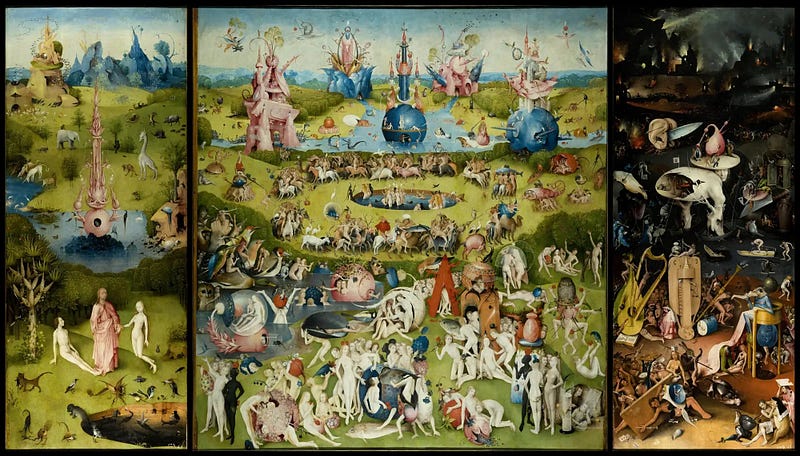
Hieronymus Bosch also contributed an element of his Garden Of Earthly Delights triptych to Into The Pandemonium. The same explicit approval afforded to this post.
Four:
The Heptagram. When it comes to Black Metal iconography, this is without rival. Devoid of the unintentionally comedic affectations that peers and predecessors attached themselves to. Too underground for the PMRC, too fiendish for the tourists.
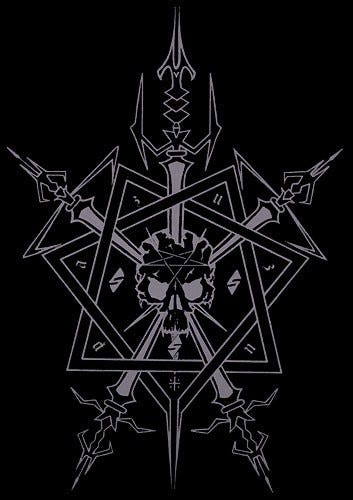
It’d be a fair argument to make that the Heptagram is the Black/Death Metal equivalent of Motörhead’s Warpig/Snaggletooth, or as its creator, Joe Petagno called it, The Little Bastard!
Five:
The death-grunt. One of the most adopted affectations of Death, Black and Thrash metal. Warrior’s verbal punctuation is without peer, though I’d argue that Wagner Antichrist’s use of this immortal approach to kick things up a notch is a well executed tribute.
Six:
Lyrics were light years beyond the shock and awe of their contemporaries. There was some dedicated occult vision woven through these tracks.
Dreams drift in the frozen wind And mysteries are reborn We rose from sand and stone To follow the light’s allure Tears drift in the shadows sleep Turn innocence into excess Fragments of a dying world And destiny lies beneath
Excerpt from Babylon Fell. Lifted from Into The Pandemonium, Noise Records, 1987.
Seven:
The band found their way back from the abyss. In 1988, Celtic Frost jumped the shark. Cold Lake was an abominable stain on a phenomenal discography.
In five short years they had transformed from bunker dwelling fiends, to a Frankenstein glam band. I don’t know at what point Fischer had the revelation, but he did manage to steer the ship back to grim reality.
While their ’84 to ’85 era was never eclipsed, Monotheist was painfully heavy, and as close to full circle as a band could evolve before becoming a parody of themselves.
Eight:
Tom G Warrior is an authentic artist. His struggle is public. He says what’s on his mind. He is plagued by visions of what could have been, and presents as someone for whom nothing is ever quite perfect enough.
It can be a little difficult to remain untarnished by the negative tide that Fischer washes over these feted recordings, but the pragmatic view is of the artist who was never satisfied.
His curation of projects such as the Hellhammer coffee table book, Only Death Is Real and the restoration of the 1983 sessions for the Demon Entrails box set show a pursuit of commitment toward perfection that should be honoured, despite presenting on the abyssic side of compulsion.
Nine:
Celtic Frost, and Hellhammer rank among the most effective bridges between 80s and 90s Black Metal. Where Bathory’s influence was more stylistically overt, Celtic Frost spoke through some of the more eccentric and atmospheric bands — Samael and Sigh being two primary examples. And where countless acts would emulate Warrior’s riffing style, the purest, most quintessential reincarnation manifested on Darkthrone’s fourth (and arguably final) Black Metal offensive, Panzerfaust.
It’s pretty wild to consider that Welcome to Hell is now 40 years old; the Hellhammer demos a scant two years its junior. The Celtic Frost of 1988, completely alien to that banner under which they marched just years before, considered veterans to bands that formed in the latter part of the same decade. Inspiring some of the earliest second wave bands such as Tormentor from Hungary, Mayhem from Norway, as well as Brazilian cults Sarcofago and Sepultura — all of whom carried the torch for the Swiss occultists.
Ten:
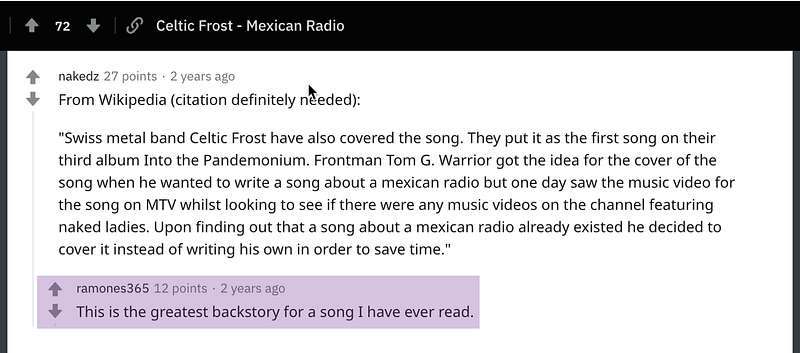
They had no fear. While recording Mexican Radio wasn’t the dumbest thing that Celtic Frost did, selecting it to open their creative triumph Into The Pandemonium went some distance in confirming that the band couldn’t always discern the wheat from the chaff. There’s a great thread on Reddit that cites the motivation behind the selection. Plausible in its banality, I hope it’s true, if only to validate the highlighted comment. LINK
It’s a suitable metaphor for the band’s temerity; they did as they willed, and I’m one to advocate for antagonisation of the fans, believing that no artist should forego their impulses for the desires of the mob.