
10 Unusual Vedic Lessons That Guarantee Happy And Harmonious Marriage
Unheard and timeless lessons from my wedding priest
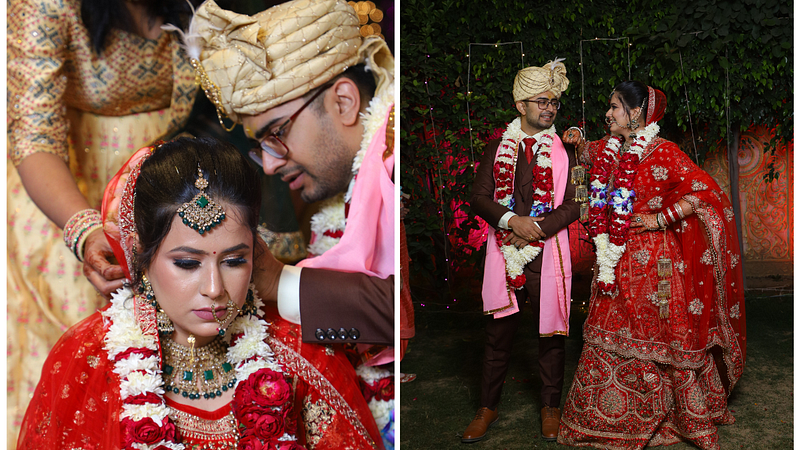
I got married in December 2021 as per Vedic marriage traditions and until the priest started explaining the vows, I never fully grasped the depth of the relationship.
I’ve been to a bunch of weddings, but I never really paid attention to that part because, honestly, I was all about the food. I know way more about the Western vows you hear in movies and TV shows than the Indian Vedic stuff because, you know, it’s just everywhere.
There is a lot of hype about creating your vows in the Western culture, and even though the promises my wife and I made to each other were pre-written thousands of years ago, they covered so much more than we could have on our own.
Even in Hindus, not a lot of people go to Vedic wedding ceremonies because they take a little longer and everyone is in a hurry. Still, everyone who was there during that ceremony eagerly listened to every word the priest said and many people even asked us for the recording for the same.
During the Vedic ceremony, several verses are recited, and each verse contributes to some guidance and asks to make different promises for a healthy relationship not only among us but with our elders, with children, and with society.
It was during the ceremony that things got serious for me. There are moments where I got overwhelmed by the emotions and it’s not usual for me to feel that way.
I was awestruck by the beauty of the verses, and it still amazes me that the vows go so deep into things I could not have comprehended on my own.
I knew on that day that more people should know about this and I felt like a fool for focussing on food at all the weddings I’ve attended before.
My relationship would have improved drastically if I had known all of this beforehand.
Here are the 10 lessons:
1. The Symbolic Power of Standing and Saying ‘Namaste’
During the wedding ceremony, everyone is expected to take a seat. The bride and groom, along with the priest, usually sit on the ground.
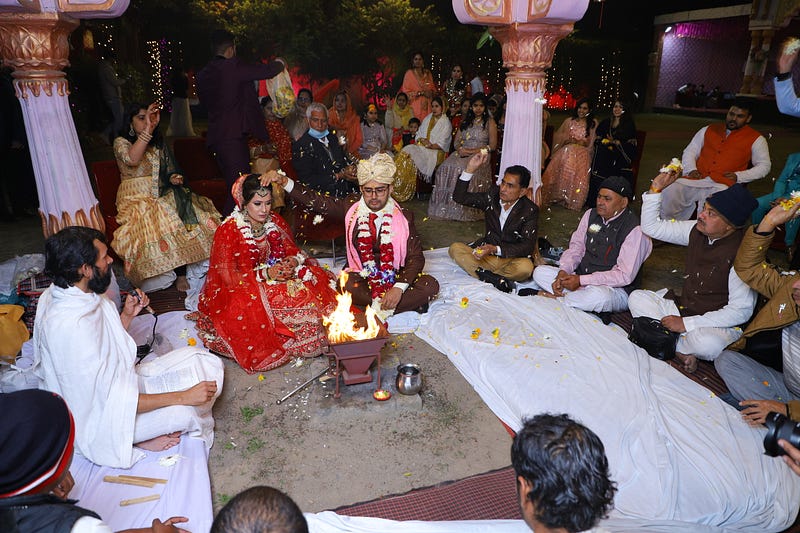
When my wife came to the altar, the priest asked me to stand and later explained that we stand because it is an etiquette to leave your chair or place when we see a respectable person coming.
Then he told us to greet each other with “Namaste” as a way of expressing mutual respect.
At that time, I didn’t give much thought to it, but this year as my wife and I were watching the Vivaah Sanskar (which we decided to do on our wedding anniversary), it finally clicked me that this simple gesture holds so much meaning.
If my father had simply respected my mother, their marriage would have not fallen to ruins. If my brother-in-law would respect my sister, not just in words, but in actions, their marriage would probably survive.
On that day, I understood that respect, not love, is the foundation of the marriage. It amazes me that in Vedic culture; the ceremony starts with this beautiful gesture.
Research also shows that being able to be yourself with your partner can deepen the trust between you and your partner, solidify your bond, and create intimacy in the relationship.
People thousands of years ago knew that a wife is not someone you take for granted, she’s someone who should hold your respect.
2. Restless Without Love
After the bride and groom were seated, the verses began. There were several verses, each teaching different lessons. And even though I wish I knew all the verses by heart, I don’t.
The verses were recited by the priest and he then explained the meaning of each verse to us.
In the first Sanskrit verse, the priest explained that in front of everyone present, my wife and I were agreeing that we were getting married happily with our choices and were not being forced.
He said that from this moment forward, our hearts should meet like two glasses of water and become one that boils and freezes together and stays inseparable. It means that we must stick together through life’s ups and downs and face the challenges as one.
Partners who believe in the strength of their relationship and have the skills to resolve conflicts are more likely to stay together long-term.
Then verse further elaborates: How much love should be there between us?
We should love each other as we love air. We see married people go without talking to each other for days, but the verse indicates that two minutes away from air and we become restless and that should be the level of love between a husband and a wife.
We must not have ego and whenever we disagree, the wife says I’ll sacrifice my ego first and make amends and the husband says I’ll sacrifice my ego first and make amends. When both partners sacrifice their egos and try to make amends, how long the conflict could last?
I knew this would be a difficult yet necessary promise from my side because I am an egoist person. I can blame my upbringing and my father for that, but it would not make my relationship work.
It’s my responsibility to work on myself.
So, right there on our wedding day, I promised myself that I would work harder to keep my ego at bay. That I will not be like my father and I will make sure our relationship holds the test of time.
3. Our Fourfold Promise for Lifelong Happiness
He then made me stand and told me to hold her hand and recited another verse in which I promised her that, “You are the one who would bring auspiciousness, honor, wealth, prosperity, and dignity. And we’ll be together till death do us part.” And she promises back.
And even though I was mostly excited on that day, things were getting serious and serious. I knew my almost wife was holding back her tears (she’s emotional like that) and I realized that even though we were together for 8 years, marriage is so much more than just living together.
There’s something about sitting in front of everyone and making promises to each other. I always knew I was lucky to have her in my life, and in that moment, while making these promises, I knew I was the luckiest today that she decided to spend her life with me.
But there was not much time to think and in the next verse, I promised, “I would never let you lack the following four things in your life.”
The four things are:
#1. Promise of speech
I promised to say only sweet & kind words while never speaking bitter ones and my wife promised back that I would never do anything to make you angry or upset.
Research also shows that appreciating the positive qualities of your partner rather than ruminating about their flaws will help your relationship.
I have watched this ceremony of ours 3 times until today and every time we come to this point, my mind gets flooded with all the stupid things I said to her in the past 10 years.
And every time I silently promise myself again to never repeat that mistake. I am also proud to say that in the last 2 years; I have only said kind words to her. And I have her permission to write this statement.
#2. Promise of nourishment
I promised to provide good quality food that nourishes the body and the mind and my wife promised that we will always eat sattvic food.
I try to live my life as per Vedic culture and eating sattvic food is a huge part of this culture. In Ayurveda, sattvic foods are believed to boost energy, happiness, calmness, and mental clarity. Simply, it means enjoying vegetarian, nutritious, fresh, and tasty foods.
And I knew even before getting married that my wife shared the same views. But it still shocked me that such simple things are also included in the vows. In any normal relationship, the type of food you eat may not seem important, but when you live together, it matters a lot.
Also, if you both share the same food preference, your kids will simply follow that. But when you have conflicting views about which type of food you should eat, it may cause conflict when the time comes to decide the food preferences of the child as well.
#3. Promise of clothes
I promised to never let her have any lack of clothes and she promised that she would only wear whatever I would get her.
I know a lot of people will not agree on that point. Some will even say that as the woman has freedom, she can wear what she likes. And she can.
It’s not about just the woman. For the last 2 years, my wife has brought clothes for me and I wear what she chooses for me. And she prefers to wear the clothes I like. It was never a big deal for us.
For any relationship, just love is never enough. You should also have the same views on major aspects of life, like religion, finances, and kids. When your views align, your choice of clothes is not a big deal and it will align.
#4. Promise of ornaments
I promised that I would never let her lack any jewelry and ornaments and she promised that she would only wear the jewelry that I would like.
In Vedic Culture, women and men are not allowed to do makeup or wear ornaments before marriage because it is said that before marriage it’s time for them to focus on being a better person mentally and physically.
So, during the Vivaah Sanskar, while making this promise, the husband is saying that he will make sure that his wife gets all the things she wants so that she can dress as per her desire.

4. The Vedic Secret to a Steadfast Mind
In another Vedic verse that was recited, I promised, “You are the only woman for me in this world, and I would never look at another woman in a bad way. I would only be devoted to you always,” and my wife promised the same.
He then narrated an incident from Ramayan.
Ram asks Lakshman (His younger brother)
पुष्पं दृष्ट्वा फलं दृष्ट्वा दृष्ट्वा स्त्रीणां च यौवनम्। त्रीणि रत्नानि दृष्ट्वैव कस्य नो चलते मनः।।
Upon seeing blossomed flowers, ripened fruits, money resting in solitude, and the youthfulness of women, whose mind doesn’t waver? Who is such a conqueror of the senses?
To this, Lakshman replies
पिता यस्य शुचिर्भूतो माता यस्य पतिव्रता। उभाभ्यामेव संभूतो तस्य नो चलते मनः।।
One whose father is pure and whose mother is devoted. Born of these two, is a conqueror of the senses.
He advised us to become virtuous and devoted to each other so that our children will have a steadfast mind that stays unaffected by worldly temptations.
It’s such a simple thing. We would think that everyone knows it’s not okay to cheat. But sadly, most people don’t.
I’ve seen many people justify minor acts of cheating as innocent conversations. However, in a committed relationship, even small things are significant.
Cheating isn’t limited to just a physical relationship; having an emotional connection with someone of the opposite sex, texting someone and then deleting the conversation, talking to your exes, etc. are also not acceptable.
Even thinking about someone inappropriately is considered a form of cheating.
I know it will sound weird to some people, but even in the early phases of our relationship, my wife and I unanimously decided to not have any friends of the opposite sex. And even after 2 years of marriage and 10 years of relationship, we follow this rule.
We know the passwords of each other phones, and we tell each other everything.
And this verse was about the same thing. If you're loyal, you’ll not even think about someone else and you’ll always be devoted to the person you’re in a relationship with.
5. The Timeless Wisdom Guiding Our Family Bonds
Both of us promised to keep peace and harmony among ourselves. I asked my family and relatives to respect and take care of my wife as our wisdom seekers have written:
पितृभिर्भ्रातृभिश्चैताः पतिभिर्देवरैस्तथा ।पूज्या भूषयितव्याश्च बहुकल्याणमीप्सुभिः॥ — Manusmriti 3.55
Women must be honored and adorned by their fathers, husbands, brothers, and brothers-in-law, who desire their own welfare.
यत्र नार्यस्तु पूज्यन्ते रमन्ते तत्र देवताः। यत्रैतास्तु न पूज्यन्ते सर्वास्तत्राफला: क्रिया:— Manusmriti 3.56
Where women are respected and honored, there reside divine beings. On the other hand, where women are not respected, all actions there remain fruitless.
शोचन्ति जामयो यत्र विनश्यत्याशु तत् कुलम् । न शोचन्ति तु यत्रैता वर्धते तद् हि सर्वदा— Manusmriti 3.57
Where the female relations live in grief, the family soon wholly perishes; but that family where they are not unhappy ever prospers
My father will not speak to me for maybe six months if he reads this article, but I’ll again give an example from my family.
I grew up in an environment where husbands hit their wives, and no one questioned it. And I can tell you firsthand that the house where such things happen will never thrive.
All my uncles and my father are the most lonely men I’ve ever seen and they will not accept it, but it’s because they never showed any respect to women in their lives.
I will never make the same mistake.
6. Rice and Husk and a Promise
In this verse, I promise,
“You will be the one to lead my lineage. I would never keep any secrets from you.”
And my wife promised the same and said,
“I would never let you feel the need to hide anything from me.”
Then both of us stood and my wife’s brother came forward and put a stone under her feet, and recited a verse with the Vedic scholar.
The verse he said translates to,
“My sister, you were raised with great love and affection in our father’s house.
Now, you’re going to your husband’s house. My sister, in that household, you may experience joys and sorrows, gains and losses, honor and dishonor, but you must remain as strong as a rock.
Just as a rock stands firm against storms, hurricanes, and snow, similarly, you must stay resilient.”
Then, the priest asked me to put my hand on my wife’s shoulder and say,
“In your life, challenges and obstacles may come, but don’t worry, I won’t leave you alone. Shoulder to shoulder, I’ll stand by you, and if anyone mistreats you, just as you crushed this stone, crush them too. You don’t have to live life as weak, become a warrior. I am always with you.”
The priest then explained that a woman sitting on the right takes rounds of the fire altar and walks behind her husband. The man keeps the woman to her right because he believes that she is more respectable than him and the woman, in return for that respect, agrees to walk behind the man during wedding vows.
The reason to revolve around the fire altar instead of anything else is to give the message that as gold becomes purified in fire, we are intended to burn all our past mistakes on the altar and live a new life that moves in an upward direction just like fire.
As the husband and wife circle the sacred fire, they throw puffed rice inside the fire after each round.

The priest explained that puffed rice was chosen to put in the fire for two reasons:
- Just as a rice plant is sown in one place and transplanted to another for growth, similarly, when a girl is born in one household, she later moves to another, contributing to the progression of life.
- Rice and husk coexist. If the husk leaves the rice, it remains worthless like chaff, and if the rice leaves the husk, its value increases, but it will never germinate. Similarly, the husband and wife should live together as they will be worthless apart.
And honestly, I am worthless without my wife. She’s the one who motivates me even when I am feeling like a loser. She’s always there, no matter what. And I hope I can do the same.
7. The Blueprint for a Conflict-Free Marriage
In the 7th verse, the man asks his wife if she must have had some dreams and wishes that do not violate the righteousness and purity of the relationship regarding her husband and then he promises to fulfill those wishes, and the wife promises the same.
Even research suggests that feeling that your partner is responsive to you is a crucial factor in developing a close and intimate relationship. So, if you fulfill the wishes of your partner, it will only improve the quality of your relationship.
Then we promised to listen to each other very carefully.
Do this too and there won’t be any fight between husband and wife ever and if there is, it’ll resolve quickly
“Husband should never do what the wife doesn’t like, and the wife should never do what the husband doesn’t like.”
This way, there will be no disagreements or fights, but if they do happen, there are four things to keep in mind:
- If the wife is angry, even if the mistake is hers, the husband should stay calm.
- Listen carefully to what the wife says. It’s not about her talking while the husband ignores her.
- If the wife asks something, answer; don’t just stand there silently.
- Respond sweetly, not with anger.
After a couple of days, when the wife calms down, the husband should lovingly explain things to her. The wife should also maintain such behavior with the husband.
In the initial days of marriage, there is a lot of love between the husband and wife. As time passes, differences arise due to their behavior, family matters, lifestyle, and more.
Therefore, the husband says to the wife,
“Right now, there is a lot of love between us. However, as time goes by, I may start seeing faults in you — in your behavior, in your habits, in your way of living, in the way you talk, in your conduct, and more. But I promise to make sincere efforts to eliminate those faults with love. Even then, if I find faults that persist, I pledge to accept them with grace and not engage in arguments or fights.”
The bride also makes the same promise.
Weirdly enough, the same thing was explained to my wife by her mother years ago. Unlike my parents' marriage, my wife’s parents have a very successful marriage. In 27 years, my wife has never seen her parents fight even once.
And once when she asked her mother about it, her mom said, “It’s simple. I don’t say anything when your father is angry. I just listen and let him speak. Then, after a few days, I will tell him my views on the matter and he listens. And he does the same when I’m angry.”
This one thing has worked efficiently for us. And hopefully, it will work for you as well. It’s hard, but worth a try.
8. The Cosmic Inspiration
Then the priest recited another Vedic verse, and he made us point out the twin star system known as Arundhati-Vasistha or (Mizar and Alcor) in the sky as a symbol of the closeness marriage brings to a couple.
Arundhati and Vasistha are two stars that go around each other, unlike other planetary systems in which one stays still, and another makes rounds around it all the time, just like some modern marriages.
But these stars dance together, making circles like partners in a perfect marriage.
In a great marriage, both people twirl around a shared center of love and understanding, just like these stars do in the sky.
It’s all about moving together, supporting each other, and sharing a beautiful journey through life.
Normally, in a relationship, if there’s one person with stronger views and a bad temper, that person rules the relationship. What he said goes. That was my father.
Naturally, my mother’s life revolved around him. Whatever she did was to make him happy, and she always made sure to not do anything that would make him angry.
But in such cases, the person who’s sacrificing their happiness again and again will eventually realize that they deserve much more. My mother realized that 6 years ago, and since that day my parents have not spoken to each other even though they live under the same roof.
If you don’t want your marriage to be like theirs, make sure you are not making yourself the center of your relationship.
9. Seven Steps of Togetherness
Then another Vedic verse was recited, and the priest explained the ritual of Saptapadi. In this, the couple takes 7 steps together as a sign of growth in their relationship and each step signifies the following things:
- There should always be food in the house. This means that the basic needs should always be fulfilled.
- The food must be nourishing and sattvic.
- Then there should always be wealth. As famous Indian philosopher Chanakya has written, “धर्मस्य मूलं अर्थः” which means being prosperous is the root of living a moral life.
- There should always be peace and harmony in the house.
- That there should be children so that we can have a complete family.
- We’ll follow the ethical code of conduct of household life.
- We’ll always be a friend to each other.
And it all will be possible if we walk every step of life together. That’s why the ritual involves walking 7 steps.
10. The Rituals That Seal Our Union
Another Vedic verse was recited, and then my father was called. The priest told him to throw a few water droplets on both of us.
The priest advised the elders that if there’s any argument between husband and wife that they cannot resolve on their own, it's the role of elders to calm them like water is. So that love continues to blossom between them.
This verse strictly tells the elders not to provoke their son to misbehave with the wife.
In fact, lack of family support was a leading factor in 43% of divorces.
There were a few small rituals after that, and the ceremony was completed.
Takeaway
There are traditions and rituals established during Vedic days that modern science is now awakening to. And these vows may sound old and patriarchal to some, but we have lost diamonds in search of coal.
A lot of things today point out that the past practices, be it organic farming, ancient building techniques, ancient clothing like organic cotton, etc didn’t have so many harmful impacts as modern clothing like polyester has.
In these discussions, we realize that the old practices that we replaced were actually somewhat better.
Similarly, my Vedic wedding wasn’t just saying “I do,” it was like an entire class on how to be the best husband and wife.
The entire Vedic philosophy, including marriage vows, is based on two principles — how to achieve happiness and fulfillment, and how to get rid of sorrow.
In a world seeking instant gratification, the Vedic lessons guide us with patience, understanding, and the enduring strength of love and respect.
The vows weren’t just words; they were promises built around kindness, respect, and even how to fight fair. We learned how to be like two stars dancing in the sky, always moving together and sharing life’s journey.
In the end, our wedding gave us a treasure chest of advice to build a strong, loving marriage that lasts, not just for us, but for generations to come.
For the Hindi-speaking audience, here’s the link to the entire video of the Vivaah Sanskar.


