
On writing better
10 (Neglected) Mistakes You Can Fix To Create Yawn-Free Content
No, I am not referring to catchy headlines or formatting

Catchy headlines and proper formatting — they have been much talked about by now and don’t need further elaboration, at least from me.
And I also cannot promise you a simple and perfect recipe for writing content that will go crazy the moment you hit the publish button, but I can indeed point you toward things that might not be working for you.
Let’s get on with the real job at hand without wasting much of your precious time.
Over-formatting
Hey! I said I would not discuss formatting, but over-formatting is rarely discussed. So, don’t make that face yet.
Over-formatting happens when you read too much into something. You heard that formatting makes content skimmable and easy on the readers. You go ahead and make it too easy.
Ultimately, it looks like reading a children’s book — with a smaller font. Trust me; it does not make it easy. So, quit that.
Fix it:
Format in moderation. Know when to draw the line. Not sure?
Hook, line, & sinker
We all have been told that the headline is the most critical part of a story because this is what hooks the reader. A story goes unnoticed without a great headline, like that extra newspaper border strip we tear without seeing.
But the trap is not all set with a good enough headline. After the excitement of the headline, the reader is looking forward to a great story waiting inside. The first glimpse of that story is the intro.
The intro is like a taster. It sets the tone of the story ahead, like a movie teaser.
If a great headline opens the door of a story, a good intro brings in the reader, giving a feel of the house.
Fix it:
Make your intro as interesting as possible and align your reader to the story ahead. Let the readers have a taste that they want to relish in the story. You can:
- talk of a personal incident [I was the only one standing with the basket..]
- a quirky fact [104 times — David Ogilvy rewrote the headline of his ad.]
- a catchy line/ quote/ anecdote
- refer to a personality [ This is why no one messes with Jackie Chan — not because he is a martial arts maestro.]
Let the hook sink deeper.
Spin it in a way that takes the reader all the way to your story. By the time the reader is done with the intro, the reader is already invested in the story. Make it count.
Drag queen
Unless you are writing about dismantling a spacecraft, spare the details. Noone’s life depends on it.
Noone’s got all the time in the world. And even if they had, they wouldn’t read something just because someone wrote it. Imagine people are in a hurry, so be quick and come to the point.
Fix it:
Talk sense. Don’t chit-chat.
If you can tell a thing in 100 words, say it in 80 — without compromising on clarity.
The ‘You’ touch
Reading also has a visual aspect. Whatever you write, the reader is trying to paint a picture — even of you.
Bringing out the real person helps the reader resonate with a living entity. Many stories lack that human touch — you touch.
Sound real.
Fix it:
Treat your reader as a person you are having a candid conversation with. Let the reader meet a genuine person on the other end.
- Talk of your flaws. It makes your story trustworthy and relatable. No one wants God-like talk.
- Brag, but with humility. Share your success stories but make it look like you are sharing for the reader’s benefit.
- Share your genuine feelings and opinions objectively.
- Do not project yourself.
Be the anchor with the mike but let the limelight fall on the reader.
Robot talk
Drop the tuxedo and the black tie. The world has (thankfully) become a casual place. Today digital space is the most significant meeting place where people spend the maximum time.
You don’t need to sound serious to bring home the point or to be taken seriously.
Fix it:
Entertain. Educate. Entertain. That is not a typo.
Learn to ‘talk’ like a person. Though reading is a one-way communication, make it sound like a conversation with some fun elements:
- A question somewhere — the reader answers in mind but gets a feeling of having a conversation
- A small anecdote/incident, preferably personal
- Reaction sounds like ew, arrgh, ouch — making the content more feelable
We are not running a school, darling. Today people want information, but in a fun way. Give them that, and you got yourself a loyal set of viewers.
Impression overload
This is a big-time put-offs. They sound like the geriatric codex of an antediluvian lexicon. Are you getting the drift?
I have come across exciting topics only to be blasted with complicated words. After encountering a couple and some more, I give up.
I understand the urge to throw in some weighty words here & there, but it’s better not to make it too heavy like the gravy of Chicken Butter Masala, else the reader will find it difficult to digest.
Fix it:
Keep it simple. People get impressed with what you offer, not how you offer them. As per the ‘impressive’ words, save them for your date (but I doubt it will work).
I-am-too-clever headlines
Confession time — guilty. I have tried a couple of times in the past and fallen flat on my face.
I get it. We all want to sound interesting and clever. And also want to pique the reader’s interest to make them click on it. But turn the dial a bit much, and you leave the readers scratching their heads, or worse, scrolling over to the next story.
Why go far when we have something close by? Take a look at my headline here:
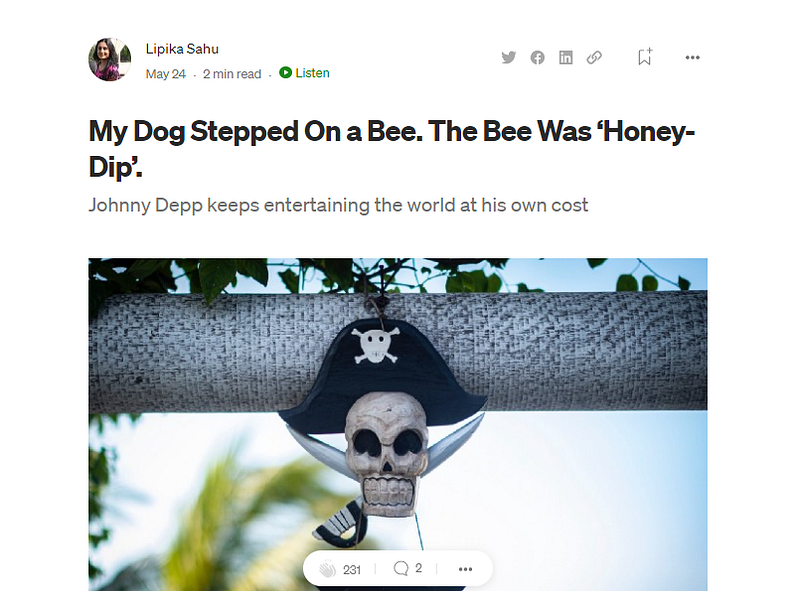
This was the Johnny Depp-Amber Heard case. See how clever I try to sound. No wonder people barely took a dip!
(I am beyond repair)
Fix it:
You don’t need to ‘sound’ clever. When in doubt, go for simple headlines.
I know it can be tricky at times, trying to decide whether the headline is clever or too clever. Take a second opinion if it helps.
Being a radio jockey and not a telecaller
Remember how the radio jockeys talk endlessly to whoever is listening? And that telecaller who called you last afternoon to invest in a policy, highlighting every benefit & countering your every excuse?
You are that telecaller with just one agenda — to sell the idea to that customer.
You are not writing for everyone. You are writing for a specific set of people.
When it is for everyone, no one wants it.
Fix it:
Focus on one reader. Imagine the persona and then address them. And learn to write precisely what your reader wants to read.
Connection fail
The next line. And the next. And the next.
A good writer takes the reader from the first line and leaves him at the last one.
This happens when a seamless flow of things happens from one point to the next. The thought needs to glide through the story.
Is there confusion with the ‘he’ — who does it refer to — the baker or the customer? “Does the paragraph above seamlessly lead into the next, or does it sound abrupt?” “What does this line mean?”
I always profile my reader as impatient. The onus to keep him in the story is mine, and mine alone. They will leave the moment they feel a lack of connection or need to go back, re-read, or overthink.
Fix it:
- Slow reading — helps weed out unwanted elements that usually get neglected by oversight
- Reading it as a reader — helps ensure that the story makes sense to the reader at every point by viewing it from a different perspective
- Reading aloud — helps ensure the story has the right tone and is well-connected all the way
Check at each point — is it confusing for the reader?
I, Me, Myself?
Is it all about you? Are you gloating? Or maybe journaling?
Frankly, no one cares about you — what you felt, what you did, or what happened to you UNTIL there is something for them to take away.
See, there is nothing wrong there. But if your objective of writing is to be read, then things have to be handled a bit differently. Does your story primarily resonates with this:
“I did this”, “I have this”, “I am doing this”, I want this” — so what?
“What’s in it for me?” — asks the reader.
Fix it:
Even if you write about yourself, have something for the reader to take away. It’s like a return gift for your birthday party.
Finally…
There is no perfect formula for writing a perfect story. I know it’s an odd thing to say after listing so many mistakes. But hear me out.
There can be so many ways to go wrong, but when you keep the reader in front of you and write for them, the chances you will go wrong are slim.
Every mistake is an instance when the writer has moved away from the reader. So, focus on your reader.
The Medium Lipika is a writer ( a bit serious type). The LinkedIn Lipika is a thinker (cooler version). Meet me there!
And yes, if you need more help with your writing, I have some cool stuff, like Content planner, 15-Min Writing Exercises, & 30-Day Writing Journal, that you can grab for FREE.


