
10 Lessons I Learned From Neil Gaiman
#7. You cannot fix the perfection of a blank page.
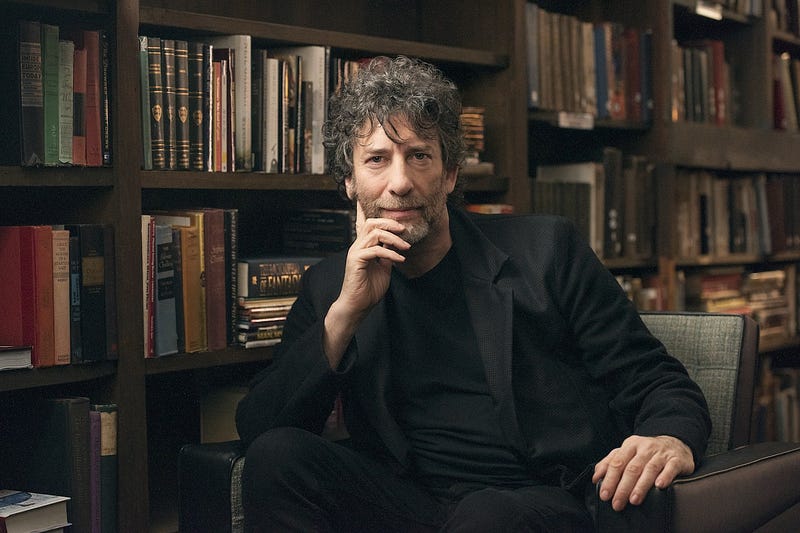
Neil Gaiman is one of the most famous English writers of fiction, comic books, author of theatre and film. He has won awards such as the Hugo, Nebula, and Bram Stoker.
He is full of creative wisdom and he is one of my heroes.
Here are the 10 lessons I’ve learned from him.
#1. Do Nothing, Or Write
This lesson from Neil is my personal favorite. As any writer (or creative in general) will tell you — starting is the most challenging part of the job.
In his interview on the Tim Ferriss Show, Neil says:
“I would go down to my lovely little gazebo at the bottom of the garden, sit down, and I’m absolutely allowed not to do anything. I’m allowed to sit at my desk, I’m allowed to stare out at the world, I’m allowed to do anything I like, as long as it isn’t anything.
Not allowed to do a crossword, not allowed to read a book, not allowed to phone a friend, not allowed to make a clay model of something.
All I’m allowed to do is absolutely nothing, or write.”
What I love about this rule is that it gives you space. You’re allowed not to write. But your mind is tricked into actually wanting to write, so writing becomes a more pleasurable experience.
One thing I noticed about Neil in his speeches and interviews is that he always tries to make things easier for himself. Creativity comes to those who don’t put too much pressure on themselves.
Personally, I tend to write in the mornings, right after breakfast. Some days, I want to write. But I found this rule to be helpful on the other days — when I don’t feel like writing.
Using Neil’s rule, I would sit and tell myself, “It’s OK if I don’t do it. But then I would stare at the wall.”Usually, after a minute or so, writing something becomes more appealing than staring at the wall.
In the same interview, Tim Ferriss mentions another writer (John McPhee) with a similar rule:
“He would sit in front of his first, as a young man, typewriter. He could sit in front of the blank page and from eight a.m. to six p.m., and with the exception of a break for lunch and swimming, it was the blank page or writing. He was disallowed from doing anything else.”
Use Neil Gaiman’s rule to get stuff done.
#2. Make Good Art
I love commencement speeches. They are usually full of wisdom, inspiration, and thought-provoking words. Two of my favorite ones are Steve Jobs’ 2005 commencement speech at Stanford and Neil Gaiman’s 2012 speech at the University of Arts.
If you haven’t watched them, I highly recommend it.
The key idea that Neil Gaiman talks about in his address is this: if you’re a creative (which you are), you can make art. Nobody can take that away from you.
Whatever happens, make good art.
Feel stuck, depressed, and worthless? Make good art. Feel great, and everything is the way it should be? Good for you. Make good art.
Make good art on the good days, and make good art on the bad days. It will save you and keep you afloat.
“Sometimes life is hard. Things go wrong, in life and in love and in business and in friendship and in health and in all the other ways that life can go wrong. And when things get tough, this is what you should do. Make good art…
Probably things will work out somehow, and eventually time will take the sting away, but that doesn’t matter. Do what only you can do best. Make good art. Make it on the bad days. Make it on the good days too.”
Making good art means doing what only you can do. It involves copying if you have to (because that’s how we all learn) but slowly transition into doing you.
Making good art means exposing yourself, being vulnerable, and being courageous enough to hit ‘publish’ when you feel scared.
I have an internal rule in my writing, especially on Medium. I hit ‘publish’ only when I feel scared. And I use that as a compass: whenever I feel most scared, that’s when I should hit ‘publish.’ If I don’t feel afraid, that means I’m playing it safe.
Make good art.
#3. Get 99 Rejections
“A freelance life, a life in the arts, is sometimes like putting messages in bottles, on a desert island, and hoping that someone will find one of your bottles and open it and read it, and put something in a bottle that will wash its way back to you: appreciation, or a commission, or money, or love,”
I couldn’t agree more.
I view getting rejections as something you have to go through to get to the other side. Instead of getting crushed by rejections, we should start seeing it as an indicator that we’re going the right way.
We should start collecting rejections.
Forty-seven publishers rejected Tim Ferriss before his first book got published. You hear the same stories from J.K. Rowling and Neil Gaiman, too. James Altucher built 20 companies, 17 of which failed.
There will be rejections, and there will be failures, we need to be prepared for that.
What helps me is coming up with a big number, say, a hundred. And then I imagine that I will get successful on my 100th try. Of course, I will probably make it on my 2nd, or 5th or 50th try, so a 100 is a good number. And then I would start collecting these rejections, knowing that each next rejection moves me closer to success.
When I sold services for my video production business, I would send emails to clients, and 99% of them were not even read. But on average, once every month, I would get a reply. That reply turned into a meeting, the meeting turned into a dinner, and dinner turned into a client. I would get paid. But that happened only on the 100th email, or so.
The same with ideas. People talk about not having good intentions. But the question is, do you have any ideas at all? Do you have bad ideas? Start coming up with any ideas — and the good ones will pop up now and then. In my experience, one good idea always needs nine crappy ones before it.
So start collecting those returned empty bottles. Put them on a shelf and be happy when the next one comes. 99 is all you need.
#4. Go Towards Your Mountain
When you’re just starting, you have a problem of not knowing which way to go.
There are so many things you can do, so many options and contradicting advice flowing from different directions: society, professors, friends, family, mentors, the Internet.
I learned from Neil that all you have to do is to go towards your mountain.
“Something that worked for me was imagining that where I wanted to be — which was an author, primarily of fiction, making good books, making good comics, making good drama and supporting myself through my words — imagining that was a mountain, a distant mountain. My goal. And I knew that as long as I kept walking towards the mountain I would be all right.
Goals are useless, and they only make me anxious. You shouldn’t put too much pressure on yourself to hit a particular target by a specific date, as it doesn’t matter, and you can’t control it.
An alternative is to have a vision of your future — your mountain — and walk towards it. As long as you’re moving in the right direction, you’ll be alright.
#5. Pretend Like You Know What You’re Doing
When Neil’s friend asked him for advice on doing something difficult, in her case, recording an audiobook, he told her, “Pretend that you’re someone who could do it.”
Recently, I was asked to record an interview in English (something I haven’t done before, because English is my second language) with a person whom I didn’t know about a topic I knew nothing about.
I wanted to bail. At one point, I even wanted to cry. But then I remembered this rule and told myself, “pretend like you know what you’re doing.”
It helped.
Derek Sivers, the founder of CD Baby and one of the most famous bloggers out there, gives this advice too, “If you want to feel confident, just pretend that you are.”
#6. Never Do It Only For the Money
My worst life decisions over the past five years were made because I wanted to chase the money.
I took jobs I hated and worked with people I hated working with, simply because I thought I needed the money.
I built businesses I hated running and ended up screwing everything up and losing other people’s money because I thought I would get rich quick.
In both scenarios, I ended up being worse than I was before.
Doing something for the money is not wrong. We all want money. But when you do something only for the money — your motivation is short-sighted, and you usually end up messing things up.
Neil Gaiman told a story of writing his first book — purely journalistic work — only for the money.
He received a handsome advance and spent it on a new electric typewriter. He was supposed to make much more. Unfortunately (or rather, fortunately), the publishing company tanked, and Neil never saw his royalties.
That experience taught him never to do anything just for the money.
“If you didn’t get the money, then you didn’t have anything. If I did work I was proud of, and I didn’t get the money, at least I’d have the work.”
One thing that helps me is to ask myself, “Would I do this if I got paid $0?” and when purchasing something, “Would I buy this if it cost $0?”, if the answer is NO, then it’s a NO no matter the money involved.
Ideally, you should get a job where you don’t even care what you’ll get paid. Because if you get paid a lot, and you don’t like it, it wouldn’t matter, you would quit. And if you get paid little, and you love it, it wouldn’t matter as well, you would stay.
Lesson from Neil here: Always do something you’re proud of. Don’t make the lucrative deal lead you astray.
#7. You Cannot Fix the Perfection of a Blank Page
If you want to do something, but feel paralyzed with fear and a force that Steven Press calls ‘Resistance,’ remind yourself that you cannot fix the blank page.
You’ve got to start somewhere.
“You just have to be starting out, which is anything you do can be fixed. What you cannot fix is the perfection of a blank page. What you cannot fix is that pristine, unsullied whiteness of a screen or a page with nothing on it, because there’s nothing there to fix.”
Like Seth Godin says, nobody has a ‘writer’s block,’ people have a ‘writing perfectly block.’ Or ‘coming up with great ideas’ block. Or ‘building an ultra-successful business’ block.
Anytime I want to do something but feel stuck, I tell myself that perfectionism is a disguise for insecurity.
Publishing something is better than publishing nothing.
One is better than 0.
When asked what someone who’s just starting in the writing career should do, Neil answers:
“Just write, finish things, and then start writing the next thing…Just write. Assume that you have one million words inside of you and they’re all rubbish. You need to get them all out.”
I like that very much. Assume that you’ve got 1 million crappy words — and you need to get them all out. That’s precisely what I am trying to do writing 12 books and publishing daily on Medium.
If you don’t do anything — there’s nothing to work with, nothing to edit and nothing to enhance. Start with anything and come up with bad ideas. Then make it better.
#8. Make Mistakes
A lot of successful people on the Internet say cliché things like “fail a lot” and “make mistakes.”
It’s cliché because it’s true.
In Russia, we have a proverb that every kid learns in school, “A fool learns on his own mistakes, and a wise man learns on mistakes of others.”
This is untrue. A correct version of this proverb would be, “A wise man learns on his own mistakes, and a fool learns never.”
As Neil says, “If you make mistakes, it means you’re out there doing something.”
Don’t be afraid to make mistakes, because then you’ll end up doing nothing.
#9. You Don’t Have to Have a Plan
My younger sister used to be paralyzed because she didn’t have a plan. Like many other young folks, she was pressured by family and society to know precisely what she needs to be doing with her life.
The good news is, you don’t need a plan.
“When you start out on a career in the arts you have no idea what you are doing. This is great. People who know what they are doing know the rules, and they know what is possible and what is impossible. You do not. And you should not.
The rules on what is possible and impossible in the arts were made by people who had not tested the bounds of the possible by going beyond them. And you can. If you don’t know it’s impossible, it’s easier to do.
And because nobody’s done it before, they haven’t made up rules to stop anyone doing that particular thing again.”
The need to have a plan is overrated. Having a plan means nothing; it just means that you’re a control freak. Plans rarely work out because you’re trying to forecast your future from the point you’re in right now. But once you get where you wanted, you’ll be a different person (with other plans!), and you’ll live in a different world.
You learn to build a business from building a business. Neil Gaiman learned to write by writing and never went to college. To learn to make pancakes, you’ve got to start making them — and getting burned, black, weird mess (which you’ll probably feed your dog with) in the beginning.
It’s OK not to know the rules. Make up your own rules.
It’s OK not to know what you’re doing. Do something nobody has done before, and what everyone else thinks is weird.
It’s OK not to have a plan.
#10. Enjoy the Process
I intentionally left this lesson as the last on the list, because it’s so important. When I watched that commencement address on YouTube, my heart started beating louder when Neil talked about the best advice he was given — and failed to follow.
It was from Stephen King.
Neil Gaiman has just published the Sandman comic book. Stephen saw the madness and publicity around Neil and gave him the following advice: enjoy it.
“Stephen King liked Sandman and my novel with Terry Pratchett, Good Omens, and he saw the madness that was going on, the long signing lines, all of that stuff, and his advice to me was this: ‘This is really great. You should enjoy it.’ And I didn’t.
Best advice I ever got but I ignored. Instead I worried about it. I worried about the next deadline, the next idea, the next story. There wasn’t a moment for the next 14 or 15 years that I wasn’t writing something in my head, or wondering about it. And I didn’t stop and look around and go, this is really fun. I wish I’d enjoyed it more.”
Sometimes life can get so bizarre that we start existing rather than living. In moments like these, we need to remind ourselves that whatever we are experiencing in the current moment — this — is life.
Having goals is great. But it’s the journey that you’ll remember. It’s the journey that matters.
Enjoy the process.
Thank you very much for reading! Join my email newsletter, and I’ll send you meaningful books and articles to read.


