
10 Intriguing Questions About Pigeons: Urban Mysteries & The Hidden Lives of City Dwellers
Unravel the city pigeon’s lifestyle: myths debunked, facts revealed, and questions answered
Ever wondered why these familiar birds are symbols of peace, or why catching one seems impossible? I’m answering the quirky questions you’ve always had but never dared to ask.
Get ready for some surprising revelations!
1. Where are pigeon chicks?
Urban pigeons breed their chicks in places where they cannot be reached by people and animals: in attics and abandoned buildings.
Sometimes, however, a pair of birds may set up a nest on an open balcony that hasn’t been used for a long time. Then you can directly observe how pigeons build their nest (sometimes quite makeshift — from a couple of branches), incubate eggs, and feed their chicks.
Little pigeons may not seem very appealing to many, but the same can be said for the chicks of some other bird species.
Yet, we don’t see them on the streets because by the age of one month, a pigeon looks exactly like an adult. By the time a chick leaves its nest in the attic, it is impossible to distinguish it from an adult bird.
2. Do pigeons spread disease?
Although pigeons primarily feed on grains, surviving in urban conditions has made them almost omnivorous. Moreover, they are forced to seek food in garbage where they can catch diseases, then transmit them to their neighbors. Due to high population density, diseases among them spread easily.
Pigeons can also carry zoonoses — diseases transmissible to humans and pets, such as chlamydiosis and salmonellosis.
To contract the latter, direct contact with bird droppings is necessary, but chlamydiosis, or ornithosis, is airborne.
Spending time near a large flock of pigeons could risk catching chlamydiosis from the birds.
This is especially dangerous for children and people with low immunity. Thus, attracting a flock of pigeons around oneself is not as safe for health as commonly believed.
3. Do pigeons freeze in winter?
Pigeons have a rapid metabolism, and their body temperature is 41–42 °C. Furthermore, they are protected from the cold by a dense feather coat and a layer of down.
Therefore, if a bird is healthy, well-fed, and not starving, it is not afraid of the cold.
4. Can a sick pigeon be saved?
Throughout my medical practice, people have constantly brought crows, seagulls, and pigeons for treatment. The latter, in fact, recover quite well.
However, it’s important to understand that contact with a street bird can be dangerous due to zoonoses. It’s better for children and people with low immunity not to interact with injured pigeons.
If a healthy adult wants to help, they should wear medical gloves and a mask before picking up the pigeon and taking it to a veterinarian.
At the clinic, the doctor will take samples, and if the bird is not a carrier of diseases dangerous to humans, you can care for your new pet without any protection.
5. What do pigeons eat when no one feeds them?
Pigeons primarily eat plant seeds. They intentionally swallow small stones (gastroliths), which grind and clean the hard seeds and husks in their crop.
However, in winter, it’s difficult for them to find seeds in the city, so they switch to anything available: bakery products, sunflower seeds provided by city dwellers, and whatever they can find in garbage.
Pigeons are synanthropic birds — they have adapted to the city, successfully reproduce here, and can find food for themselves. Thus, feeding them is not necessary.
Often, people want to do a good deed and bring moldy bread or other stale food to the birds. This should be avoided. Stale food is as harmful to pigeons as it is to humans.
6. Why is the pigeon a symbol of peace? Are they very peaceful?
According to the biblical Book of Genesis, during the Great Flood, Noah released a dove from the ark three times to see if the water had receded and land appeared. On the second occasion, the dove returned with an olive branch, signifying that the waters had receded and God had replaced wrath with mercy. As a result, the dove with an olive branch became a symbol of peace.
Moreover, in art, the depiction of this bird often symbolized the human soul. And the images of a dove and pigeon were considered symbols of marital fidelity and purity, as these birds, like many others, are monogamous, meaning they choose one partner for life.
However, from a scientific standpoint, it’s hard to call a pigeon peaceful. Most animal species, especially predators, have an inhibition against intraspecific killing, which is a kind of internal limiter to preserve the population. For example, a fight between wolves will not end in the death of one of them, but with the weaker submitting to the stronger by exposing its neck, showing surrender, and the victor will stop.
Pigeons lack this inhibition.
A pigeon can beat its fellow to death, just like humans. That’s the kind of “peace bird” it turns out to be.
7. Can pigeons eat meat?
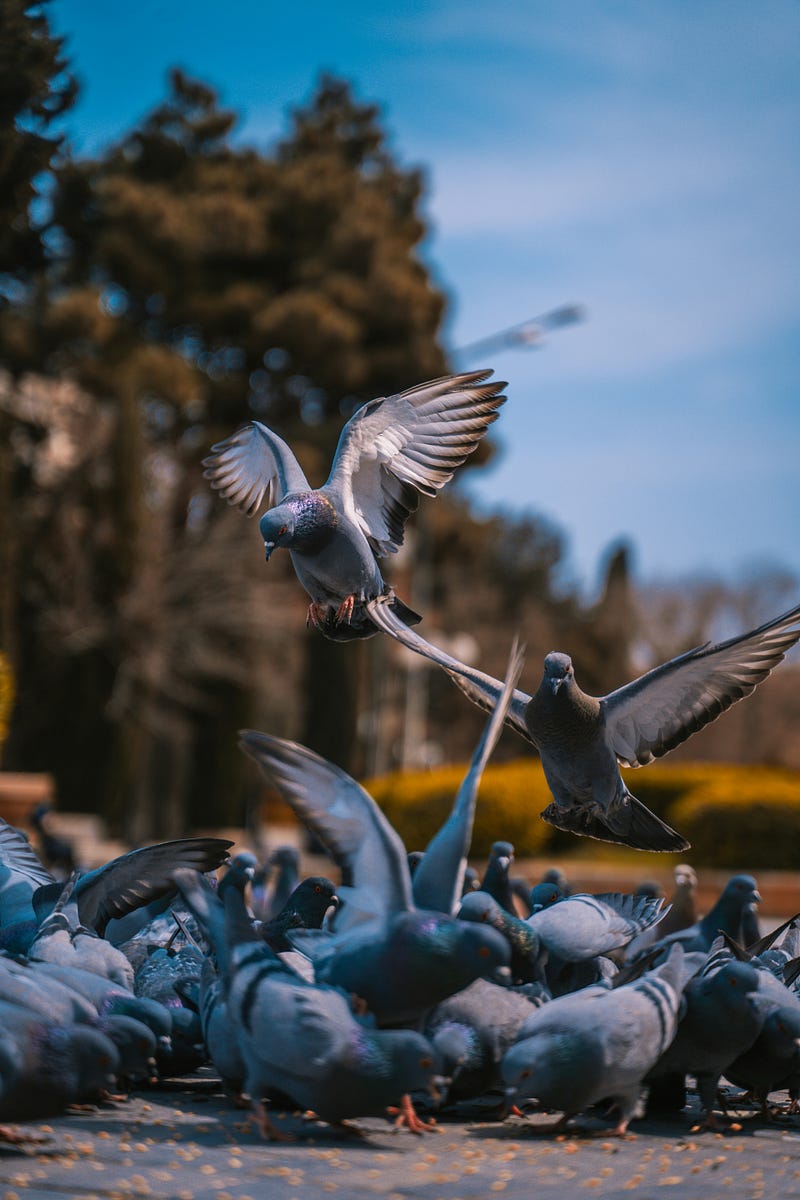
Surviving in urban conditions, birds are forced to adapt. Therefore, one might observe a lazy pigeon feeding on leftover nuggets and french fries, pecking at any waste from the garbage, including those of animal origin.
Such a diet is unsuitable for the bird’s digestive system and negatively affects the functioning of their gastrointestinal tract. As a result, their immunity suffers, and the pigeon becomes susceptible to various infections. Moreover, the bird may develop liver diseases and obesity.
8. Why are only gray pigeons seen in the city?
The gray urban pigeons are the original, “wild” coloration. They were like this before they went through a long period of domestication.
All other colorations appeared much later, due to breeding and natural mutations. That’s why we predominantly see gray pigeons in cities.
9. How did pigeons carry letters?
Pigeons are unmatched in navigation, as they determine direction using three internal compasses. At night, birds can visually orient themselves by the stars and understand where to fly based on their positions. During the day, they determine direction by the sun’s position. Moreover, they have an internal magnetic compass, allowing them to fly long distances without getting lost.
Even if a pigeon is taken a thousand kilometers away in a completely closed box, it can return home.
People, of course, noticed this ability and began using pigeons for rapid mail delivery. To better accomplish this task, considerable attention was given to breeding and training.
10. Why is it so hard to catch a pigeon?
Pigeons have very sharp vision and excellent reaction time, necessary for their survival. Therefore, one can easily catch only a pigeon weakened by infection.
However, there is one technique by which one can catch a healthy individual. You need to stand as still as possible and throw seeds in front of you, closer and closer. When the pigeon is sufficiently close, you must quickly bend over, without bending your knees, and grab the bird by hand.
Of course, this should not be done just for fun, as it’s a great stress for the bird, and if it’s infected, a risk for the person catching it.
If you want to catch a sick pigeon to take it to a veterinarian, you can throw a jacket or blanket over the bird, or use a net.
If you found this article engaging, I warmly invite you to explore my dedicated collection on “Exploring Boundaries.” Dive into a diverse range of topics, from productivity hacks to personal development and futuristic sports. Discover insightful perspectives that challenge conventional wisdom and expand your horizons. Join me for an enriching journey of exploration and discovery.