
Food prices
10 Hacks to Save Money and Eat Better
Tip One: Don’t be a sucker at the grocery store
Grocery stores are designed to make you overspend on shitty foods that aren’t good for you.
Seriously, the layout of grocery stores is no accident. They are laid out specifically to lure you into buying crap.
My mother worked for a food brokerage company when I was a young adult, and I learned a lot about why some things are placed where they are.
You don’t have to be a sucker, though. You can ignore where the grocery store designers seek to lead you and purchase what’s actually in your best interests.
Now that all that shitty food is hit by inflation, it’s a really good time to change your shopping, cooking and eating habits.
Your meals should feed your soul and nourish your body without emptying your wallet.
Re-learn how to cook if necessary
I learned how to cook the basics as a kid, but we ate standard Midwestern fare — some kind of fried meat, some kind of potato, some kind of canned vegetable.
I expanded my repertoire when I wanted to stay home with my babies. I’d already cut every other expense to the bone, so I had to figure out how to cook for less. I was working for a newspaper, so I started a cooking column.
This gave me an excuse to interview older women who knew how to cook everything from scratch.
I interviewed an older Mexican woman to learn how to make tortillas. I interviewed an older Italian woman to learn how to make pizza and pasta.
You get the idea. The readers got some good information, the ladies got some nice attention and I got paid (minimally!) to take custom cooking classes.
That was pre-internet. Now you can learn how to cook online without having to start a cooking column.
Here are some of my best inflation-busting cooking tips:
Eat more oatmeal
Oatmeal is one of those ideal foods. It’s high in fiber and very filling. It’s versatile. It’s dirt cheap. Never buy the little envelopes. They’re too sugary and expensive. I buy a 42-oz. canister of oatmeal at Aldi for $2.85. It has about 30 servings. In other words, that’s a month of breakfasts for less than $3!
Of course, you’re probably going to want to add something to the oatmeal. I stir in chopped apples, cinnamon and raisins, or some peanut butter, or some fresh or frozen berries, or even something like canned pumpkin, brown sugar and cinnamon. Be creative.
You can make a week’s worth of overnight oats in little glass containers whenever you have time, making this a grab-and-go option. They’re not just for breakfast. The pumpkin-and-cinnamon-brown-sugar version is basically a dessert.
Make eggs a primary protein source
You’re not going to want oatmeal every day. Sometimes you’ll want toast or something higher in protein. Eggs are perfect.
I don’t buy cheap eggs. Caged laying hens are probably the most badly treated farm creature on earth. I pay extra for free range eggs, which are currently running around $4 per dozen. That’s still only about 33 cents each and well worth the extra cost to me.
A good weekend breakfast or for that matter dinner is a spinach omelet. Saute some fresh spinach and onion together in a little olive oil. Use this and a sprinkle of cheese to stuff your omelet. Leftover asparagus with a little cheese makes a very good dinner omelet, too.
Soup is your budget friend
Soup is a great budget stretcher, and it’s versatile. Plus, you make it when you have some time and then you eat it for days. (If you’ve made sourdough bread, that goes really well with it.)
Potato soup is one of the few things everyone in my extended family — vegetarian and carnivore alike — loves. You can put out some crumbled bacon or cooked ham cubes for the meat eaters if you want, but you don’t have to.
Vegetable soup is great. So is your basic hambone and bean soup.
Chicken soup with vegetables and noodles is delicious. Be sure to add about half a shredded cabbage. It makes the soup more hearty. I’m personally not a fan of watery soups.
Cabbage is nutritious and cheap and it gives that je ne sais quoi to soup. Yes, cheap old cabbage.
Pasta is quick and cheap
Pasta is a great budget meal and almost everyone loves it. Everybody has their favorite pasta recipe. Even if you use prepared sauce, it’s pretty cheap.
If you have an herb garden, make a huge batch of pesto in the fall before pulling your plants. Freeze the pesto in a flattened freezer bag. It’s easy to break off a few small chunks to stir into the hot pasta.
Be on the lookout for deals
After Easter and Christmas, you can often find whole hams for almost nothing. I’ve paid as little as .33/lb.! Buy one, chop the entire thing into cubes and freeze it in freezer bags. A sprinkle of these are great in an omelet, or to top things like potato soup. If you snag one with the bone, make a big batch of ham and bean soup.
Sometimes you can buy bananas that are getting soft at a steep discount. Buy bunches of them and make and freeze multiple loaves of banana bread. I like to make them in mini loaf pans. These are great to grab and take to work if you aren’t lucky enough to work remotely.
If you find anything non-perishable marked way down, stock up. Sometimes I have half a dozen jars of peanut butter on hand because I found a great sale.
Ditto for olive oil, and that’s good, because my local store hasn’t had any in stock for two weeks.
Forget about branding
Look, I know all about branding. I used to work at an advertising agency. Ignore advertising, OK? I still don’t understand why that even works.
When I was a kid, my dad worked in a factory that made certain food items. They’d stop the line, change labels from the name brand to the store brand or generic, and then start the line back up again. It was the exact same stuff. Don’t trust that a given name brand is better unless you’ve done a blind taste test and are confident the more expensive brand is worth it.
Bake your bread
Yes, I know some of you don’t eat gluten or carbs. I don’t eat a lot of bread myself, but my Dutch husband, like most Dutch people, eats lots of bread daily. (They are all much fitter than the average no-carbs-for-me American, too.)
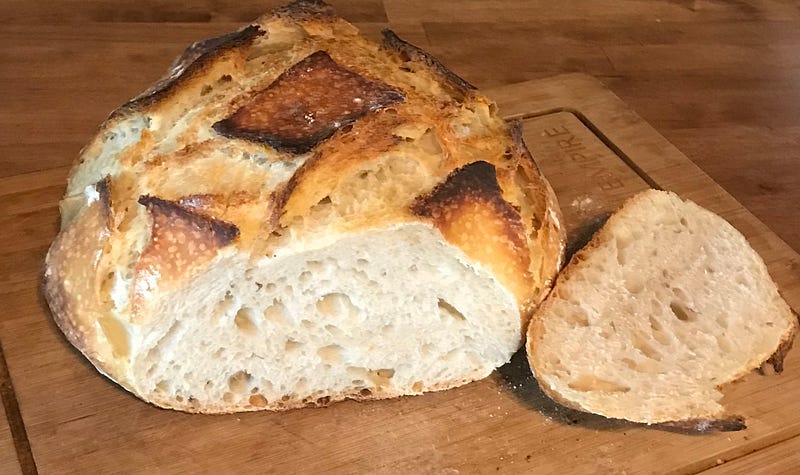
I made a sourdough starter in 2015 and have been using it ever since. (I gave out a lot of starters during the Great Covid Sourdough Bake-Off of 2020.)
You might think bread is difficult to make, but it’s honestly not.
It’s super easy to make sourdough bread using the stretch and fold method. It takes a few minutes to mix and then it needs 30 seconds of attention every 45 minutes for a few hours, and then you leave it alone in the fridge for a couple of days until it’s convenient to bake it in a preheated Dutch oven. It’s so flexible that it fits into almost anybody’s schedule.
I actually did some math, which I don’t do very often, to convince you it’s worth it:
- 1 5-lb bag of flour at my local Aldi costs $1.75
- This bag of flour contains a little more than 18 cups
- My recipe uses about 6 cups of flour
- Thus, I get three big loaves of sourdough for about $1.75 — less than 60 cents per large loaf.
And I promise you, this bread will be equal to the gourmet bread you’d buy in a pricey European-style bakery.
This recipe isn’t exactly like mine, but it does a good job of describing the method. My own recipe is similar, but I essentially double it. I most often make it partially with whole wheat flour, which will increase your price per loaf a bit, but will also make the bread more nutritious.
It’s easier to learn to bake bread with white flour, though. If you’re new to baking, it’s easier to get the basics down before you start adding whole wheat.
Eat more peasant food
Do you think Mexican people traditionally ate meat every night? No, beans were a staple. Eat your Mexican foods with spiced-up beans and little or no meat.
Do you think the Chinese people traditionally ate the sort of thing you see on your local buffet? Ha, hardly. I once spent a week with a Chinese family. I assure you nothing from their kitchen was remotely like the Chinese food I see at Chinese restaurants. More vegetables, less meat.
Think about beans, lentils and grains. Use meat and cheese sparingly for flavor. Use more herbs and spices.
Think about getting the most nutrition for your dollar. Thus, even though whole wheat flour is more expensive than bleached all-purpose flour and brown rice is more expensive than refined white rice, you’re getting more nutrition from the whole grain.
Saving money is secondary to eating well
Cheap hotdogs made with a lot of fillers are no bargain. Ramen noodles are not good for you. Neither is a good use of your food budget.
Bon appétit, or as my Dutch husband says before each meal, smakelijk eten. Or, as my fellow Midwesterners might say, dig in!
About Michelle Teheux
I’m a freelance copywriter from central Illinois. Find me on Twitter or LinkedIn.