

10 Building Blocks for Engaging Employees While Satisfying Customers
“The leaders who work most effectively, it seems to me, never say ‘I.’ And that’s not because they have trained themselves not to say ‘I.’ They don’t think ‘I.’ They think ‘we’; they think ‘team.’ They understand their job to be to make the team function. They accept responsibility and don’t sidestep it, but ‘we’ gets the credit. This is what creates trust, what enables you to get the task done.”― Peter Drucker
Leaders act as the cornerstone upon which an organisation will either stand or fall. Accountable to both employees and customers, as well as shareholders, they manage the delicate balance between engaging a talented workforce and earning customer satisfaction.
Like an expert construction manager, a true leader oversees the entire operation by ensuring the development and sustainability of multiple building blocks that are necessary to the ongoing viability and longevity of the organisation. These building blocks — held together by true leadership — include a talented workforce, genuinely collaborative teamwork, appropriate and up-to-date tools, clear processes, a focused mission and goals, excellent communication and transparency, effective awards and incentives, a positive company brand, and, finally, high-quality products and services.
Successfully maneuvering these building blocks into a cohesive structure requires the talents of an extraordinary leader. By addressing each one and determining the best way to achieve optimal results, a leader can craft a culture that enables employee engagement. But the focus of the culture is not only to ultimately attain customer satisfaction and loyalty, but also to empower and enhance the employee’s personal and career-related development.
Building Block 1: Talent
In light of what the organisation offers in terms of products and services, leaders must be able to determine what specific talent is needed to fulfill its purpose, then find and hire the best talent to accomplish the job. But that step is only the beginning. In the words of Jack Welch, “Before you are a leader, success is about growing yourself. When you become a leader, success is all about growing others.” By reviewing the existing skills in the workforce and considering whether individuals require upskilling as work, technology, and consumer demand evolve, the leader supports ongoing education. Further, encouraging employees to take ownership of their careers engages them in self-development.
Through leadership’s efforts to maintain a motivated, talented, and self-aware employee base — who take pride in their work and their organisation — customers benefit from access to the reliable, high-quality products and services they desire. Further, positive interaction with skilled employees who know the business allows customers to get what they need when they need it in the most cost-effective and timely manner.
Building Block 2: Teamwork
Having the right talent in the right place at the right time allows departmental units to interact and operate at optimal levels. When leaders encourage employees and their managers to invest in learning new skills, these individuals will not only broaden their own experience and capabilities, but also be able to step in when another department or colleague requests assistance. Having a diverse array of skills, including sessions on leadership and management, also serves to enhance employees’ self-perception. The more that they can contribute positively to their own and other work units, the better will be the outcome in terms of tangible (high-quality workmanship) and intangible (self-esteem) results.
True teamwork on the part of employees offers an added bonus to customers, who will feel secure in the knowledge that a capable service team is available to handle their requests in a timely manner. This point is especially important when it comes to providing services rather than manufactured products. Different team members, whose own knowledge base and skill bank are broad, can bring new perspectives to customers who might not be familiar with everything the company offers. A team of customer service individuals, well-versed in company operations, can also prove advantageous in brainstorming innovative ways to resolve customer issues.
Building Block 3: Tools
The necessary tools for fulfilling the organisation’s purpose — whether in creating a product, offering a personal or business-related service, facilitating the distribution of another company’s product, or other task — can be either technological or non-technical. Leaders should ensure that the workforce has, on hand, the appropriate tools that allow employees to accomplish their work smoothly and on time, thereby completing their assigned responsibilities, whether related to internal functions or external customers. By keeping such tools practical and easy to learn and use (especially the high-tech items), internal processes should ultimately improve and satisfactorily reduce the ennui of mundane tasks.
From the customer perspective, appropriate tools for their use allow easy access to such tasks as purchasing products and accessing customer representatives with a minimum of effort. Such positive availability is also likely to result in positive feedback from customer users, who may be willing to spread the word about the company’s accommodations to their needs.
Building Block 4. Processes
“The leader is one who, out of the clutter, brings simplicity….out of discord, harmony….out of difficulty, opportunity,” according to Albert Einstein. To achieve that level of simplicity and harmony, clear and defined processes and procedures are a requisite, paving the way for timely and cost-effective results. These well-thought-out processes should offer an overall view of how the company operates, while providing minute details to get where the company needs to go. Definitive manuals should accompany the processes and procedures, allowing for employee feedback for improvements to the various systems. Yet, these inner workings need to be flexible and supple to accommodate and adjust to unexpected challenges and changes in the market’s supply and demand, as well as in response to other factors that might arise.
With clear procedures in place, followed by responsible employees and shared with customers as the situation might demand, customers gain an understanding of how things operate and why, for example, there may be delays in processing their requests. By inviting customers to participate in brainstorming activities, leaders can gather external input on ways to improve the company’s internal processes and ultimate delivery of the desired products and services.
Building Block 5. Mission and Goals
With a grasp of the company’s objectives, a leader ensures that they are carried out through a well-defined and communicated mission statement, along with specific goals and strategies to carry out the mission. These items help employees focus on what the company is trying to achieve and help them understand their role in the company’s operation, as well as how they can contribute to its success. Without a clear intent, the organisation is liable to drift along in response to the latest market trends, for example, with or without determining if that is the course it should follow. Swerving from the desired path can lead to employee disengagement as the “plan” changes from month to month.
Having an acknowledged mission and set of goals also serves to reassure customers of the direction in which the company is moving, along with the knowledge that employees are dedicated to support that mission and achieve those goals. Such pronouncements go further to display, for public consumption, the company’s commitment to achieving financial viability, social responsibility, and other key aims of interest to clients.
Building Block 6: Communication and Transparency
A leader sets the stage for what is to come, as a result of sound decision-making, so that employees remain informed and engaged at all times. The best decisions made by leaders result from an analysis of facts and data, not emotions, although intuition, based on valid experience, may play a part. They listen to knowledgeable experts, gather pertinent facts, consider alternatives and options, and explain the rationale of their decisions through transparent actions. Communication, via multiple media channels, should be open, easy to access, frequent, and responsive to the audience — not only available when changes are coming, but routinely, in order to engender trust and openness. Focus groups offer one vehicle for encouraging input and ideas to improve innovation, discover challenges, and determine ways to resolve issues. Communication, in essence, should be a back-and-forth effort.
Transparent communication should also be available to customers, whether through interaction with client service representatives or different communication channels. Customers appreciate being included in company news, not only to stay abreast of what the company offers, but also to discover what the company plans to offer in future — perhaps new distribution outlets, innovative products, mergers and acquisitions to broaden the portfolio of offerings, and so on. Further, if the company is openly communicative with employees, then customers may experience an additional measure of reassurance that engaged employees will be more willing to provide reliable products and services.
Building Block 7. Awards and Incentives
When it comes to employees, the leader enables the human resources team to create and implement effective, efficient, practical, well-understood, and accepted performance evaluations, along with attractive career opportunities. Ongoing mentor discussions about what the employee is doing, how well the employee is doing, how the employee fits into the company strategy, and, ultimately, what the employee wants to do are all beneficial. Continuous and engaging one-on-one discussions can invite confidences, boost management’s credibility, and ensure that employees understand their contribution to the organisation’s success.
On the other hand, attractive incentives offered to customers can ensure continuing loyalty while boosting satisfaction with the company’s offerings. Potential incentives can include product samples, referral discounts, and other ways to engage customer participation — including, perhaps, ways to incentivise employees and clients simultaneously through sales programmes.
Building Block 8. Products and Services
Successfully selling a unique brand requires innovation and creativity, both of which should be encouraged and nurtured by leaders. Research teams should make ongoing efforts to help the company remain competitive by exploring better ways to meet customer demands. Discovering the possibility of new products, for example, might require an upgrade of skills that will allow employees to transform innovative ideas into reality. Acquiring new skills can serve to enhance the satisfaction of both employees (the recipients of new capabilities) and customers (the recipients of improved products and services).
Evidence of improved products and services, created by engaged employees, allows customers to reap the benefits of the innovations offered by the company that reflect customer needs. Knowing that the organisation’s dedication in continuing the work of refining products engenders customer loyalty and anticipation of what more the company will offer in future.
Building Block 9. Company Brand
By creating a positive public image, the leader enhances employee pride in the company, pride in their colleagues, and pride in their own personal achievements. An added advantage is that the company’s reputation serves to attract talented candidates, who genuinely desire to be a part of the team.
Gaining genuine customer testimonials, to support the public image, can help to boost the company’s brand and spread the good news. On their part, however, when customers are certain of the organisation’s excellent standing, they are secure in knowing that whatever products and services they purchase will be of the highest quality and offered by talented experts.
Building Block 10. Organisational Culture
As the company structure evolves, the leader should ensure that its culture reflects the values indicated in the mission statement. The organisation should be open to change and growth, willing to nurture talent, behave with compassion and a strong sense of ethics, act socially responsible, encourage innovation and idea sharing, wield guidelines with appropriate flexibility, and make decisions that are informed and sound.
With such a culture in place, the organisation should find it easy to attract candidates who fit the culture, who are willing and eager to contribute positively to their assigned tasks, and who take pride in their efforts. Such a workforce will provide high-quality products and services, gaining loyalty and creating collegial relationships, whether interacting directly or indirectly with their customers. After all, “To stay vigorous, a company needs to provide a stimulating and challenging environment for all these types: the dreamer, the entrepreneur, the professional manager, and the leader,” says Howard Shultz, author of Pour Your Heart Into It: How Starbucks Built a Company One Cup at a Time. “If it doesn’t, it risks becoming yet another mediocre corporation.”
A Leader’s Role
Essentially, the leader takes on multiple roles — boss, mentor, facilitator, sales person, accountant, technician, even a parent, along with many others. Having the capability to step into each role as circumstances demand is an exceptional trait.
General Douglas MacArthur once said, “A true leader has the confidence to stand alone, the courage to make tough decisions, and the compassion to listen to the needs of others.” Leaders require self-knowledge to possess this confidence, courage, and compassion. Self-aware leaders, working closely with self-aware employees, form an optimal partnership that leads to long-term sustainable success based on the creation and delivery of reputable products and services. The leader leads by practical example and action, acting as a role model for ethical business behavior and sound decisions.
And an exceptional leader recognises the importance of both employees and customers: Customers need quality products and services; employees manufacture and deliver the products and services. An organisation cannot exist without either of them. Contrary to traditional and outdated thinking, acknowledging that the customer is always right does not preclude engaging employees in the process. To create a win-win scenario, the leader seeks to nurture both parties and support them through overseeing and guiding all building blocks that comprise a successful organisation.
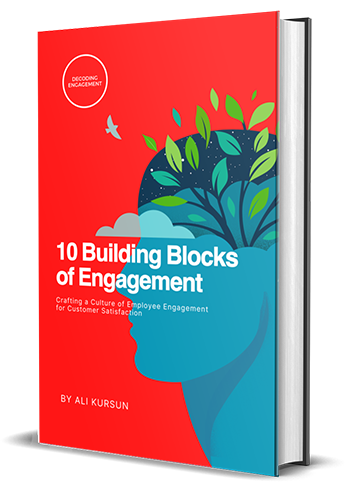
From the upcoming book 10 BUILDING BLOCKS OF ENGAGEMENT by Ali Kursun. Copyright © 2024 by Ali Kursun. (March 2024)