
10 Books the Dalai Lama Reads and Recommends
I asked the Dalai Lama what books he recommends, and this is what he answered.
If you’re not a member, join 👉 Medium, or read this story for free here 👈
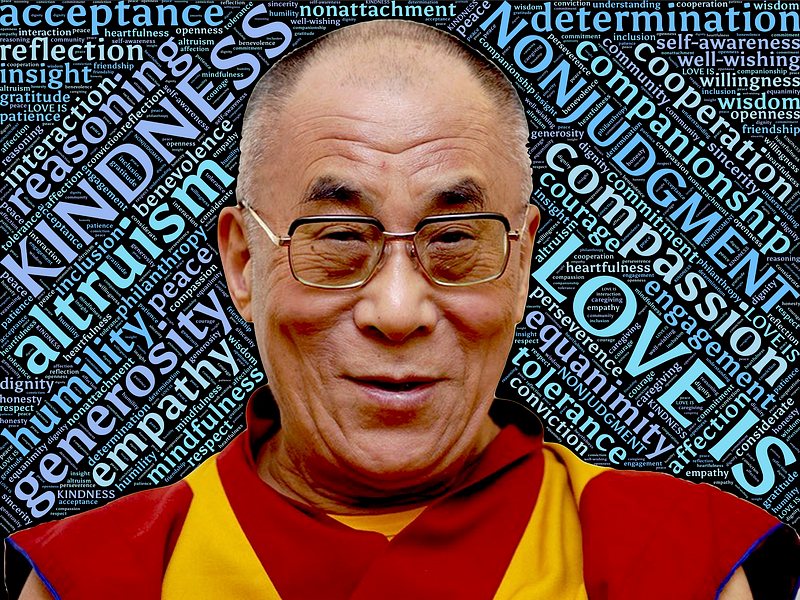
I searched the internet to find what books does the Dalai Lama reads and recommends. But I couldn’t find any information. Some sites list the books he published and not what he reads. So, I decided to ask him; how hard could it be?
My family told me I was crazy; His Holiness would never answer. He has more important things to do than reply to an unknown writer’s mail. They said, “Wait until you have several bestsellers published, and maybe then he will.”
I searched everywhere, and after a couple of days, I finally got his office address and did what others told me was far too crazy. I wrote an email every week from my personal, social, and work addresses and waited for an answer.
It only took three months and 36 emails, but I finally got what I wanted. When I opened it, I thought His Holiness would decline, telling me he was too busy working on his next project.
But to my surprise, it was the answer to my request directly from the Office of His Holiness the Dalai Lama (OHHDL).
So now, finally, I can write an article on the ten books recommended by the Dalai Lama on Tibetan and Buddhist Philosophy. Here is the list:
Ten books His Holiness Dalai Lama reads and recommends
“Most of the books His Holiness reads are classical Buddhist scriptures that form the main syllabus of Buddhist studies in all major monasteries of Tibet. They include the Five Canonical Scriptures.” — OHHDL
The Five Canonical scriptures are:
1. Perfection of Wisdom Studies:
The root text of Abhisamayalankara by Lord Maitreya.
Abhisamayalankara (aka AA) translates to “Treatise of Instructions on the Perfection of Wisdom called the Ornament of/for Realization.” Lord Maitreya revealed the first of the five treatises, the future Buddha who will return to Earth after achieving complete enlightenment and teaching the pure dharma. His Holiness studies this treatise with his teachers and Tsenshabs (Master debate partners)
The AA comprises eight topics, grouped into three aspects: 1. The aspects of wisdom that must be known. a. Knowledge of all aspects, which has to be achieved b. Knowledge of the path, which is the means of achievement c. Knowledge of the bases, which is what has to be abandoned. 2. The cause and effect of acquiring skill d. Application of all aspects e. Peak Application 3. The cause and effect of stability. f. Progressive application g. Instant application
Since the original text is in Sanskrit, you can get the English versions: “Analysis of the Abhisamayalamkara,” by Eugene Obermiller. “Abhisamayalamkara with Vrtti and Aloka,” by Maitreya-Natha, and Gareth Sparham (English Translator)
2. Madhyamaka Philosophy:
“Introduction to the Middle Way: Chandrakirti’s Madhyamakavatara.” by Chandrakirti and The Padmakara Translation Group.
The Madhyamakāvatara relates the Mādhyamaka doctrine of the ten stages of transformation from śūnyatā (emptiness, vacuity, or voidness) to the sādhanā or “spiritual discipline” made by a bodhisattva (any person on the path towards Buddhahood).
I would also suggest Tsongkhapa’s Illuminating the Intent: An Exposition of Chandrakirti’s Entering the Middle Way, an authoritative commentary on Chandrakirti’s Madhyamakavatara. Geshe Thupten Jinpa’s, Principal English translator/interpreter of HHDL, has translated it and Wisdom Publication has published it. This book is a favorite of His Holiness in his meditation on the Buddhist understanding of shunyata, emptiness. — OHHDL
3. Logic and Epistemology
Dharmakirti’s Pramanavarttika and its Indo-Tibetan commentaries in Sanskrit.
It comprises around 2,000 verse stanzas, with four chapters dealing with inference for oneself, helpful knowledge, sense perception, and inference for others.
English versions: “Foundations of Dharmakirti’s Philosophy,” by John D. Dunne. “Buddhist Epistemology” by S. R. Bhatt and Anu Mehrotra.
Here we suggest Roger Jackson’s Is Enlightenment Possible? (published by Snow Lion Publications) which contains the translation of Gyaltsab Darma Rinchen’s commentary on the Pramasiddhi, the second chapter of Pramanavrttika (Commentary on Valid Cognition).
For some basic book of buddhist logic you may read Anne Klein’s Knowledge and Liberation and Daniel Perdue’s Debate in Tibetan Buddhism (which contains a translation of some parts of a logic primer text written by the tutor of the Thirteenth Dalai Lama in a formal debate format.) These books give some idea of how Buddhist philosophy is pursued in traditional monastic settings in Tibet. They are quite technical in nature. — OHHDL
4. Abhidharma
Vasubhandu’s Treasury of Higher Knowledge and Tibetan commentaries by the First Dalai Lama and Chim Jampel Yang in Sanskrit.
Vasubandhu lived in the northwestern part of India was a monk of the Sarvastivada (Doctrine That All Is Real) around the 4th or 5th century. He wrote “The Treasury of Knowledge” during that time, comprising 600 stanzas of poetry and other 8,000 prose commentaries. His work is the standard introduction to Hinayana Buddhism in China, Japan, and Tibet, explaining cosmological, ethical, philosophical, and salvational doctrines.
I couldn’t find the English translation of what His Holiness reads, but if you are interested, you can read the following versions:
The Treasury of Knowledge, by Jamgon Kongtrul. Abhidharmakosa-Bhasya of Vasubandhu: The Treasury of the Abhidharma and Its Commentary (4 vols) by Gelong Lodro Sangpo.
(Note FYI: Kongtrul’s Sheja Kun-khyab dzod (Encyclopedic Treasury of Knowledge) covers the entire Buddhist wisdom from Sutra to Tantra. But Vasubhandu’s Abhidharmakoshakarika and its Bhashya do not touch anywhere on Tantra or the bodhisattva path. It is believed to be an abridgement of Mahavibhasha Treatise which belonged primarily to the Vaibhashika school of philosophy). — OHHDL
As for the commentaries, The Dalai Lama reads, here is the English translation: Ornament of Abhidharma, a Commentary on Vasubandhu’s Abhidharmakosa, by Chim Jampalyang and Translated by Ian James Coghlan.
If you want to know more about The Buddhist philosopher Vasubandhu, you can start with the work of the Stanford Encyclopedia of Philosophy on the author.
5. Vinaya (Monastic Code of Discipline)
Vinaya Sutra by Gunaprabha; Sunlight: An Extensive Commentary on Vinaya Sutra by Tibetan Master Kunkhyen Tsonawa in Sanskrit.
Buddha founded Dhamma-Vinaya, a religion based on the truth (Dhamma) for all who want to gain release from suffering. The set of rules, ideals, and standards of behavior for those seeking freedom in greater earnestness (Vinaya).
Although this book deals with discipline, Dhamma and Vinaya function only together. To reach the desired goal, we need both, and the person who practices them merges qualities in the mind and character.
You can read the English version. “The Buddhist Monastic Code” by Thanissaro and translated by Bhikkhu.
His Holiness recommends reading the following books on Buddhism
The following list has some titles that are among H. H. the Dalai Lama’s favorite. — OHHDL
6. A Guide to the Bodhisattva’s Way of Life
by Acharya Shantideva (8th century Indian Master from the famous Nalanda Monastic University of ancient India).
There is no single treatise more deeply revered and considered a guide to cultivating the mind of enlightenment and generating compassion, generosity, love, and patience. It is a classic in Buddhist universities' studies and has been practiced in India and Tibet for centuries. Written as personal meditations in verse, it shows the path for those renouncing the peace of individual enlightenment and vowing for the liberation of all beings towards Buddhahood, known as the Bodhisattvas.
You can read the English translation either on paper or digital with A Guide to the Bodhisattva Way of Life by Santideva, translated by Alan and Vesna Wallace.
7. The Fundamental Traatise of the Middle Way
(Prajan-nama-mula-madhyamaka-karika) by Master Nagarjuna.
Written by the Buddhist saint, it is considered the most influential, and studied Buddhist philosopher, wrote this book around the second century CE. It provides a clear source for those with little or no prior knowledge of Buddhist philosophy.
8. Entering the Middle Way (Madhyamaka-avatara)
by Master Chandrakirit.
These twenty-seven-chapter Fundamental Verses are the foundational text of the Madhyamaka school of Mahayana Buddhist philosophy. They represent the doctrine of emptiness or ‘voidness,’ an expression in Buddhist thought marking the distinction between the way things seem to be and how they are.
You can find the English version free here: Entering the Middle Way (Madhyamaka-avatara) by Master Chandrakirit.
9. Buddhapalitia
Commentary by Acharya Buddhapalita (a disciple of Nagarjuna).
Indian and Tibetan philosophers considered this Wisdom text the key to unlocking the intellectual freedom from the confusion and perplexity that Centrist schools provide their students. It is also the foundation of the Prāsaṅgika tradition, representing Tibetan Buddhist philosophical thought culmination.
Here, you can find the English version: Buddhapalita’s Commentary on Nagarjuna’s Middle Way, by Buddhapalita, translated by Ian James Coghlan.
10. A Lamp for the Path to Enlightenment
by Master Atisha Dipankara Shrijnana and its explanations, forming the genre of Lamarim (Stages of the Path to Enlightenment).
Atisha Dipankara Shrijnana explains the importance of the Buddhist path towards higher births and Lamarim. We are cultivating the “enlightenment mind” towards awakening, compassion, empathy, and stating that all sentient beings are creatures sharing our lives and deserve quality care.
Here is the English version: Atisha’s Lamp for the Path to Enlightenment by Geshe Sonam Rinchen, translated by Ruth Sonam.
In conclusion
After his exile, His Holiness has access to magazines like: Times of India, Hindustan Times, Indian Express, Tribune, and Reader’s Digest, as well as newspapers like; The Times, Newsweek, and National Geography. Above all, His Holiness is an arduous listener to BBC World News. — OHHDL
I found out that besides being a moral authority among the world leaders today, His Holiness spends many hours reading and writing.
Expecting he would recommend one of the 130 books he’s authored or co-authored, he shared the books on the topics that interest him. Showing once again his characteristic humility and modesty.
I couldn’t find a better way to end this article than sharing the end of the mail I received:
His Holiness works tirelessly for the preservation and promotion as well as advancement of Tibetan Buddhist culture of compassion and universal responsibility for the benefit of the global community, as well as to non-violence and compassion in the world.
Please feel assured of prayers from His Holiness for your wellbeing, success and happiness. — from the Office of His Holiness the Dalai Lama.
© Copyright Jose Luis Ontanon, 2022