
“10,000 Hours of Practice Is the Secret to Becoming an Expert at Anything”
Truth or Myth? — Learning Quickly
The first time I heard words like these was at the beginning of my painting journey. It came from an artist who had many years of experience in the art market. It was one of the most frightening things I’d ever heard!
It’s about doing the same thing every day for 4 years if you practice for 8 hours a day or 10 years if you practice for 4 hours a day.
He even added, “Anyone who hasn’t put in 5 years of practice can’t consider themselves a visual artist.”
But the most important question is: does it work?
It’s a lot of practice time. It’s reasonable to think that anyone would become really good at something with so much dedication. I myself evolved a lot in my painting technique, but it was a combination of many other things, not just practicing every day for 8 hours, especially since I only practice 5 days a week. However, this is not exactly how specialized learning occurs, according to experts.
In fact, the famous “10,000-hour rule” was popularized by Malcolm Gladwell in his 2008 book “Outliers.” However, it was a misinterpretation by Gladwell of the research by psychologist K. Anders Ericsson and science writer Robert Pool. Gladwell and Pool researched for 30 years how specialists in specific areas such as medicine, music, chess, and sports had achieved such mastery in what they did. As a conclusion to the research, they released the book “Peak: Secrets From The New Science Expertise” in 2016. In this book, the authors say that Malcolm’s interpretation was too simplistic and that there are more things involved in someone becoming an expert in something.
The research’s conclusion is that what’s common among the specialists in the study areas is that they focused exclusively on deliberate or intentional practice and dedicated a lot of time to it. These men worked outside their comfort zones, meaning they demanded a little more from themselves than the norm in every session, individually, as each of us has our own limits.
Is It a Path to Learning and the Fastest?
I’m not a professional or an expert on the subject to give a conclusive answer. But it’s certainly clear that 4 or 10 years to learn something isn’t exactly fast and doesn’t guarantee that anyone will become an expert. For example, someone who practices something incorrectly for 4, 5, or 10 years will only be very good at doing something the wrong way.
But it is indeed a path to learning.
Learning fast and learning well should go hand in hand.
Things That Helped Me Learn Fast and Could Help You
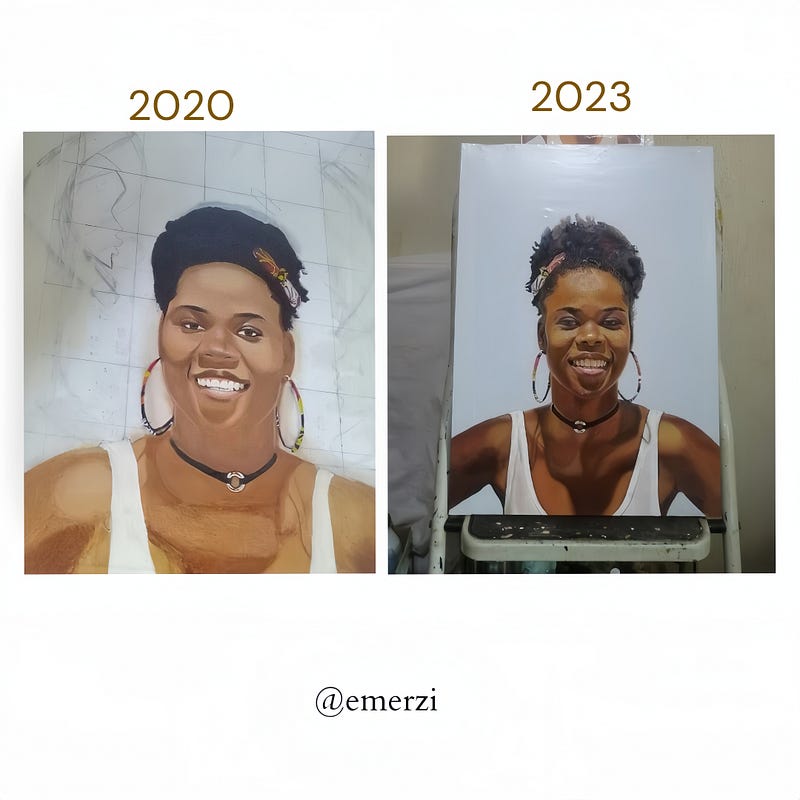
I’ve been painting for 3 years and 7 months. My technique is very good, especially considering that in the last 6 months, I’ve practiced more than in the previous 3 years and 1 month. And it was certainly a lot thanks to the challenge of practicing painting “10,000 hours to become an expert.” However, I realized that it’s not just about practicing, and here I share what I’ve learned:
1. Have a mentor, or at least three
Learning the right way from someone doing it right is much more important than learning fast, and it’s funny that seeking and following the steps of a mentor accelerates learning. With the internet, we have this part made easier because through social networks like YouTube, Facebook, and Instagram, we can follow artists or specialists in an area we want to learn. There’s also Patreon.
I would be thrilled if Leonardo da Vinci were alive and had a YouTube channel!
But if you can have your mentor physically present with you, it’s certainly much better.
My greatest painting mentors are André Maurício, Waddell, and Michael James Smith.
2. Deconstruct
Any skill is actually a combination of several other skills. So, understanding this is essential to know if there’s an order in which these skills need to be applied to learn the awaited new skill. This also works for the thing we want to do. For instance, in painting, I discovered that dividing my artistic process into phases or stages made it easier to develop the work and sped it up. I learned to deconstruct, to take the possible end result, break it down into smaller stages, and it became less challenging.
3. Prepare the Environment
This is something that will have a significant impact on learning. As the saying goes, it’s about doing it before we start doing the activity. Our brain always goes for what’s easier, and if our environment, including the emotional and cognitive, isn’t conducive to the activity, it’ll be easier to procrastinate rather than practice. Gather all the tools and theoretical knowledge needed to develop the skill you desire before you start practicing.
4. Be Productive, Not Busy
The most practical way to be productive is to set priorities and do them first. Start with the most challenging thing. It’s because easy things will hardly stimulate significant changes in our learning, be it short-term or long-term.
5. Have a Daily Routine
Having a daily routine is like giving some peace to your brain so it won’t enter into chaos every day with unexpected things. It also prepares it for each day and improves your physical, emotional, and mental health. Create a morning routine, then immediately start your most important work, take breaks, and have a fixed bedtime.
These are the things that have had a great impact on my learning. I remember that the weekend before last, I showed the painting of the fantastic artist Phillip Weber, and someone asked me, “How far can you reach this level?” I immediately answered that in a year and a half. Perhaps because I realized that I can speed up my learning a lot if I take the right path. Actually, I could take Phillip’s course if he has one (laughs)!
Good journey, my dear friend!