
Nanodegree = Lifelong Learning
Introduction
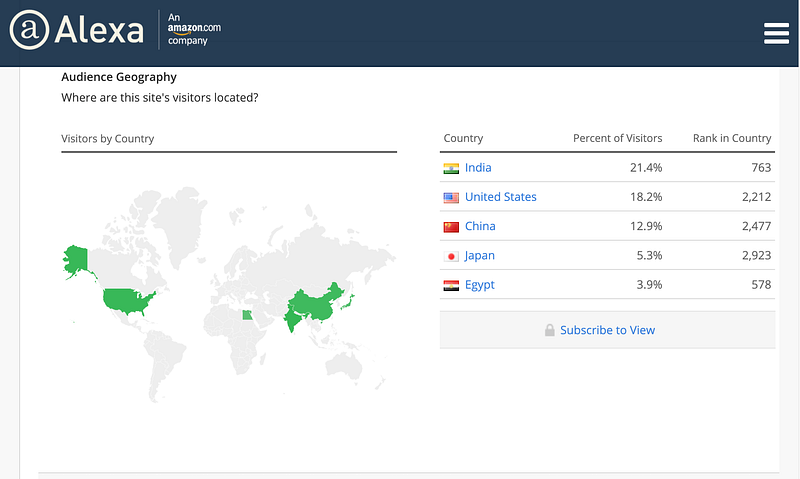
Statistics don’t lie. Saw the huge traffic coming from India? I will be sharing my opinion on why this traffic will keep rising, and why Udacity has ranked #8 on CNBC for two years in a row, and finally, why you should leverage its Nanodegree programs to prepare for the ever-changing job market of today and tomorrow, keeping in mind the time constraints.
I am a big admirer of Udacity and their goal to democratise education through the iterative process of project-based and lifelong learning. There are a lot of online courses available on any tech-related topic (I am talking trending ones like Big Data, Artifical Intelligence, Autonomous Driving, Cybersecurity, React, Digital Marketing and Blockchain ones) you are studying right now. But from my experience of 1.5+ years, that includes 4 completed Nanodegrees and one is in progress, I want to elucidate what makes Udacity unique and turbocharger for career advancement (or an entire switch for some people).
Breakthrough
Before enrolling in Data Analyst Nanodegree(DAND), I researched on the web about the impact of a Nanodegree and what are its career outcomes, what do other Nanodegree graduates from around the world say about this.
I did not dig deep into the articles so I was unable to find a line between Udacity’s free courses and their Nanodegrees. Based on my experience at that time, I thought of giving DAND a shot (it was more like an investment for me and they had a 1-week refund option too). And then I ended up finishing ML Basics Nanodegree and ML Advanced Nanodegree also. And yesterday I graduated from the latest exciting program: Data Scientist Nanodegree.
So why was I triggered to complete several paid Nanodegrees when there is a myriad of free content available on the web? Here are some points that distinguish Nanodegrees from other e-learning platforms (especially free courses and if you’re considering immediate career outcomes):
Project-Based Learning
Every instructor has emphasised one thing throughout the course:
“You learn by doing”.- Josh Bernhard
Humans learn from feedback, whether it is positive or negative, it incentivises us. And if you are establishing a career where you have to deal with problems like delivering the best performance or meeting strict deadlines, you have to continuously improve yourself through iterative feedback while keeping in mind the time constraint.
Each project you submit is reviewed by a Udacity project reviewer. If your submission does not meet the rubric criteria for that project, then you are allowed for unlimited resubmissions before it meets all the specifications. And these resubmissions are an integral part of the learning process, helping you avoid mistakes in a professional environment.
And this is how we learn (by doing and making mistakes). Udacity project reviewers provide expert code reviews and that’s what I like most about them. I developed good coding practices this way, like soft coding, refactoring, DRY principle, informative docstring, commit style guide, modularised code, impressive documentation, etc.
Really, it is hard for a beginner to get into those tiny details to make your work one of a kind and impressive for recruiters. But you realise exponential growth when you have an engaging mentor. So here is the next part.
“Audacious” and Mentorship Program
This was completely new and I applaud Udacity’s commitment to helping you sail through the challenging problems. Sebastian Thrun, the Father of Self-Driving Car technology, says:
Udacity stands for “we are audacious, for you, the student”
There are multiple platforms where they provide you with technical and non-technical support for your successful completion. One-to-one video call with the mentor is also an option if you are stuck in an extended deadline. You can also schedule online F2F sessions with your mentor if you are unable to articulate your matter on Slack DM (every Nanodegree has a Slack workspace managed by Udacity).
Recently they have started Knowledge and Student Hub: these are two coherent platforms where students can take part in “Stackoverflow like” QnA forum and a mere resemblance of “Slack like” workspace for real-time doubt clearance from mentors and peers.
Real-World Problems
The projects in Nanodegrees are focussed on real-life problems (and challenging ones too). Some of the projects are intermediate level and some are so challenging that after completing them you feel proud to showcase them on your social network and witness the Nanodegree impact. Here is the Disaster Response project that I did as a part of Data Scientist Nanodegree in collaboration with Figure Eight and realised how enterprises are using data for social good. This project combines Data Engineering, Software Engineering, Machine Learning and Natural Language Processing pipeline to help natural disaster victims.
Before starting DAND, I had zero projects (zero experience with GitHub and intermediate level Python skills). I had nothing to put on my resume. In short, I had no portfolio. And now, I have around 30+ projects on my GitHub, and more than 50% are from Nanodegrees. I’ll be adding more projects as I enrol in Big Data Foundation ND and complete my ongoing AI for Trading ND Term 2.
If you are passionate about data science and have done some data munging, then you know what data looks like when working in a Jupyter Notebook: CSV, TSV, audio, video, text, databases and other formats depending on your domain and scale. You are given a massive amount of data to generate intelligent insights from and communicate it to stakeholders. And believe me, the results are pleasing when you convert that information into insights (also called Data Story Telling).
60–70 % of the time in a data science project is just about understanding and manipulating data so that the remaining 30–40 % (the modelling, evaluation, optimisation and deployment part) is fault-tolerant. In order to master that first major part, you need to face the challenges that real-life data present. And again, quoting Josh Bernhard, “You learn by doing”.
Instructors
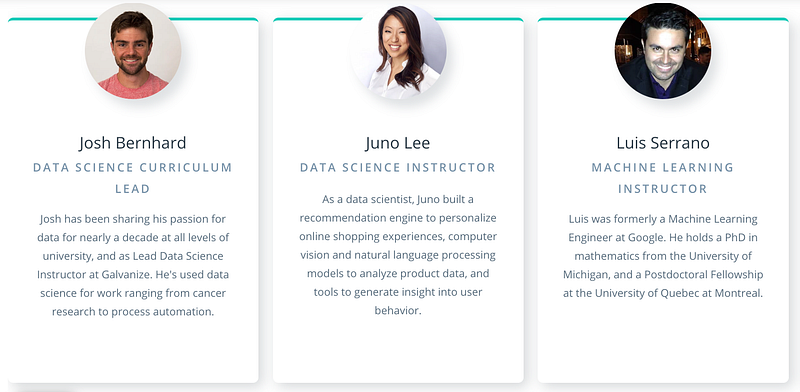
Can’t stress this enough. Though you only see them in video lectures and text instructions prepared by them, they are your ultimate guide throughout the classroom session and play a great deal in understanding concepts.
See the profile of any instructor on the course page of any Nanodegree, you will find that they all work (or have worked) for top Silicon Valley giants in their respective domains like Google, Amazon, Facebook, Microsoft, Nvidia, Coinbase, Mode Analytics, Alteryx, JP Morgan, and after-all the leader in Autonomous Transportation System— Udacity itself.
So, just imagine the industry value and quality of the content they are building in collaboration with such organisations.
Career Services
This is relatively new in India. Udacity India organises Propel, their flagship job fair event, quarterly (since 2017) where it connects the Nanodegree graduates with its new age hiring partners. I’ve never attended a Propel event (I attended a mini-version of it called PropelX) before, so as of now I cannot provide the whats and hows of it.
I am attending Propel on Feb 9, 2019, in Bengaluru. I will share my experience after that.
Takeaways
You can leverage the Nanodegree experience when you do other projects outside of program curriculum also. The projects in Nanodegrees will strengthen your portfolio. Plus their Career Service Portal is a very comprehensive resource for your job search after you graduate from a Nanodegree program. This will accelerate your job hunt and really stand out from the crowd using a strong networking approach.
A Nanodegree is a self-paced course with a fixed program deadline, so following the suggested deadline for each project will ensure that you graduate on time.
Acknowledgements
I express my immense gratitude to Udacity and Udacity India for supporting me at every step and ensuring that I stay on track with their mentorship support and personalised project reviews.
I also thank my course instructors Luis Serrano, Josh Bernhard, Derek Steer, Mat Leonard, Alexis Cook, Jay Alammar and Sebastian Thrun himself who explained the complex jargons in laymen terms (the rest is coding practice). The evaluation method is so transparent that I enrolled in one Nanodegree, and now I just can’t get enough of it.
This article is also published on Udacity India. Udacity is a for-profit organization whose goal is to democratize education through skills-based online credential programs.


